
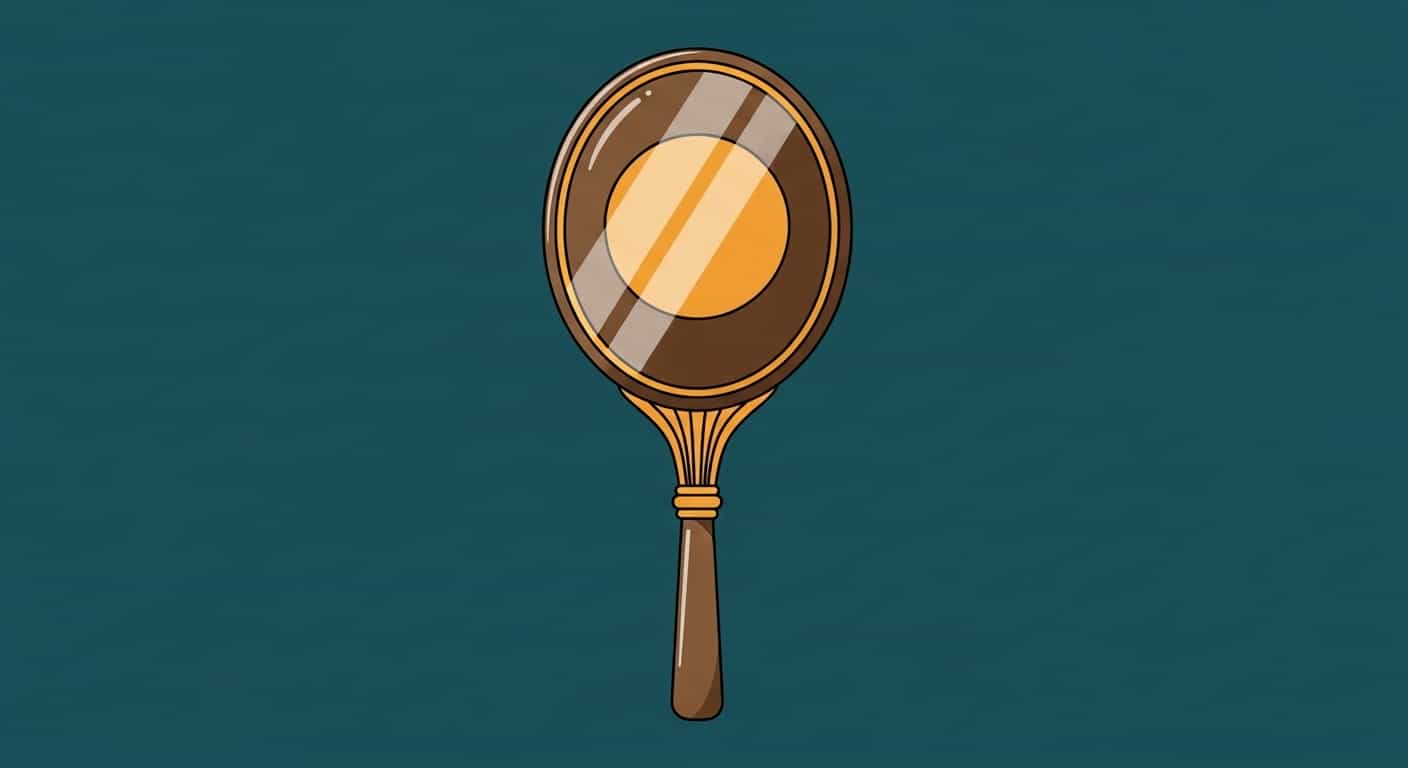
When we look into a mirror today, we typically seek a practical function: checking our appearance, fixing our hair, or ensuring our clothes are straight. But in the land of the pharaohs, the act of gazing into a reflective surface was a matter of cosmic significance. Far from being mere vanity items, mirrors in Ancient Egypt were potent religious artifacts, tools of magic, and vital instruments for the soul’s journey into eternity.
To understand the sacred significance of Egyptian mirrors, one must abandon the modern notion of the mirror as a simple household object. To the Egyptians, a mirror was a gateway—a device that could capture the light of the sun, house the essence of a deity, and protect the very core of a person’s existence as they traversed the perilous underworld. These objects, typically crafted from highly polished copper, bronze, or silver, were shaped so that the reflective disc formed the loop of the ankh—the symbol of life—with the handle acting as the stem, physically linking the act of reflection to the concept of vitality and the primordial marsh of creation.
Did Ancient Egyptians Believe Mirrors Were Sacred?
The answer is a definitive yes. In Ancient Egyptian culture, there was no clear division between the sacred and the secular. Objects used in daily life were often imbued with religious significance, but mirrors occupied a unique hierarchical space. They were not just sacred; they were considered divine entities in their own right.
Evidence of this sanctity lies in their construction and ownership. Mirrors were expensive. They were made by skilled artisans and were primarily owned by the elite, royalty, and the priesthood. However, their value was not solely monetary. Archaeological discoveries reveal that mirrors were frequently placed in temples as votive offerings. Donating a mirror to a temple was an act of profound piety, symbolizing the giver’s desire to reflect the divine order (ma’at) into the world.
Furthermore, the materials used to create mirrors were symbolic. While bronze was common, the most powerful mirrors were made of electrum (a natural alloy of gold and silver) or pure gold. Gold was considered the flesh of the gods, and silver was the bones. A mirror crafted from these metals was believed to be a physical manifestation of divine essence. The act of polishing a mirror to a perfect shine was not merely a maintenance task; it was a ritual act meant to remove chaos and impurity, allowing the reflective surface to function as a pure conduit for spiritual energy. For the Egyptians, a perfectly polished mirror was a piece of the sky brought down to earth—a controlled fragment of sunlight that could be held in one’s hand.
The Egyptian Mirror as a Symbol of the Sun & Ra
To truly grasp the spiritual function of Egyptian mirrors, one must look to the sky. The Egyptians viewed the sun god Ra as the ultimate source of life, light, and order. Every morning, Ra sailed across the sky in his solar barque, banishing the darkness of chaos. The mirror, with its blinding reflection when angled toward the sun, was understood to be a terrestrial counterpart to Ra’s disc.
Egyptian texts often refer to the mirror as ankh-en-ma’at—the “life of truth” or “living image of order.” But more directly, mirrors were associated with the sun’s rays. When a person held a mirror, they were symbolically capturing the life-giving energy of Ra. The circular shape of many Egyptian mirror discs, known as the iat, directly mirrored the solar disc. To hold a mirror was to hold a miniature sun, capable of dispelling the shadows of ignorance and spiritual decay.
This solar connection made mirrors indispensable in temple rituals. Priests would use polished mirrors to reflect sunlight deep into the inner sanctums of temples, illuminating the statue of the god during specific ceremonies. This act was not merely practical lighting; it was a ritual awakening. The reflected sunlight was considered the literal gaze of Ra blessing the deity within the shrine. In this context, the mirror acted as a tool of heka (magic), bridging the human realm with the divine.
Hathor’s Mirror — Goddess of Beauty & the Afterlife
No discussion of Egyptian mirrors is complete without the central figure of Hathor. The goddess of love, beauty, music, motherhood, and the afterlife, Hathor was known as the “Lady of the Mirror.” In Egyptian art, mirrors were often inscribed with her face or featured her emblem—the menat necklace—engraved on the handle. The menat itself was a ritual instrument of clacking beads used in Hathor’s ceremonies to awaken the goddess through music and joy, further linking the mirror to her cultic worship.
Hathor’s connection to the mirror was twofold. First, as the goddess of beauty, mirrors were her sacred tools. Women would dedicate mirrors to her shrines in hopes of receiving her blessings of fertility and joy. But more importantly, Hathor was a protective deity who welcomed the dead into the underworld. In the Book of the Dead, Hathor is depicted as a celestial cow or a woman emerging from the sycamore tree, offering refreshment and sustenance to the souls of the deceased.
This connection was deepened by the myth of the Eye of Ra. When the Eye—a fierce, solar force of destruction—was pacified, it manifested as Hathor. Thus, the mirror represented not only beauty but the contained, protective power of the sun’s ferocity. Because mirrors were linked to Hathor in this dual role, they became funerary items of immense importance. A mirror buried with a woman was not just a personal belonging; it was a divine invitation. It signified that the deceased was under the protection of Hathor. The reflective disc served as a symbol of the goddess’s nurturing solar eye, watching over the soul as it navigated the dangerous pathways of the Duat (the underworld). In essence, the mirror ensured that the deceased would not be forgotten or lost in the dark, for Hathor’s light—encapsulated in the mirror—would guide them to rebirth.
Mirrors & the Ka (Soul Double) in Egyptian Belief
Central to understanding the sacred significance of Egyptian mirrors is the concept of the Ka. In Egyptian theology, a human being was composed of several parts. The Ka was the life force—the spiritual double that continued to exist after the physical body died. It required sustenance (food offerings, prayers) and a place to reside, typically a statue or the preserved body.
Mirrors became intrinsically linked to the Ka because of the nature of reflection. When an Egyptian looked into a mirror, they did not merely see their physical face; they believed they were seeing their Ka. The reflection was the spiritual double made manifest. This was a powerful and sacred moment. To see your Ka was to confirm your existence not just in the material world, but in the spiritual realm.
This belief elevated the mirror to the status of a soul tool. It was a device that allowed a person to visually connect with their own immortality. Because the Ka was eternal, seeing it in the reflection was a reminder that death was merely a transition, not an end. This is why mirrors were handled with such reverence. To damage a mirror or allow it to tarnish was not just a matter of poor maintenance, but a symbolic threat to the integrity of the Ka.
Why Mirrors Were Buried With the Dead
The burial of mirrors with the dead was one of the most common funerary practices in Ancient Egypt, spanning from the Old Kingdom to the Roman period. This practice was far from sentimental; it was a strategic act of magical insurance.
When a person died, their Ka needed to be anchored to the physical world to survive. Mirrors placed in tombs served multiple functions:
- Housing for the Ka: Just as statues served as physical receptacles for the Ka, the mirror’s reflective surface was considered a potential home for the soul double. As long as the mirror was intact, the Ka had a place to dwell.
- Tools for Resurrection: The Book of the Dead contains spells that empower the deceased to transform into various beings. Mirrors were placed in the wrappings of mummies (often on the chest) to act as a catalyst for resurrection. The sun’s light, reflected into the tomb during funerary rituals or magically summoned via spells, was believed to reanimate the deceased, allowing them to open their eyes in the afterlife.
- Protection from Chaos: Tombs were dangerous places, inhabited by snakes, scorpions, and demonic forces seeking to destroy the soul. A mirror, representing the light of Ra and the protection of Hathor, served as an apotropaic device—a magical weapon to blind or repel chaotic entities.
The Danger of Losing Your Reflection
The flip side of this belief was a profound fear: the danger of losing one’s reflection. Because the reflection was the Ka, a broken mirror was not considered seven years of bad luck (as in later European superstition), but something far graver. A damaged or tarnished mirror represented a fractured soul.
In Egyptian magical texts, there is evidence of spells designed to “repair” or “cleanse” the reflection of a person who had been cursed or who had fallen ill. If a person’s Ka was attacked by a malevolent spirit or a sorcerer, it was believed that their reflection might become dim or distorted. Consequently, the destruction of a mirror was considered an act of symbolic murder. For this reason, mirrors were crafted with extreme durability, and if a mirror broke, it was often ritually buried rather than thrown away, to prevent the fractured energy from causing harm to the living.
Mirror Amulets & Protective Magic in Ancient Egypt
The potency of the mirror extended beyond full-sized objects. The Egyptians, being masters of sympathetic magic, miniaturized this power into amulets. Mirror amulets are frequently found in archaeological contexts, particularly in funerary jewelry.
These amulets were small, flat discs often made of faience (a glazed ceramic), gold, or silver, designed to be strung on necklaces or wrapped into the bandages of mummies. They were not functional mirrors (they did not reflect well), but they carried the shape and symbolism of the mirror.
For the living, wearing a mirror amulet was a declaration of devotion to Hathor and an act of personal protection. It was believed to ward off malevolent forces—what modern terminology calls the “evil eye”—by harnessing the power of Ra to burn away envious glances or malicious spells.
For the dead, these amulets were vital. The Book of the Dead (Spell 166) specifically addresses the use of a mirror amulet made of mefkat (turquoise or green feldspar). The spell declares:
“This is a mirror of mefkat… it is placed at the throat of the deceased… it opens the mouth… it provides breath.”
Here, the mirror amulet acts as a respiratory aid and a speech enabler for the deceased, allowing them to breathe and speak the necessary spells to navigate the afterlife. It transformed the vulnerable mummy from a passive corpse into an active, empowered spirit.
Egyptian Divination Using Reflective Surfaces
While mirrors were used for protection and resurrection, they also served as powerful tools for scrying—the art of divination using reflective surfaces. Although Egypt is most famous for its temple oracles and dream interpretation, there is substantial evidence that priests and priestesses, particularly those of Hathor, used mirrors for prophecy.
The practice was known as scrying or catoptromancy. A priest or initiate would gaze into a highly polished copper or silver mirror, often in a darkened chamber, until a trance state was achieved. The reflective surface served as a liminal space—a threshold between the world of the living and the world of the gods. In the shimmering depths of the mirror, the practitioner believed they could see visions of the future, locate lost objects, or communicate with the Akhu (the blessed ancestors).
The connection to Hathor is significant here. As the goddess of the sky and the stars, she was associated with destiny. Scrying was often performed during the festival of Hathor, where mirrors were used to predict the outcome of the harvest or the health of the royal family. This practice was considered highly dangerous, as staring into a mirror could also attract malevolent forces if not performed within a sacred circle of protection. Priests would inscribe protective spells on the backs of scrying mirrors to ensure that only divine visions, not demonic deceptions, appeared in the reflection.
What Modern Spirituality Borrows From Egyptian Mirror Magic
The echoes of these ancient beliefs are remarkably clear in modern spiritual practices. The sacred significance of Egyptian mirrors has experienced a revival in contemporary esotericism, paganism, and Kemetic (Egyptian reconstructionist) spirituality.
Today, practitioners often place mirrors on altars dedicated to Hathor or Sekhmet (the lioness goddess of protection, who is considered an aspect of Hathor’s solar eye). The practice of “black mirror” scrying, which became famous in the Renaissance and Victorian eras, has its roots in the Egyptian tradition of gazing into dark, polished obsidian or bronze surfaces to access the underworld.
Furthermore, the concept of using mirrors for protection against psychic attack is a direct descendant of the Egyptian use of mirrors as apotropaic devices. Modern witches often place mirrors facing outward in windows to “reflect” negativity back to its source, mirroring the Egyptian practice of using the mirror disc to blind the forces of chaos.
The funerary use of mirrors also finds a modern parallel. In some contemporary spiritual traditions, mirrors are covered during periods of mourning. While this is often associated with Jewish or Victorian customs, the underlying logic—that the soul of the deceased might become trapped in the mirror, or that the living might see a dangerous reflection of the dead—is deeply aligned with the Egyptian fear of losing one’s Ka or encountering it improperly.
Finally, the mirror remains a symbol of truth and self-discovery. Just as the Egyptian mirror revealed the Ka—the eternal soul—modern spiritual seekers often use mirror work (meditation while looking into one’s own eyes) to confront their shadow self and connect with their higher consciousness. This practice is a direct, albeit evolved, continuation of the Egyptian belief that the mirror is not for vanity, but for soul gazing.
Summary: Key Spiritual Functions of Egyptian Mirrors
| Function | Purpose | Associated Deity / Concept |
|---|---|---|
| Solar Conduit | Captured and reflected the life-giving rays of Ra | Ra |
| Divine Protection | Shielded the living and dead from chaotic forces | Hathor, Eye of Ra |
| Ka Vessel | Housed and anchored the soul double | Ka (life force) |
| Resurrection Tool | Assisted in the rebirth of the deceased in the afterlife | Book of the Dead |
| Divination Device | Enabled scrying and communication with ancestors | Hathor, Akhu |
| Amulet Power | Miniaturized protection worn for magical defense | Mefkat, Spell 166 |
Conclusion
From the glittering temples of Ra to the dark silence of the tombs in the Valley of the Kings, the mirror was a constant companion to the Egyptian soul. It was an object of profound duality—a symbol of the life-giving sun and a protector in death; a tool for the vanity of the living and a vessel for the eternal Ka.
The sacred significance of Egyptian mirrors transcends mere superstition. It reveals a sophisticated worldview in which material objects were infused with divine energy, serving as bridges between humanity and the gods. Whether used to reflect the rays of Ra, honor the nurturing protection of Hathor, guard the soul double, or scry the future, the Egyptian mirror was far more than a piece of polished metal. It was a sacred technology—a device designed to illuminate the path from this life to the next, ensuring that even in the darkest depths of the underworld, the soul would never lose sight of the light.
For the modern seeker, these ancient mirrors still hold a lesson: that true reflection is not about what we look like, but who we are, deep within, where the Ka resides.