
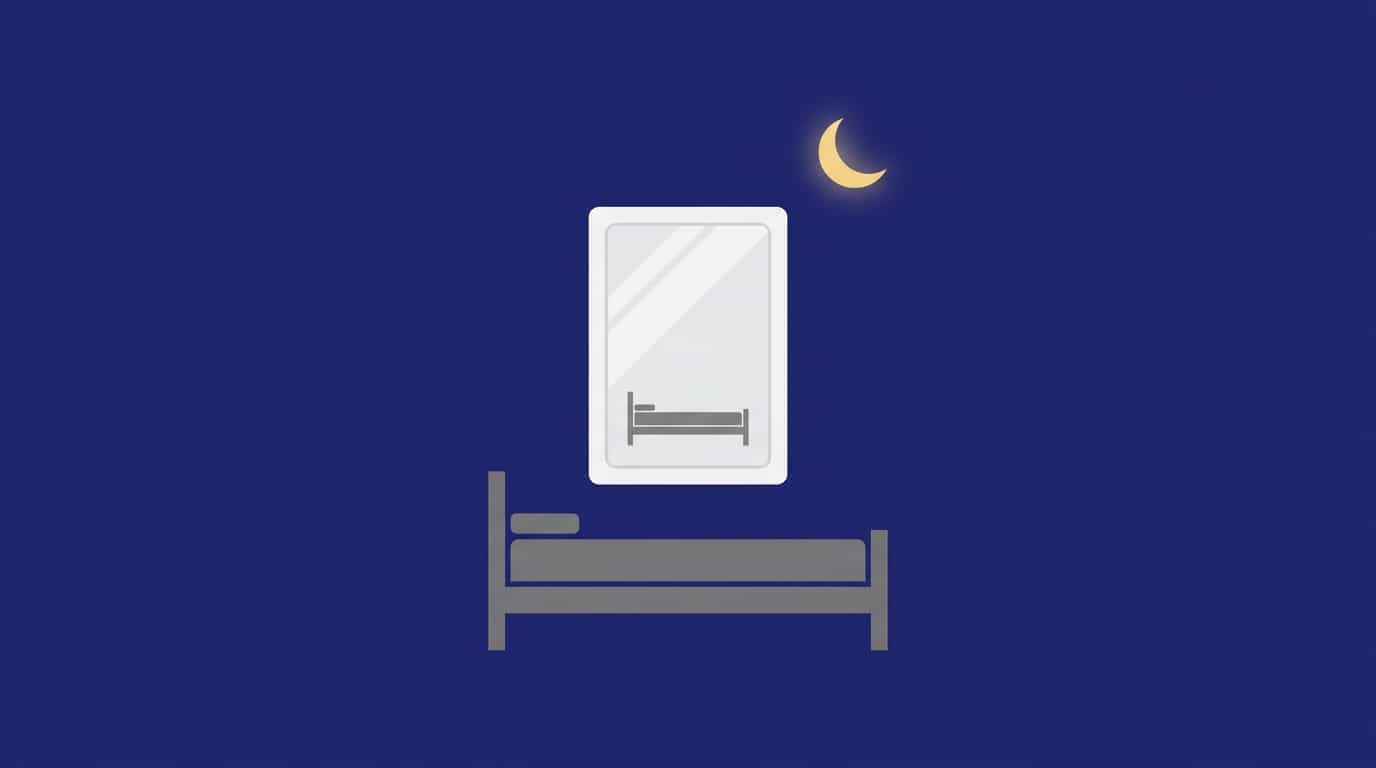
For centuries, the simple act of placing a mirror in a bedroom has been a subject of intense debate among spiritualists, interior designers, and cultural traditionalists. While a mirror can make a room feel larger and add a touch of elegance, its placement is often treated with caution, especially when it comes to where we sleep.
If you have ever woken up in the middle of the night, groggy and disoriented, only to catch a glimpse of your own reflection staring back at you from across the room, you understand the visceral unease it can provoke. This isn’t just a modern superstition; the question of why you shouldn’t sleep facing a mirror is rooted in ancient Chinese philosophies like Feng Shui, deep-seated folklore from around the world, and even modern psychological science.
In this article, we will explore the global fear of sleeping with mirrors, dive deep into the 9 specific reasons why this practice is considered harmful, and provide practical solutions if your bedroom layout currently violates this ancient wisdom.
The Global Fear of Sleeping With a Mirror Facing You
The anxiety surrounding mirrors and sleep is not confined to one culture; it is a global phenomenon. From the misty forests of Eastern Europe to the bustling cities of China and the spiritual practices of Native American tribes, there is a universal acknowledgment that mirrors hold power.
Historically, mirrors were not the cheap, mass-produced items we see today. They were rare, expensive, and often considered magical artifacts. People believed that mirrors were more than just reflective surfaces; they were portals, tools for divination, and holders of fragments of the soul. The fear of sleeping facing a mirror stems from a time when a mirror was seen as a boundary between the physical world and the spiritual realm.
In the Victorian era, it was common practice to cover mirrors in the house after a death, lest the soul of the deceased become trapped in the glass. Similarly, many cultures believe that mirrors are most active at night. When we sleep, we are in our most vulnerable state—our consciousness is dimmed, our physical body is still, and our energetic field is open. In this state, having a reflective surface aimed directly at you is seen as an invitation for disruption. Whether you view these beliefs as spiritual truths or ancient psychological coping mechanisms, the consensus remains clear: sleeping facing a mirror is inviting trouble.
What Feng Shui Says About Mirrors in the Bedroom
Feng Shui, the ancient Chinese art of placement, has very strict guidelines regarding mirrors. The core philosophy of Feng Shui revolves around the flow of Chi (or Qi)—the vital life force energy that flows through all living things and spaces. A bedroom is considered a sanctuary. It is the room of rest, intimacy, and rejuvenation. The energy in a bedroom should be calm, stable, and nurturing.
Feng Shui experts universally advise against having a mirror facing the bed. This is considered one of the most significant corrections one can make in a home for better sleep and relationship health. The rationale goes beyond simple superstition; it is about how energy interacts with the reflective surface.
How Mirrors Disturb Chi & Disrupt Sleep
According to Feng Shui principles, mirrors have the ability to redirect, speed up, and multiply energy. While this can be beneficial in a living room or a dark hallway (to bring in light and movement), it is detrimental in a bedroom. In Feng Shui, energy is meant to flow in gentle, curving patterns—like a slow-moving river. Mirrors, however, create abrupt, straight-line reflections. When a mirror faces a bed, it generates what is known as “Sha Chi” (killing energy) —the same type of harmful energy created by sharp corners or exposed beams aimed directly at the body.
Here is how mirrors disturb the Chi:
- Over-Activation: When you sleep, your Chi should be settling. It should be sinking into the earth, allowing your body to repair itself. A mirror facing the bed bounces energy back at you. Instead of letting your energy rest, the mirror agitates it, creating “Poison Arrows” of energy that shoot back at you while you sleep. This can lead to restlessness, an inability to fall asleep, and waking up feeling exhausted rather than refreshed.
- Splitting the Person: In Feng Shui, seeing your reflection in a mirror while lying in bed is believed to symbolically “split” your energy. It creates a duality. Instead of being one whole person resting, you are two—the physical you and the mirrored you. This split can lead to confusion in the subconscious mind and, over time, can contribute to feelings of anxiety or a lack of direction in life.
- The “Third Person” Effect: Perhaps the most famous Feng Shui rule regarding bedroom mirrors is their prohibition if you are in a relationship. A mirror facing the bed is said to invite a “third party” into the relationship, leading to infidelity or a loss of intimacy. This is because the mirror reflects the bed and the people in it, effectively doubling the space and allowing energy for an outsider to enter the dynamic.
9 Reasons Not to Sleep Facing a Mirror
While Feng Shui provides a structural framework for understanding this taboo, the reasons to avoid sleeping facing a mirror are vast and varied. Here are 9 compelling reasons drawn from spiritual traditions, folklore, and scientific reasoning.
1. It Invites a Third Party Into Relationships
As touched upon in Feng Shui, this is one of the most feared consequences. The mirror is a symbol of external energy. When placed facing the marital bed, it is believed to create a reflection that acts as an intruder. In many traditions, it isn’t just about infidelity in the physical sense; it represents a spiritual intruder that saps the emotional connection between partners.
If you are single and wish to find a partner, a mirror facing your bed is said to repel potential suitors or cause them to be “mirrored” away from you, leaving you feeling perpetually lonely. The mirror’s energy is inherently solitary; it reflects only what is present. If you want a partnership, you want the energy to be unified, not duplicated and exposed to an empty reflection.
2. Your Soul May Wander & Get Confused
In many shamanic and indigenous traditions, the reflection in a mirror is considered a part of the soul. In cultures ranging from ancient Greek to some Native American tribes, it was believed that mirrors could capture or confuse the soul, especially during sleep.
Sleep is the time when the hun (the ethereal soul that leaves the body during dreams) can depart. If you are sleeping facing a mirror, the soul, upon returning to the body, may be disoriented by the reflection. It might see the reflection and attempt to enter that body instead, leading to a feeling of spiritual fragmentation. This “soul confusion” is often cited as a cause of severe fatigue, depression, and a persistent feeling of being “not quite yourself.”
3. Spirits Use Mirrors as Doorways at Night
This is a prevalent belief in Gothic literature, Victorian folklore, and various spiritualist movements. The idea is that the mirror acts as a portal or a veil between the physical world and the astral plane. During the day, sunlight is said to “seal” the portal, but at night, especially between midnight and 3:00 AM (the “witching hour” ), the veil is thin.
If you sleep facing a mirror, you are essentially staring directly into a potential doorway. Believers warn that spirits, whether they are lost souls or malevolent entities, can use this portal to cross over into your room. Having this portal facing your vulnerable, sleeping body is considered an open invitation for unwanted spiritual attachment or haunting.
4. It Amplifies Nightmares & Disturbing Dreams
From a psychological and energetic perspective, mirrors are amplifiers. If you are prone to nightmares or anxiety, sleeping facing a mirror can act as a feedback loop. When you sleep, your subconscious processes the day’s events. If a mirror is reflecting your sleeping form, it is believed to amplify the energy of your dreams.
Moreover, if you enter a state of sleep paralysis—a terrifying state where you are conscious but unable to move—waking up to see your own reflection, or a distorted version of it, can turn a frightening experience into a traumatic one. Many people report that simply removing a mirror from their line of sight while sleeping resulted in the immediate cessation of chronic nightmares.
5. Scientific Angle — Disrupted Sleep From Movement
Moving away from the metaphysical, there is a concrete scientific reason why you shouldn’t sleep facing a mirror: the startle reflex. Human beings are hardwired to be alerted by movement in their peripheral vision.
If you have a mirror facing your bed, you are essentially creating a panoramic view of the room. If your partner rolls over, if a shadow shifts, or if a stray beam of headlight passes through the window, the mirror catches it and reflects the movement. Your brain, even while sleeping, is subconsciously monitoring the environment for threats. Seeing motion (even your own motion) in the mirror can trigger micro-awakenings.
You may not fully wake up, but your sleep cycle is disrupted from deep slow-wave sleep (the most restorative stage) into lighter stages. Over the course of a night, this leads to poor sleep quality, hormonal imbalance, and daytime fatigue.
6. Slavic Belief — The Double Can Replace You
In Slavic folklore, mirrors are treated with profound respect and fear. There is a long-standing superstition that a mirror is a threshold to the Nav (the underworld). When you sleep facing a mirror, you allow your “double”—a doppelgänger—to gain power.
The belief holds that your reflection is not just light bouncing off glass; it is a separate entity that exists in a parallel world. During the day, you control the double. At night, if you sleep with the mirror facing you, you give the double access to you. In many European traditions, encountering one’s doppelgänger is considered a death omen or a sign of severe misfortune. If the double stares at you while you are unconscious, it can learn your habits and eventually attempt to “replace” you. In extreme interpretations, this is thought to lead to illness or a slow draining of vitality as the double siphons your life force to make itself more real.
7. It Keeps Your Energy Awake When It Should Rest
This reason blends energetic healing with physiology. Our bodies have an electromagnetic field, often referred to as the aura. Mirrors reflect energy as well as light. When you sleep facing a mirror, your own energy is constantly being reflected back onto you.
In yogic traditions, this is understood as overstimulation of the Third Eye Chakra (Ajna) —the energy center located between the eyebrows that governs intuition, perception, and the sleep-wake cycle. When the third eye is bombarded with reflected energy throughout the night, it remains active rather than resting. This prevents the “switching off” of the conscious mind.
Think of it like a tennis match. Your body emits energy, it hits the mirror, and it bounces back. This constant back-and-forth creates a circuit. For your body to rest deeply, that circuit needs to be broken. The energy needs to disperse into the earth, not bounce back into your third eye or solar plexus. This constant energetic stimulation is why people often report feeling “wired but tired” after sleeping in a room with a mirrored wardrobe facing the bed.
8. You May See Things in the Mirror at Night
This is a practical and psychological reason that is often the final straw for people who decide to cover their mirrors. When you wake up in the middle of the night, your eyes are not adjusted. You are groggy, and your brain is still partially in a dream state. In this state, the brain is prone to pareidolia—seeing patterns or faces where none exist.
A mirror in a dark room creates depth and shadows. It is very common for the mind to misinterpret the shadows and reflections as figures, faces, or movement. Even if you are not “spiritual,” seeing a shadow figure in your mirror at 3:00 AM is a deeply unsettling experience that can cause anxiety and make it difficult to return to sleep, reinforcing a negative relationship with your own bedroom.
9. Chinese Ghost Month Belief
In Chinese culture, the seventh lunar month is known as Ghost Month. It is believed that the gates of hell open, and spirits roam the earth. During this time, many traditional families adhere to strict rules regarding mirrors.
One of the most important rules is to never sleep facing a mirror, especially during Ghost Month. It is believed that spirits are drawn to reflective surfaces. A mirror facing a sleeping person makes that person an easy target for possession or haunting. While this is a seasonal practice for some, for many traditional Chinese families, the practice of avoiding mirrors facing the bed is a year-round rule to ensure safety and harmony, reflecting a deep cultural respect for the unseen world.
What to Do If Your Mirror Faces Your Bed Already
If you are reading this and realize that your bedroom layout violates these principles—perhaps you have a large mirrored closet door or a dresser mirror pointed directly at your pillow—do not panic. There are several practical solutions to rectify the situation without necessarily having to remove the mirror entirely.
| Solution | Description | Effectiveness |
|---|---|---|
| Reposition the Bed | Move your bed so it is not directly in the line of sight of the mirror. Ideally, place the bed against a solid wall with the headboard providing support, and ensure the mirror is on a perpendicular wall. | Highest |
| Move the Mirror | If you have a standing or wall-mounted mirror, relocate it to a different wall. Placing it on the same wall as the headboard (so you cannot see it while lying down) or inside a closet door is a safe compromise. | Highest |
| Angle It Away | If moving the mirror or bed is not possible (for example, with built-in wardrobes), tilt the mirror upward toward the ceiling or downward toward the floor so it reflects the wall rather than the bed. | Moderate |
| Use a Screen | Place a decorative folding screen or room divider between the bed and the mirror. This physically blocks the reflection and adds a layer of aesthetic elegance while creating an energetic barrier. | High |
| Perpendicular Placement | If you love the aesthetic of a large mirror, position it on a wall that runs perpendicular to the bed. This allows the mirror to reflect a side wall rather than your sleeping body. | High |
Covering Your Mirror at Night — Does It Work?
For those who cannot move furniture, the simplest solution is to cover the mirror. But does this actually work, or is it merely a placebo?
From a spiritual and energetic standpoint, covering the mirror is widely accepted as a complete solution. By covering the glass with fabric, you are effectively sealing the “portal” and preventing the reflection from bouncing energy back at you. In many traditions, covering mirrors at night is a standard practice to allow the soul to rest peacefully. Black cloth is often recommended for maximum protection, though any heavy, opaque fabric will do.
From a scientific and psychological standpoint, covering the mirror is equally effective. If you are not seeing your reflection, your peripheral vision is not catching movement, and you are not risking the startle reflex or the anxiety of seeing shadows in the glass. The placebo effect here is real; if you believe you are safer and will sleep better because the mirror is covered, your nervous system will relax, allowing for deeper sleep.
A Note on Materials: If you choose to cover your mirror, avoid sheer or lightweight fabrics that can shift in the night. A heavy velvet, tapestry, or even a simple blackout curtain panel secured with adhesive hooks will provide the most consistent coverage.
Whether you subscribe to the ancient wisdom of Feng Shui, the cautionary tales of Slavic folklore, or simply want to optimize your sleep hygiene based on scientific principles, the consensus is overwhelming. Understanding why you shouldn’t sleep facing a mirror is about respecting the energy of your environment.
A bedroom should be a cave of rest—dark, quiet, and secure. Mirrors, by their very nature, are agents of light, movement, and reflection. By ensuring your mirrors are placed thoughtfully—either covered, angled, or moved—you create a sanctuary free from energetic disturbance, spiritual intrusion, and subconscious anxiety.
Take a look at your bedroom tonight. If you see your reflection staring back from the darkness, it might be time to make a change for the sake of your sleep, your soul, and your peace of mind.