
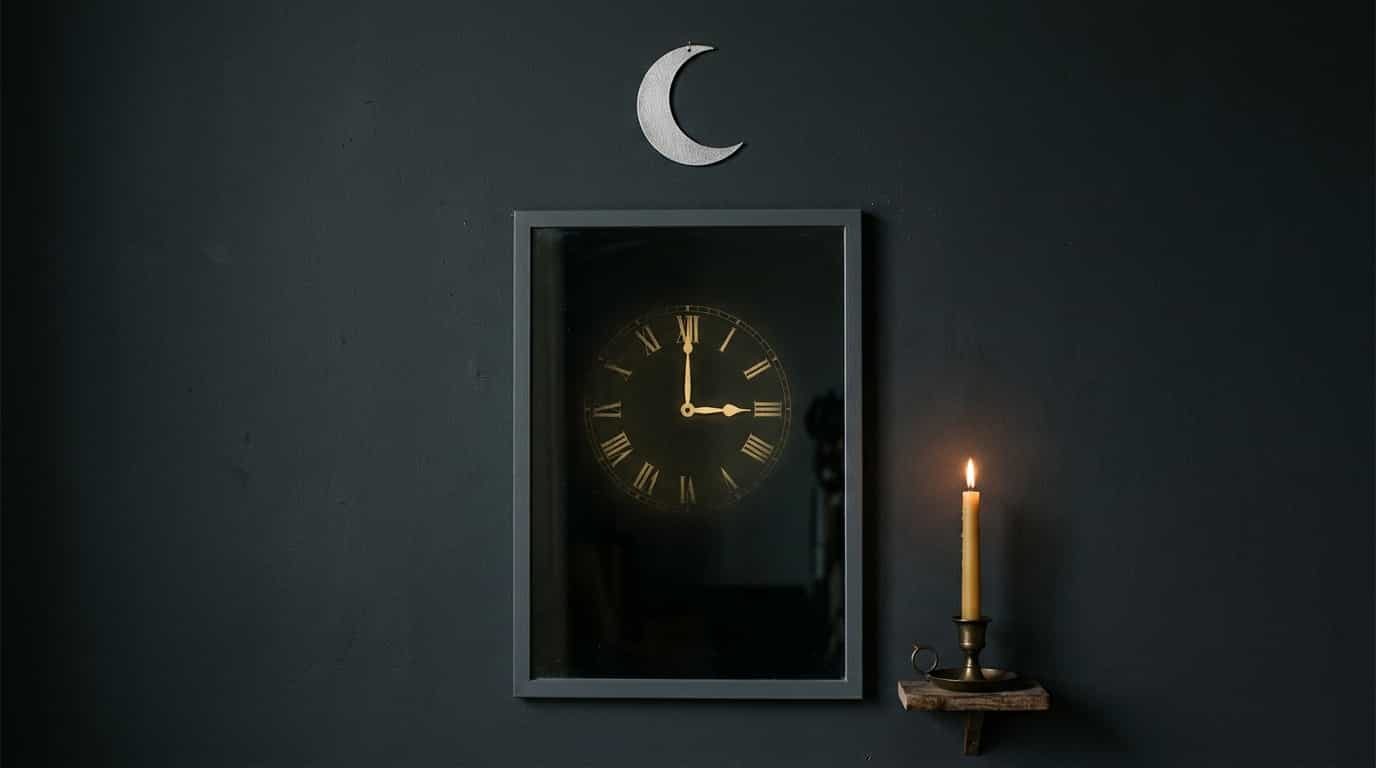
There is something inherently unsettling about catching your own reflection in a dark room. During the day, a mirror is a mundane tool—used for grooming, checking an outfit, or adding a sense of space to a home. But as soon as the sun sets and the lights dim, that same sheet of glass seems to take on a different personality. For centuries, cultures across the globe have adhered to strict rules regarding the mirror at night superstition, warning that to gaze into a reflective surface after dark is to invite the unknown into your life.
Whether you are a skeptic who dismisses these ideas as folklore or a believer who has felt the hair on the back of your neck rise while walking past a dark hallway mirror, the power of this belief is undeniable. This article explores the deep-rooted history, global variations, and psychological reasons behind why we treat mirrors so differently when the sun goes down.
Why Mirrors at Night Are Treated Differently
Why do we cover mirrors during periods of mourning? Why do Feng Shui experts advise against placing a mirror facing the bed? The answer lies in the duality of what a mirror represents. During the day, a mirror reflects reality. It shows us what we expect to see: our face, our clothes, and the physical world around us. However, when visibility is low, the mirror no longer reflects the tangible world but instead acts as a window into the intangible.
In many traditions, the boundary between the physical world and the spiritual realm is believed to thin during darkness. Mirrors are viewed as surfaces that do not merely reflect light but hold energy. Because they are smooth, dark, and cold, they are considered ideal conduits for spirits, ghosts, and psychic energy. When the sun is out, positive “Yang” energy dominates, neutralizing the mirror’s potential danger. At night, “Yin” energy—associated with darkness, passivity, and the spiritual—takes over, activating the mirror’s dormant properties.
Historically, this distinction was a matter of survival. Before electricity, a candlelit glance into a mirror could easily be distorted by flickering shadows, leading to paranoia. Our ancestors learned to associate the night mirror with fear, a primal instinct that has been passed down through generations via superstition.
The Veil Between Worlds — Nighttime & Spiritual Sensitivity
To understand the gravity of the taboo surrounding night mirrors, one must first understand the concept of the “veil.” In metaphysical and spiritual circles, nighttime is considered a time when the veil between our world and the spirit world is at its thinnest. From dusk until dawn, the energy shifts from external productivity to internal introspection—and vulnerability.
Mirrors are often described as “liminal spaces.” A liminal space is a threshold, a point of transition. Just as a doorway is the threshold between inside and outside, a mirror is the threshold between the self and the other. At night, when we are tired and our conscious mind is lowering its defenses, the mirror becomes an active portal.
In traditions like Feng Shui, the placement of mirrors is meticulously planned to avoid “Sha Chi” (negative energy). A mirror in a dark bedroom is considered one of the worst placements because it is believed to bounce energy around the room, disturbing sleep and attracting restless spirits. The reflective surface acts like a magnet for wandering souls who are confused by the transition between life and death. This is why the fear of night mirrors is not merely about seeing a ghost; it is about inadvertently inviting one into your sacred space.
8 Night Mirror Superstitions From Around the World
While the fear of mirrors at night is universal, the specific superstitions vary dramatically depending on cultural context. Here are eight of the most compelling beliefs regarding mirrors and the night.
1. Mirrors Become Active Portals After Midnight
In European folklore, particularly in Slavic and Germanic traditions, midnight is not just the end of a day; it is the “witching threshold.” It is believed that from 12:00 AM to 1:00 AM, mirrors shift from being reflective surfaces to open doorways. During this hour, it is said that spirits can cross through the glass into the human world.
This belief is why many older European homes have a tradition of turning mirrors to face the wall after the family retires for the night. By turning the mirror away, you are essentially “closing the door.” If a mirror is left uncovered or facing outward, it is believed that anything wandering in the night might look into your world and decide to stay.
2. Spirits Enter Homes Through Uncovered Night Mirrors
This particular branch of nocturnal mirror lore is closely tied to funerary practices. In Jewish tradition, following a death, the family covers all mirrors in the house during the period of shiva (mourning). The primary religious explanation is to turn the focus inward away from vanity, minimizing worldly distractions during a time of grief. However, the underlying folkloric reason runs deeper: covering the mirrors prevents the soul of the deceased from becoming trapped in the glass and stops other spirits from entering the home via the reflective surfaces.
Similarly, in many parts of rural Ireland and the UK, it is considered highly dangerous to leave a mirror uncovered at night if someone in the house is sick or dying. The mirror is viewed as a vortex that could confuse the soul leaving the body, trapping it in a state of limbo.
3. Never Pass a Mirror at 3 AM — The Devil’s Hour
If midnight opens the portal, 3:00 AM is considered the apex of supernatural activity. Often referred to as the “Devil’s Hour,” this time is believed to be a mockery of the hour of Christ’s death (3:00 PM). (The broader “Witching Hour” typically spans from midnight to 3 AM, with this final hour considered the most potent.) According to superstition, the danger surrounding night mirrors intensifies tenfold at 3 AM.
Passing by a mirror at this hour is said to bring seven years of bad luck—a twist on the classic “seven years of bad luck” for breaking a mirror. More ominously, some cultures believe that looking into a mirror at 3 AM allows you to see demons or negative entities that are usually invisible to the naked eye. The belief is that if you see something behind you in the mirror at this hour, you should not turn around to check; instead, you should leave the room backward to avoid inviting the entity to follow you.
4. Your Reflection Moves Differently at Night
One of the most unsettling aspects of nighttime mirror beliefs is the fear that your reflection might act independently. Have you ever glanced in a dark mirror and felt that your reflection smiled a split second too late, or that it turned its head when you did not?
In Japanese folklore, this phenomenon is tied to the concept of ikiryō—living spirits that can leave the body. It is believed that staring at a mirror in a dimly lit room can cause a dissociation between the soul and the body. The reflection is not “you” but a separate entity mirroring you. If you see your reflection move without your volition, it signifies that your soul is becoming detached or that a malevolent spirit is mimicking your form to confuse you. In extreme cases, this is seen as a precursor to spiritual possession or severe illness. Some regional tales also speak of kitsune (fox spirits) using mirrors to disguise themselves, further cementing the mirror’s reputation as a tool of illusion and danger after dark.
5. Seeing a Shadow in a Mirror at Night — What It Means
Not all reflections are of ourselves. One of the most commonly reported experiences tied to dark mirror lore is the sighting of a shadow figure in the glass. Shadow people are a staple of paranormal lore, often described as dark, humanoid silhouettes with glowing red or white eyes.
If you see a shadow in a mirror at night, interpretations vary. In Mexican and Latin American folklore (curanderismo), seeing a shadow behind you in a mirror is a warning. It suggests that a negative energy is attached to you or that someone is wishing you ill (the “evil eye”).
Traditional Remedy: If this occurs, it is advised to immediately wash your face with salt water—salt being a purifying agent—and cover the mirror to sever the connection. Some traditions also recommend placing a small bowl of salt water beneath the mirror overnight to “trap” any negative energy that may have entered through the glass.
In other traditions, a shadow in the mirror is seen as a death omen—a herald that someone in the family will pass away soon.
6. Full Moon & Mirror — Heightened Spiritual Activity
The moon has always been a driving force in superstition, and its interaction with mirrors is particularly potent. The full moon is a time of high energy, emotional intensity, and, according to lore, madness (lunacy). When the light of a full moon hits a mirror, it creates a unique reflective loop.
In Wiccan and pagan traditions, a mirror charged by the full moon is a powerful tool, but it is also considered volatile. Leaving a mirror uncovered facing a window during a full moon is thought to attract roaming spirits who are energized by the lunar light. It is believed that during a full moon, a mirror can act as a battery, storing spiritual energy. If that energy is negative, it can radiate into the home, causing nightmares, sleep paralysis, and a heavy atmosphere in the house.
7. New Moon & Mirrors — Best for Scrying
While most mirror superstitions warn against accidental glances, some traditions involve intentionally using the dark mirror—though they come with their own set of dire warnings. The new moon—representing darkness, new beginnings, and the void—is considered the optimal time for scrying.
Scrying is the ancient art of gazing into a reflective surface (a mirror, crystal ball, or water) to gain prophetic insight or communicate with spirits. Practitioners of divination will sit before a mirror in a completely dark room, often with a single black candle, and stare into their own eyes until their vision blurs and visions appear. However, even practitioners warn that this is a dangerous practice. Without proper protective rituals, scrying can invite malevolent forces. The mirror, in this context, is not a tool of vanity but a direct line to the other side, and once that line is opened, it is difficult to close.
8. Never Stare Into a Mirror in the Dark
This is perhaps the most universal rule. Whether you believe in ghosts or not, the act of staring into a mirror in a pitch-black room is psychologically destabilizing. The superstition warns that if you stare long enough (often cited as 10 to 15 minutes), you will begin to see distortions.
Folklore describes a phenomenon known as “the other face.” Eventually, your reflection will appear to melt, shift, or turn into the face of a stranger, a demon, or a corpse. In some cultures, it is believed that the face you see in the dark mirror is your future self—but if you see an old or dead face, it means you will die before you grow old. In others, it is simply the mirror showing you the “true” nature of the soul, uncloaked by the distractions of daylight.
The Science of Why Mirrors Feel Creepy at Night
While the superstitions surrounding night mirrors are rich with cultural and spiritual history, there is also a robust scientific explanation for why we find this practice so unnerving. Understanding the science does not necessarily disprove the superstition; rather, it explains why the instinct is so hardwired.
The primary scientific culprit is a phenomenon called peripheral vision degradation. In low light, the human eye relies more on rod cells than cone cells. Rods are excellent for detecting motion and light contrast, but they have poor resolution. When you look into a dark mirror, your peripheral vision begins to “fill in the blanks.” Your brain, desperate to make sense of the dark shapes in the glass, may create false images—commonly leading to the perception that your reflection is smiling, frowning, or moving independently.
Additionally, there is the Troxler’s fading effect. If you stare at a fixed point (like your own eyes in a mirror) for a short period in dim lighting, your brain begins to ignore the unchanging stimuli. The face around the fixation point begins to disappear or morph. This neurological quirk is responsible for the “strange-face-in-the-mirror illusion.” A 2010 study by Italian psychologist Giovanni Caputo demonstrated that when individuals gaze into a mirror in low light for approximately ten minutes, they often report seeing distorted faces, monsters, or even the faces of deceased relatives. What our ancestors interpreted as a spirit revealing itself is, in fact, our brain’s sensory adaptation mechanism going awry.
Finally, there is the psychological concept of pareidolia—the tendency to see faces in inanimate objects. In a dark mirror, the shadows and reflections of furniture can combine with our own blurred reflection to create the illusion of another person standing behind us. Combined with the evolutionary fear of the dark (umbraphobia), it is no wonder that our ancestors developed rigid rules to avoid this psychological distress.
| Scientific Phenomenon | What It Does | Why It Feels Supernatural |
|---|---|---|
| Peripheral Vision Degradation | In low light, peripheral vision loses detail and fills in gaps with false information. | Creates the sensation that your reflection is moving or smiling independently. |
| Troxler’s Fading Effect | The brain ignores unchanging visual stimuli, causing the face to morph or disappear. | Leads to the “stranger in the mirror” illusion, interpreted as a spirit or demon. |
| Pareidolia | The brain seeks out familiar patterns (faces) in random shapes and shadows. | Causes the perception of shadow figures or entities standing behind you in the glass. |
Should You Cover Mirrors at Night — Final Verdict
After exploring the global superstitions, spiritual implications, and psychological science, the question remains: Should you cover your mirrors at night?
There is no one-size-fits-all answer, as it largely depends on your personal beliefs and how your environment makes you feel.
From a spiritual perspective: If you are sensitive to energy, practice Feng Shui, or follow metaphysical traditions, covering mirrors at night is a practical form of spiritual hygiene. Covering them—especially in bedrooms—creates a barrier. It prevents the mirror from acting as a portal while you sleep, reduces the bouncing of “Chi” energy that can disturb rest, and offers peace of mind to those who fear waking up to see a reflection in the dark. A simple cloth, a decorative screen, or even turning the mirror to face the wall can serve this purpose.
From a psychological perspective: Even if you do not believe in spirits, the unease surrounding night mirrors persists because of the anxiety it induces. If walking past a dark mirror in your home causes you stress or disrupts your sleep quality, covering it is simply a form of self-care. There is no need to challenge your own comfort. Creating a dark, mirror-free sleeping environment can reduce the likelihood of sleep paralysis hallucinations and midnight anxiety.
From a practical and aesthetic perspective: Modern interior design often ignores the superstition entirely. Large, ornate mirrors are considered decorative focal points. However, even designers typically advise against placing a mirror directly across from the bed or where it will catch your reflection while you are trying to sleep.
The Final Reflection
The superstitions surrounding mirrors after dark are among the most enduring and cross-cultural beliefs in human history. They bridge the gap between ancient folklore and modern neuroscience. Whether you view the mirror as a portal for spirits, a tool for scrying, or simply a sheet of glass, its effect on the human psyche at night is undeniable.
Respecting the belief does not require you to believe in ghosts. It simply requires acknowledging the power of the mind and the environment. A mirror reflects not just our image, but our fears. At night, when the light fades and the world goes quiet, that reflection can become a source of profound unease.
If you find yourself tossing and turning, feeling watched, or waking up with a sense of dread, try this: cover your mirrors for one week. Whether the result is fewer nightmares due to the absence of reflective anxiety, or a genuine spiritual protection from wandering entities, the outcome is the same—a deeper, more restful sleep.
After all, darkness changes everything about what a mirror can do. It transforms a tool of clarity into a mystery. By understanding the rules of this ancient tradition, you reclaim control over your space, your mind, and the reflection that stares back at you when the lights go out.
Do you cover your mirrors at night, or do you leave them open? Whether you follow the superstition strictly or view it as harmless folklore, the choice ultimately lies in what makes you feel safest in your own home.