
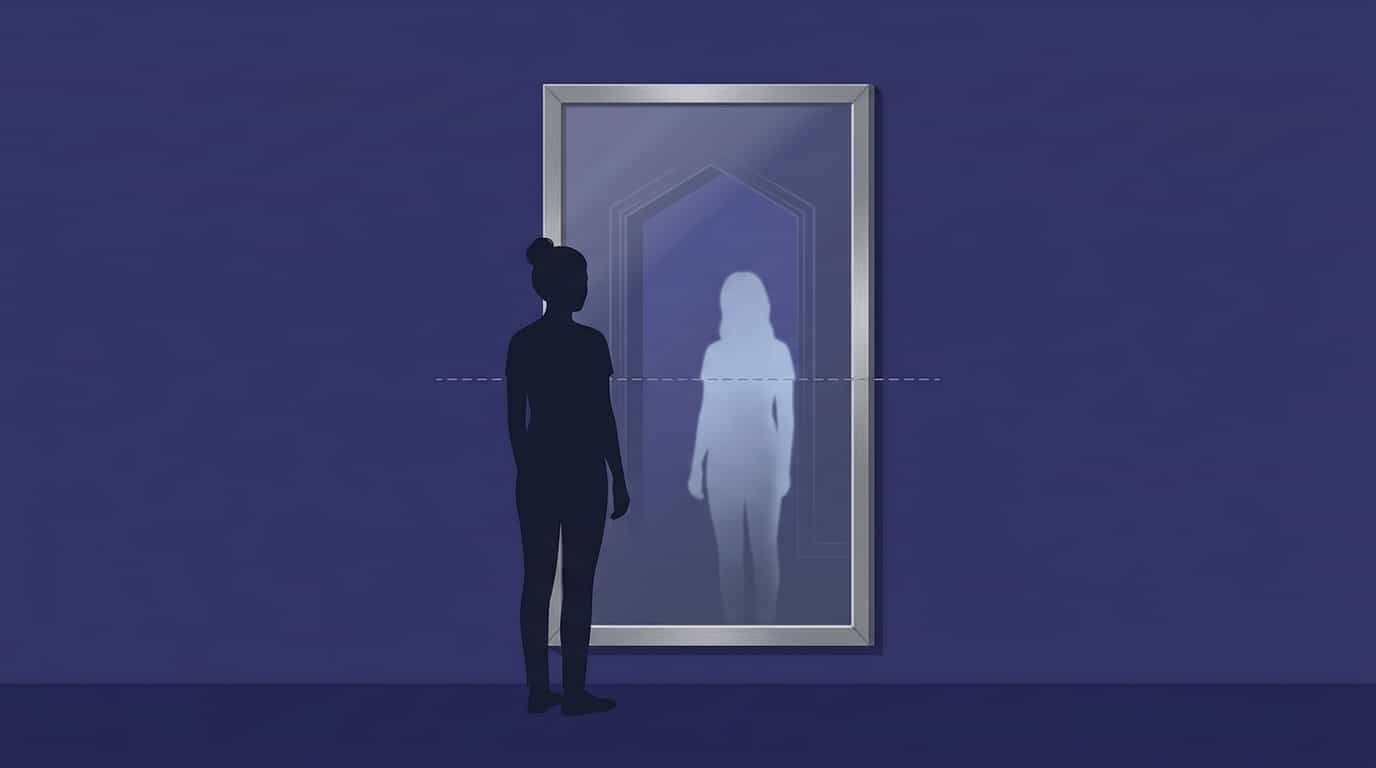
For centuries, humanity has harbored a deep, primal fascination with reflections. Beyond their practical use for grooming, mirrors hold a unique position in the human psyche. They are the only household object capable of showing us a world that looks exactly like ours—yet is fundamentally inaccessible. This duality has cemented the mirror as portal spiritual meaning across countless cultures and centuries.
We have all felt it: that fleeting moment of hesitation when glancing into a dimly lit mirror, the slight unease of seeing a reflection move out of the corner of our eye, or the ancient superstition of shattering one. But is this merely a psychological quirk, or does it point to something deeper?
From ancient mystics to modern spiritual practitioners, the belief persists that a mirror is not just a piece of glass but a potential gateway—a threshold between our physical reality and something other. This pillar article explores the rich tapestry of mythology, folklore, and genuine spiritual beliefs surrounding the concept of the mirror as a portal, offering insights into how this idea was born, how it evolved, and what it means for your spiritual practice today.
The Mirror Portal Concept — Where Does It Come From?
To understand the mirror as a portal, we must first look at the history of the object itself. Before the invention of silvered-glass mirrors in the 16th century, humans viewed their reflections in water, polished obsidian, or dark metals like bronze. These surfaces were rare, valuable, and often considered magical. In ancient civilizations, a reflection was not seen as a mere image but as a part of the soul.
The Latin word for mirror, speculum, is also the root of the word “spectacle” and “speculate.” To look into a mirror was to engage in an act of speculation—both a visual observation and a philosophical inquiry into the nature of the self and the universe.
The idea of the mirror as a portal stems from three core ancient concepts:
- The Threshold Theory: Mirrors were believed to be “liminal” spaces. In anthropology, a liminal space is the “in-between”—the boundary between two states of being. Just as a doorway separates indoors from outdoors, a mirror was thought to be a doorway separating the physical world from the spiritual or astral world.
- The Soul Double: Many cultures, including the ancient Greeks and Chinese, believed that a reflection captured a person’s soul or life force. To harm a reflection was to harm the person. This belief positioned the mirror as a container of spiritual essence, making it a natural conduit for spirits to cross over.
- The Reverse World: The mirror shows a world that is reversed—left becomes right. This inversion led to the belief that the “Other Side” was a mirrored version of our own, a parallel dimension where logic was inverted and spirits dwelled.
This historical foundation transformed the mirror from a simple tool into a powerful spiritual object, setting the stage for centuries of folklore and mystical practice.
Folklore & Literature That Established the Mirror Portal Myth
While the concept of the mirror portal has ancient roots, it was solidified in the Western imagination through folklore and classic literature. These stories codified the rules of the mirror portal, turning superstition into a narrative archetype that persists today.
Lewis Carroll — Through the Looking Glass
No literary work has done more to popularize the mirror as a portal than Lewis Carroll’s 1871 novel, Through the Looking-Glass, and What Alice Found There. Building on the success of Alice’s Adventures in Wonderland, Carroll introduced a new kind of journey. Alice doesn’t fall down a rabbit hole; she steps through a mirror above the mantelpiece.
Carroll’s genius was in treating the mirror not just as a barrier but as a literal gateway. He explored the physics of the reversed world, where everything is backwards, time moves strangely, and the laws of logic are inverted. This narrative established a key element of the mirror portal myth: the world on the other side is not a replica; it is a paradox. It is a realm of shadows, opposites, and hidden truths. For generations, this story has subconsciously taught us that a mirror is not an ending, but a point of entry.
European Fairy Tale Mirror Portals
Long before Carroll, European fairy tales used mirrors as magical devices, though often with darker connotations. In these stories, mirrors rarely showed a simple reflection; they showed elsewhere.
- “Snow White”: The Evil Queen’s “Mirror, mirror on the wall” does not function as a portal for travel, but as a portal for communication. It is a scrying tool—a window through which she can access a spirit or entity that knows all. This established the idea that a mirror can be a listening device to other realms.
- French Fairy Tales: In stories like Beauty and the Beast, magical mirrors allow the user to see distant events. The mirror becomes a portal for the gaze, allowing one to project their consciousness across space and time.
- The Legend of the “Bloody Mary”: Perhaps the most enduring mirror-portal folklore is the ritual of summoning “Bloody Mary.” This modern legend, which involves chanting into a candlelit mirror, is a direct descendant of ancient cacoptromancy—a form of divination using mirrors to glimpse one’s future spouse or one’s own death. In traditional folklore, these rituals were performed with solemn intent, not merely as a children’s game. The mirror, under specific conditions (darkness, repetition, a threshold time like midnight), was believed to open a channel to the unknown.
Slavic Mythology — The World Behind the Glass
In Slavic mythology and folk tradition, the mirror holds a particularly potent and dangerous status. Known as “the world behind the glass,” mirrors were viewed as a separate dimension inhabited by spirits and the souls of the dead.
Slavic traditions hold that:
- Mirrors must be covered when a person dies. This is arguably the most famous mirror superstition. The belief is that the soul of the deceased, lingering near the body, could become trapped in the mirror if it sees its reflection. Alternatively, the mirror acts as an open door that could allow other spirits to enter the home.
- Mirrors are dangerous at night. It was believed that at midnight, the “world behind the glass” aligns most closely with ours. To look into a mirror at this hour was to risk seeing a reflection that wasn’t your own, or to be pulled into the other side.
- Kalevala and Eastern Traditions: In broader Slavic and Finno-Ugric myths, shamans used polished stones or metals to access the spirit world. These tools were considered “portals” for the shaman’s soul during journeys, emphasizing that the mirror’s primary function was to facilitate travel between worlds.
Feng Shui and Vastu Shastra — The Mirror as Energy Gateway
Beyond Western folklore, Eastern traditions offer a profound understanding of the mirror as a portal. In these systems, the mirror is not merely a reflective surface but a dynamic tool that directs energy (Qi or Prana) between worlds and within the home.
| Tradition | Core Belief | Key Practice |
|---|---|---|
| Feng Shui | Mirrors are called the “aspirin of Feng Shui”—powerful remedies that can fix bad layouts. However, they are considered active portals that can “suck” energy (Qi) if placed incorrectly. | Mirrors are strictly forbidden from facing the bed, as this is believed to create “third-party interference” in relationships and disrupt sleep by acting as an open portal during rest. |
| Vastu Shastra | Mirrors should never face the bed, as they are thought to reflect the soul’s energy outward during sleep, leading to restlessness and nightmares. | Mirrors are ideally placed on North or East walls to reflect positive solar energy into the home, never on South or West walls where they may invite stagnant or negative influences. |
In both traditions, a mirror facing the main door is considered dangerous—it is believed to reflect good fortune back out of the home before it can enter. Conversely, a mirror placed in a dining room is seen as multiplying abundance, reflecting the food and family to create a symbolic doubling of prosperity.
What Spiritual Practitioners Actually Believe
Moving beyond folklore and into contemporary practice, modern mystics, witches, and spiritual practitioners hold nuanced beliefs about the mirror as a portal. For them, the idea is not merely superstition but a functional aspect of their spiritual work.
Mirrors as Thin Places Between Worlds
In spiritual circles, mirrors are often classified as “thin places” —locations where the veil between the physical and spiritual realms is weaker. While natural thin places might be caves, forests, or ancient wells, mirrors are manufactured thin places.
Practitioners believe that a mirror’s surface acts as a pivot point. It is neither here nor there. When used intentionally, it can become a gateway for:
- Scrying: This is the ancient art of gazing into a reflective surface (black obsidian, water, or a mirror) to enter a trance state. In this state, practitioners believe they can receive visions, communicate with guides, or see past the veil of ordinary reality. For them, the mirror is a portal for vision.
- Spirit Communication: Many mediums and necromancers use mirrors as a focal point to contact the deceased. They believe that the mirror provides a “meeting ground” where a spirit can manifest more easily. This practice is tied to the ancient tradition of covering mirrors in a house of mourning—not to trap the soul, but to prevent an unwanted, uncontrolled opening.
- Astral Projection: For those who practice astral projection (the intentional separation of the soul from the body), mirrors are seen as pre-programmed portals. Some practitioners will place a mirror near their bed, intending to use it as an exit point for their astral body to travel into the “lower astral” or “etheric” planes.
The Receiver Theory — How the Portal Functions
In mystical traditions, a mirror is not simply a door; it functions as a receiver and magnifier. Unlike a wall, which blocks energy, a mirror returns energy with intensity. Practitioners believe that if a spirit or entity is “stuck” in the lower astral planes, it can use the reflective surface as a magnifying glass—pushing its energy through the glass by reflecting intention back and forth until a tear in the veil forms. This is why mirrors are often described as “active” portals rather than passive ones; they do not simply open; they amplify whatever energy is present.
Specific Times When Mirrors Are Most “Active”
Spiritual practitioners are not afraid of mirrors, but they are deeply respectful of them. They recognize that certain times and conditions amplify a mirror’s portal-like qualities. These are considered periods when the veil is thin, making the mirror a more volatile or powerful tool.
- The Witching Hour (Midnight to 3:00 AM): Universally recognized as a time when spiritual activity peaks. This is considered the “dead of night” —a liminal time between days. Practitioners often avoid looking into mirrors during this window unless performing a specific, protected ritual.
- Samhain (Halloween): In many pagan traditions, Samhain (October 31–November 1) is the original “night when the veil is thinnest.” This is the most potent time for mirror work involving ancestors or divination. It is also considered the time when a mirror portal is most likely to open unintentionally.
- The Dark Moon: In moon-based spirituality, the dark moon (the three days when the moon is not visible) is a time for introspection and banishing. It is also a time when mirrors are considered “hungry” —more likely to absorb energy or act as a conduit for shadow aspects.
- During Emotional Turmoil: Practitioners believe that intense emotions—rage, deep grief, or terror—can energetically “charge” a mirror. A mirror in a room where there has been a violent argument is thought to have absorbed that energy, potentially making it an unstable portal that could attract lower-vibrational entities.
Signs a Mirror in Your Home May Be Functioning as a Portal
While a mirror is a neutral object, its environment and usage can cause it to become a “stuck” or “active” portal. For those who believe in the mirror portal concept, certain signs indicate that a mirror is no longer just reflecting the room but is potentially functioning as an open doorway.
Here are signs to watch for:
- Unexplained Temperature Drops: If a specific area in front of a mirror is consistently cold—especially a localized cold spot—while the rest of the room is warm, it may indicate a flow of energy between worlds.
- Recurring Reflections: You catch movement in the mirror out of the corner of your eye, but when you look directly, nothing is there. If this happens frequently with a particular mirror, it may be showing activity from “the other side.”
- Dream Disturbances: If a mirror is facing your bed, many practitioners believe it can act as a portal that disrupts sleep. Signs include nightmares, sleep paralysis, or a feeling of being watched while sleeping.
- Pet Behavior: Animals, particularly cats and dogs, are considered sensitive to spiritual energy. If your pet consistently stares, hisses, or barks at a specific mirror for no apparent reason, they may be perceiving an entity or energy you cannot see.
- A Sense of Unease: Your intuition is a powerful tool. If a mirror gives you a persistent, unexplained feeling of dread, oppression, or being watched, it is a sign that the energy around it has become negative or that it has formed an unwanted connection.
How to Close a Mirror Portal If You’ve Opened One
If you suspect a mirror in your home has become an active portal—whether through intentional ritual, a traumatic event, or simple neglect—it is important to know how to “close” it. In spiritual practice, closing a portal is about setting boundaries, cleansing energy, and sealing the threshold.
Here is a step-by-step guide used by practitioners to close a mirror portal:
1. Smoke Cleansing (Smudging)
The first step is to purify the energy around the mirror. Using smoke from white sage, palo santo, or rosemary, waft the smoke in a clockwise direction around the frame of the mirror. Pay special attention to the corners and the back of the mirror. As you do this, state your intention clearly: “Only light and love may remain. This portal is closed.”
2. Visual and Physical Sealing
After cleansing, you must seal the “door.” A simple method is to trace a protective symbol on the mirror’s surface with your finger or a small amount of blessed oil. Common symbols include a pentagram (for protection), an equal-armed cross, or simply a circle to symbolize wholeness and containment.
3. Cover the Mirror
If the energy feels particularly heavy, physically cover the mirror for a period of time—typically 24 hours to a full moon cycle (28 days). Use a black cloth, a thick blanket, or a piece of fabric. This acts as a physical barrier, cutting off the mirror’s ability to act as a threshold.
4. Seal the Back of the Mirror
In many magical traditions—particularly Hoodoo and Appalachian folk magic—the back of the mirror is considered as important as the front. A portal is often permanently sealed by painting the back of the mirror black or placing black fabric behind it. This prevents spirits from crossing through the glass and is considered a permanent closure method for mirrors that cannot be removed from the home.
5. Re-ground the Space
Once the mirror is cleansed and sealed, re-ground the energy of the room. Open windows to let in fresh air. Ring a bell or clap your hands loudly to break up any stagnant energy. You can also place protective items around the mirror, such as:
- Selenite wands: Placed on the windowsill or against the mirror frame to maintain a high-vibration barrier.
- Black tourmaline: Placed at the base of the mirror to absorb any residual negative energy.
- A small bag of salt: Salt is a classic purifier and boundary-setter. Placing a small dish of salt in front of a sealed mirror can absorb lingering portal energy.
6. For Permanent Closure
If a mirror continues to feel like a portal despite cleansing and covering, some practitioners believe it must be removed from the home. When disposing of a mirror that was a portal, do not break it. Breaking a mirror is thought to release the energy it has contained. Instead, wrap it carefully in a black cloth and take it to a recycling center or dispose of it off your property, while stating firmly that any connection to your home is severed.
Scientific Angle — Why Humans Perceive Mirrors as Gateways
While the spiritual perspective is rich and compelling, modern neuroscience does not debunk the experience of the mirror portal; rather, it explains the mechanics of why the experience feels so real to the human mind. Our perception of mirrors as gateways is not just a myth; it is rooted in the very wiring of our brains.
Psychologists and neuroscientists have studied the “uncanny” effect of mirrors, pointing to a phenomenon known as mirror gazing or the strange-face illusion. In experiments, when a person stares at their own reflection in a dimly lit room for several minutes, their brain begins to experience a breakdown in normal facial processing.
This occurs for several reasons:
- Neural Adaptation: Your brain’s neurons, responsible for processing your own face, eventually fatigue. As they stop firing efficiently, the brain begins to “fill in the blanks” with distorted information. People report seeing distortions, deformities, unfamiliar faces, or even monstrous apparitions in the mirror.
- Dissociation: The act of staring at oneself creates a dissociative state. The brain temporarily loses its sense of self-recognition, causing the person to feel as though the reflection is a separate entity. This directly contributes to the feeling of a “portal”—as if there is another being on the other side of the glass.
- Sensed Presence: In low-light conditions, the brain’s default mode network (responsible for self-identity) can “flicker,” causing the brain to interpret the reflection as a separate sentient being. This phenomenon, known as “sensed presence,” explains why mirror gazing often feels like being watched by an other.
- Liminality in Perception: Science confirms that the mirror is a true liminal space for the mind. It is a place where sensory input (what we see) can diverge from cognitive expectation (what we know is there). This conflict triggers a primal anxiety—a feeling that the boundary between self and other, reality and illusion, is dissolving.
From an evolutionary perspective, this hyper-vigilance around mirrors may have been a survival mechanism. Our ancestors needed to be acutely aware of their surroundings. A reflection that moves incorrectly could have signaled the presence of a predator or a threat. This innate sensitivity primes us to view the mirror not as a static object, but as a potential source of danger—or magic.
In this way, science and spirituality do not contradict each other. Instead, they converge on a single truth: the mirror is a unique threshold in human experience—a place where our perception of reality becomes malleable, and the boundaries of the self are tested.
Whether you approach the mirror as a spiritual practitioner seeking to open a conscious portal for divination or as a skeptic appreciating the psychological quirks of human perception, the mirror remains one of the most powerful symbols in our collective consciousness. It is a reminder that the world is not always as it seems, and that sometimes, the greatest mysteries are found not in distant lands, but in the quiet, reflective surfaces of our own homes. By understanding the history, respecting the folklore, and practicing mindful spiritual hygiene, you can transform your relationship with mirrors—moving from fear to a place of empowered awareness.