
We have all felt that split second of dread. The clatter of glass hitting a hard floor, the sudden silence, and then the inevitable sigh: “Well, there goes seven years of bad luck.”
For most people in the Western world, the broken mirror meaning across different cultures is usually boiled down to a single, grim superstition. But what if that mirror didn’t doom you, but freed you? What if, in another part of the world, that broken glass is actually a symbol of good fortune, a sacred ritual, or an artistic masterpiece?
The truth is, the way we perceive a shattered reflection varies wildly across the globe. Some cultures have built elaborate rituals to avoid the curse of a cracked mirror. Others view the act of breaking one as a release from spiritual bondage or a necessary step in a marriage ceremony.
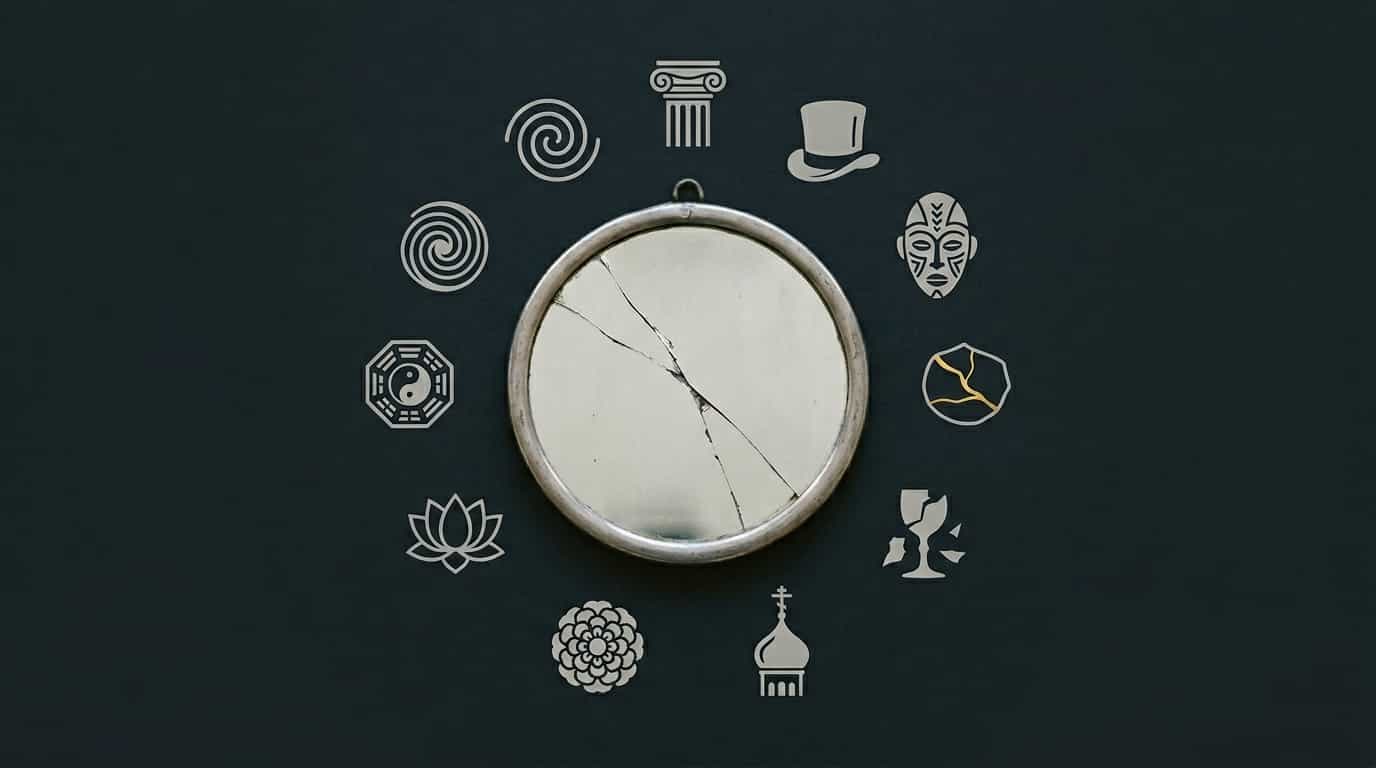
In this article, we explore 10 distinct cultural perspectives on broken mirrors:
| Culture/Tradition | Primary View of Broken Mirror |
|---|---|
| Ancient Rome | Origin of the 7-year curse |
| Victorian England | Financial & social misfortune |
| West African & Diasporic | Liberation & release |
| Japan | Beauty in imperfection (Kintsugi) |
| Jewish | Sacred act of remembrance |
| Russian/Slavic | Spiritual catastrophe |
| Latin American | Mala suerte & fragmented future |
| Indian/Vastu Shastra | Disruption of prosperity |
| Chinese | Compromised spiritual protection |
| Contemporary Spiritual | Ego death & transformation |
By the end, you may find that when it comes to superstition, context is everything—and a broken mirror might just be a matter of perspective.
The Western Bad Luck Assumption Is Not Universal
For most English speakers, the mythology is rigid: a broken mirror equals seven years of bad luck. This belief is so ingrained that it often feels like a universal truth. However, this assumption is a relatively specific cultural construct, primarily rooted in Roman and Victorian sensibilities.
Ancient Rome: The Birth of the Curse
The origin of the seven-year curse dates back to ancient Rome. Romans were the first to propose that a person’s health cycled in seven-year increments. Since a mirror was believed to hold a piece of the soul, breaking it was seen as damaging the soul’s vessel. Without a healthy mirror to reflect the soul, the owner would suffer ill health—or bad luck—until the seven-year cycle concluded and the soul “renewed” itself.
Victorian England: Superstition as Social Control
Centuries later, the Victorians—famous for their elaborate mourning rituals and strict etiquette—cemented this belief. During the Victorian era, mirrors were expensive, luxurious items. To break one was a financial tragedy, and thus, a social one. To discourage carelessness, the superstition was weaponized: break a mirror, and you’ll pay for it with seven years of misery.
But here is the crucial distinction: this is a localized belief. If you travel outside of the Anglo-Saxon and Roman-influenced spheres, you will find that the broken mirror meaning across different cultures shifts dramatically. In many societies, glass holds no monopoly on your soul, and a crack in the silver backing is merely an opportunity for something new.
Cultures Where Breaking a Mirror Is Neutral or Good
In a surprising number of traditions, a broken mirror is not a curse but a blessing. It signifies the shattering of ego, the end of a difficult cycle, or the beginning of a new, more beautiful existence.
1. West African & Diasporic Traditions — Release & Liberation
Across various West African spiritual traditions, and in diasporic systems like Haitian Vodou or Louisiana Voodoo, mirrors serve as portals. They are used in divination and as spiritual receptacles. However, when it comes to breaking, the interpretation is often far from negative.
In many traditional religions, a mirror that breaks on its own—or is broken intentionally during a ritual—is viewed as a form of release. If a person has been suffering from spiritual attack, depression, or stagnation, a broken mirror can signify that the negative energy attached to them has been shattered.
Elders in some communities do not rush to clean up the glass with a broom in fear. Instead, they see it as the resolution of a conflict. The concept of liberation is key here. If someone has been trapped by a hex or a bad omen, the breaking of a mirror acts as a physical manifestation of that spiritual chain snapping.
Furthermore, in some West African cultures, the reflective surface is seen as a symbol of vanity. Breaking a mirror is a humbling experience—a reminder to look inward at the soul rather than outward at the face. It is a neutral event, weighted only by the intention of the people involved.
Important note: African spiritual traditions encompass hundreds of distinct ethnic and belief systems. The themes described above represent common threads found across many West African and diasporic practices, not a single unified doctrine.
2. Japan — Beauty in Breakage (Kintsugi & Wabi-Sabi)
Perhaps no culture has a more positive, philosophical approach to breakage than Japan. While Japan does have some superstitions regarding mirrors—particularly the ancient Shinto belief that mirrors are sacred objects housing deities—the modern and philosophical approach to a broken mirror aligns with the concept of Wabi-Sabi: the acceptance of imperfection.
This is most famously illustrated by the art of Kintsugi (or Kintsukuroi). When a piece of valuable lacquerware or ceramics breaks, Kintsugi is the practice of repairing it with gold, silver, or platinum lacquer. Rather than hiding the cracks, the artisan highlights them.
If you break a mirror in Japan and choose to apply the philosophy of Kintsugi—even metaphorically—the broken mirror meaning across different cultures takes on a radical transformation. It stops being a damaged item to be discarded in shame and becomes a unique piece of art. The philosophy teaches that the object is more beautiful for having been broken. It represents resilience, repair, and the beauty of history.
There is no seven-year curse in this tradition. Instead, there is a belief that the cracks allow light to pass through in new ways. Applied spiritually, if one breaks a mirror—or their own ego—the process of repairing it with gold—patience, experience, and wisdom—makes the person stronger and more valuable than before.
3. Jewish Tradition — Breaking as Sacred (Wedding Glass)
Judaism offers one of the most profound counterpoints to the Western fear of broken mirrors. In Jewish culture, breaking something—specifically a glass—is a central component of the happiest day in a person’s life: the wedding day.
At the conclusion of a Jewish wedding ceremony, the groom (or often the couple together) stomps on a glass wrapped in a cloth. The shattering of the glass is met with cries of “Mazel Tov!” (good luck). While the glass is usually a cup or a goblet rather than a mirror, the symbolism overlaps directly with the broken mirror meaning across different cultures.
Why is breaking a glass considered good luck at a wedding?
| Symbolic Layer | Meaning |
|---|---|
| Remembering Destruction | A reminder of the destruction of the Temple in Jerusalem. Even in ultimate joy, the couple acknowledges the world’s brokenness. |
| Shattering Illusions | Symbolizes the irrevocable change of marriage. Just as the glass cannot be made whole again, the relationship enters a new phase that cannot be undone. |
| Warding Off Evil | The loud noise scares away evil spirits or the evil eye that might envy the couple’s happiness. |
In this context, the breaking of glass is not a curse but a protection against curses. It is a sacred, intentional act of destruction that sanctifies the union. If we extend this logic to a mirror, within a Jewish cultural context, breaking a reflective surface might simply be seen as a reminder that life is fragile, relationships are precious, and sometimes, you have to break things to move forward.
Cultures With the Strongest Mirror-Breaking Superstitions
Of course, not every culture views the broken mirror with such equanimity. In some regions, the fear of breaking a mirror is intense, deeply woven into daily life, and comes with elaborate counter-rituals to avoid catastrophe.
4. Russian & Slavic Tradition — Deep Fear of Broken Mirrors
If you ever visit a home in Russia or much of Eastern Europe, you will likely notice that mirrors are treated with a reverence that borders on fear. In Slavic tradition, the broken mirror meaning across different cultures is one of the most severe omens imaginable.
The Russian belief system holds that a mirror is not merely a reflective surface but a portal to the otherworld. It is a boundary between the world of the living and the world of spirits. This belief was so strong historically that mirrors were often covered with cloth when someone died in the house, so the soul of the deceased would not get trapped inside the glass.
Consequently, breaking a mirror is a spiritual catastrophe. It is believed to open the portal, allowing evil spirits or negative energy to flood into the home. Furthermore, it is thought to bring seven years of misfortune—a similar duration to the Western belief, but often considered far more sinister and tangible.
If a mirror breaks in a Russian household, the reaction is immediate and ritualistic:
- Apologize: You must apologize to the mirror, addressing the spirits within.
- Bury the pieces: Carefully collect the shards, wash them under running water to cleanse the bad luck, and bury them in the ground. Under no circumstances are you to look into a broken mirror, as it is said to distort your soul or invite madness.
- Salt: Often, salt is thrown over the left shoulder immediately after the break to neutralize the evil eye.
In this tradition, the broken mirror is a serious matter, requiring immediate spiritual hygiene to avert disaster.
5. Latin American Folk Beliefs
Latin American folklore, which blends Indigenous beliefs with Spanish Catholicism, also harbors a deep wariness of broken mirrors. The broken mirror meaning across different cultures in Latin America often circles back to the concept of susto (fright) and the mal de ojo (evil eye).
Breaking a mirror is seen as a direct invitation for mala suerte (bad luck). However, unlike the purely punitive seven-year curse, the Latin American interpretation often focuses on the future. It is believed that a broken mirror cracks your future. If you look into a cracked mirror, you are essentially fragmenting your destiny, making it difficult to see a clear path forward.
There is also a strong association with vanity. In many Latin American homes, older generations warn that breaking a mirror is a punishment for being too prideful about one’s appearance.
Remedies vary by country and tradition:
| Region | Common Remedy |
|---|---|
| Mexico | Take broken pieces and cross them three times with holy water, or throw them into a river so flowing water carries the bad luck away |
| Caribbean | Practitioners of Santería may use broken shards in cleansing rituals, using herbs to seal the portal the broken glass allegedly opened |
| General | Never look into broken fragments; dispose of them immediately and facing downward |
6. Indian & Vastu Shastra Traditions
In India, superstitions regarding mirrors are deeply tied to Vastu Shastra—the traditional Indian system of architecture—and general household harmony. While intentionally breaking a mirror is considered highly inauspicious, the presence of a cracked mirror is often treated with even more urgency than the act of breaking it.
In Indian culture, a mirror is a symbol of Lakshmi, the goddess of wealth and prosperity. To break a mirror is to insult the goddess of fortune, potentially leading to financial instability or domestic discord.
If a mirror is already cracked, it is considered extremely dangerous to keep it in the house. A cracked mirror reflects a distorted image, which in turn distorts the energy (prana) of the inhabitants. It is often cited as a cause for arguments between spouses or a lack of mental clarity.
The timing of the break also matters:
- Morning break: Considered a bad start to the day
- Night break: Some believe it is a warning that a secret will be exposed
The remedy: Remove fragments from the home immediately without touching them with bare hands (to avoid absorbing the bad energy), and perform a small prayer to Lakshmi to restore balance.
7. Chinese Tradition — Mirrors as Protective Tools
In traditional Chinese culture, mirrors—particularly bronze bagua mirrors—are powerful protective objects used to deflect negative energy (sha chi). These mirrors are often placed above doorways or on exterior walls to guard against harmful influences.
A broken mirror is considered inauspicious because it compromises this protection. However, the severity depends on context. A mirror that breaks while actively protecting the home from a perceived threat may be honored rather than mourned—it has fulfilled its purpose by absorbing negative energy meant for the household.
Key principles in Chinese tradition:
- Mirrors should never face the bed or the front door directly (this creates negative energy flow)
- A broken mirror must be wrapped in red cloth before disposal—red is a protective color that neutralizes bad luck
- Never hang a broken or cracked mirror; discard it immediately
- Some families consult a feng shui practitioner to perform a cleansing ritual after a significant mirror break
The Chinese perspective adds another layer to the broken mirror meaning across different cultures: a broken mirror is not inherently cursed, but it signals that a protective boundary has been breached, requiring immediate attention and spiritual reparation.
Historical Context — Why Western Bad Luck Belief Dominated
Given the diversity of views—from the sacred breaking in Jewish weddings to the protective symbolism in Chinese tradition—why did the dark Roman superstition become the global default?
The dominance of the Western interpretation of the broken mirror meaning across different cultures can be traced back to two major historical forces:
- The Roman Empire: The Romans spread their superstitions across Europe. As Latin evolved into Romance languages and Roman Catholicism spread, so did the idea of the mirror as a soul-vessel.
- The British Empire & Victorian Influence: The true solidification came during the Industrial Revolution and the rise of the Victorian middle class. As mass production made mirrors accessible to average households, they became a staple of home decor. The Victorians—known for their elaborate social codes and fascination with death—codified the superstition into the version we know today.
- Global Media: The dominance of American and British media in the 20th century exported this superstition worldwide. Hollywood films, literature, and news outlets consistently reinforced the “seven years bad luck” trope. In a globalized world, this narrative overshadowed the more nuanced, localized beliefs.
It was simply easier to propagate a catchy curse (seven years!) than to explain the complex spiritual frameworks of African liberation, Japanese aesthetics, Jewish wedding symbolism, or Chinese protective traditions. Consequently, while a person in Tokyo might appreciate the philosophy of Kintsugi, they are also likely aware of the Western trope due to cultural globalization.
What Does This Cultural Diversity Tell Us Spiritually?
After exploring these ten traditions, the question remains: what is the actual spiritual truth of a broken mirror? Is it a curse, a liberation, a sacred act, or a protective failure?
The answer lies in the concept of intention and perspective. The broken mirror meaning across different cultures ultimately reveals that objects themselves are neutral; they only carry the meaning we assign to them.
Three Ways to Understand the Mirror
| Perspective | Interpretation |
|---|---|
| The Mirror as the Ego | In Western cultures, breaking the self (the ego) is terrifying—hence the curse. In Eastern traditions like Japanese Buddhism, breaking the ego is the goal of enlightenment—a release from suffering. |
| The Mirror as a Portal | For Slavic and some African traditions, the mirror is a threshold. Whether that threshold is dangerous or liberating depends on the spiritual hygiene of the individual and the community. |
| The Mirror as Fortune | In Indian, Chinese, and Latin American traditions, the mirror is tied to wealth, protection, and destiny. A crack is a warning to reassess one’s life path, not a permanent damnation. |
If you find yourself staring at a pile of shattered glass on your floor, you have a choice. You can adopt the Victorian fear and wait for seven years of misfortune. Or, you can take a page from the global perspective.
- Choose the Jewish route: accept that the breaking marks a significant change in your life that cannot be undone, but greet it with a “Mazel Tov” of new beginnings.
- Choose the Japanese route: save the pieces, and metaphorically repair your situation with gold—using wisdom and resilience to create something stronger than before.
- Choose the African route: recognize that sometimes, the universe breaks our illusions to liberate us from stagnation.
- Choose the Chinese route: acknowledge that a protective boundary has been breached, and take conscious action to restore harmony to your space.
How to Handle a Broken Mirror (Informed by Global Wisdom)
Rather than offering a single hybrid ritual that might inappropriately combine sacred practices, here are approaches drawn from different traditions. You may choose the one that resonates with your own background and beliefs.
The Russian-Slavic Approach
For those who want to neutralize negative energy thoroughly
- Apologize to the mirror (or the energy within it)
- Collect shards carefully without looking into any broken piece
- Wash the pieces under running water to cleanse them
- Bury the fragments in the ground, away from the home
- Throw salt over your left shoulder immediately
The Latin American Approach
For those who want to release bad luck and protect the future
- Gather all pieces immediately
- Sprinkle holy water (or salt water) over the fragments
- Dispose of them in moving water (river, stream) or wrap them in dark cloth and discard away from home
- Never look into the broken glass before disposal
- Sweep the area thoroughly—leaving a single shard behind is considered more dangerous than the break itself
The Chinese Approach
For those who view mirrors as protective tools
- Wrap the broken pieces in red cloth immediately (red neutralizes bad luck)
- Dispose of them outside the home without lingering
- Check other mirrors in the home for any cracks or improper placement
- Consider consulting feng shui principles to restore protective energy to your space
- If the mirror was a bagua or protective mirror, honor its service before disposal—it may have absorbed negative energy meant for you
The Contemporary Spiritual Approach
For those who focus on personal transformation
- Take a breath and avoid panic—energy follows attention
- Acknowledge the break: “Something has shifted. I release what no longer serves me.”
- Clean up mindfully, treating the pieces with respect
- Reflect: What in your life is shattering or transforming right now?
- Create closure: Write down what you’re releasing and safely burn the paper, or create art from a few shards as a reminder of resilience
Frequently Asked Questions
Is breaking a mirror always bad luck?
No. While Western and Slavic traditions often view it as bad luck (typically seven years), many cultures see it as neutral, liberating, or even sacred. In Jewish weddings, breaking glass is a symbol of joy and commitment. In some African traditions, it represents spiritual release. In Chinese culture, the meaning depends on whether the mirror broke while protecting the home.
What does it mean spiritually when a mirror breaks by itself?
Spiritually, interpretations vary:
| Tradition | Interpretation |
|---|---|
| Western superstition | A warning or the start of bad luck |
| African traditions | A spiritual release; negative energy has been shattered |
| Indian/Vastu | Disruption of household harmony; a sign to reassess |
| Contemporary spirituality | A sign that a major life shift is occurring; the ego is cracking to allow growth |
| Chinese tradition | A protective boundary has been breached; the mirror absorbed negative energy meant for you |
How do you reverse bad luck from a broken mirror?
Common remedies across cultures include:
- Washing the shards in water to cleanse them
- Burying the pieces in the ground
- Throwing salt over your left shoulder
- Wrapping fragments in red cloth before disposal
- Ensuring no one looks into the broken glass before it is disposed of
- Sweeping the area thoroughly—leaving shards behind is considered dangerous
What does Kintsugi have to do with broken mirrors?
Kintsugi is the Japanese art of repairing broken pottery with gold or silver lacquer. While traditionally practiced on ceramics, its philosophy applies to broken mirrors: finding beauty in imperfection and valuing the history of the object. Rather than hiding cracks, Kintsugi illuminates them, transforming a broken object into something unique and more valuable than before.
Why do mirrors need to be covered when someone dies?
In Russian and Slavic traditions, mirrors are covered after a death to prevent the deceased’s soul from becoming trapped in the glass. Similar practices appear in Jewish tradition (covering mirrors during shiva, the mourning period) to focus attention on grief rather than vanity. In parts of South America and Europe, this custom persists as a way to protect the living and honor the dead.
Can I keep a cracked mirror in my home?
Most traditions advise against keeping cracked mirrors.
- Indian Vastu Shastra: A cracked mirror distorts prana (energy) and can cause domestic discord
- Chinese feng shui: A cracked mirror creates sha chi (negative energy) and disrupts harmony
- Latin American beliefs: Looking into a cracked mirror fragments your future
- Western superstition: A cracked mirror extends or perpetuates bad luck
If you choose to keep one for sentimental or artistic reasons, consider the Japanese Kintsugi philosophy: repair it with intention, highlighting rather than hiding the damage.
Sources & Further Reading
For readers interested in deeper exploration of the traditions discussed in this article, the following sources provide authoritative background:
- Dundes, Alan. The Evil Eye: A Folklore Casebook. University of Wisconsin Press, 1992.
- Okakura, Kakuzō. The Book of Tea. 1906. (For background on Japanese aesthetics and Wabi-Sabi)
- Cosentino, Donald. Vodou Things: The Art of Haitian Vodou. Fowler Museum at UCLA, 1998.
- Senn, Harry A. Jewish Wedding Customs. Jewish Publication Society, 1997.
- Ransel, David L. Village Mothers: Three Generations of Change in Russia and Tataria. Indiana University Press, 2000.
- Lipner, Julius. Hindus: Their Religious Beliefs and Practices. Routledge, 2010. (For context on Lakshmi and household traditions)
- Skinner, Stephen. Feng Shui: The Living Earth Manual. Tuttle Publishing, 1999.
Final Reflection
The broken mirror meaning across different cultures is a testament to the rich tapestry of human belief. What terrifies a Muscovite might be welcomed by a Mande healer. What signals doom in Mumbai might signal celebration in Tel Aviv. What warns of danger in Shanghai might inspire artistic creation in Tokyo.
By looking beyond the Western narrative of the seven-year curse, we discover that a broken mirror is not inherently good or bad. It is a mirror—literally and metaphorically—reflecting our own deepest fears and highest hopes.
If we choose to see the shattering as an ending, we will find bad luck. But if we choose to see it as a beginning, a release, or an opportunity for golden repair, we align ourselves with thousands of years of global wisdom that suggest: sometimes, things must fall apart so that something beautiful can emerge.
So, the next time you hear the sound of glass breaking, don’t count the years. Instead, look at the pieces and ask yourself: Am I going to let this haunt me, or am I going to let this liberate me?
Your answer will determine your luck far more than the mirror ever could.