
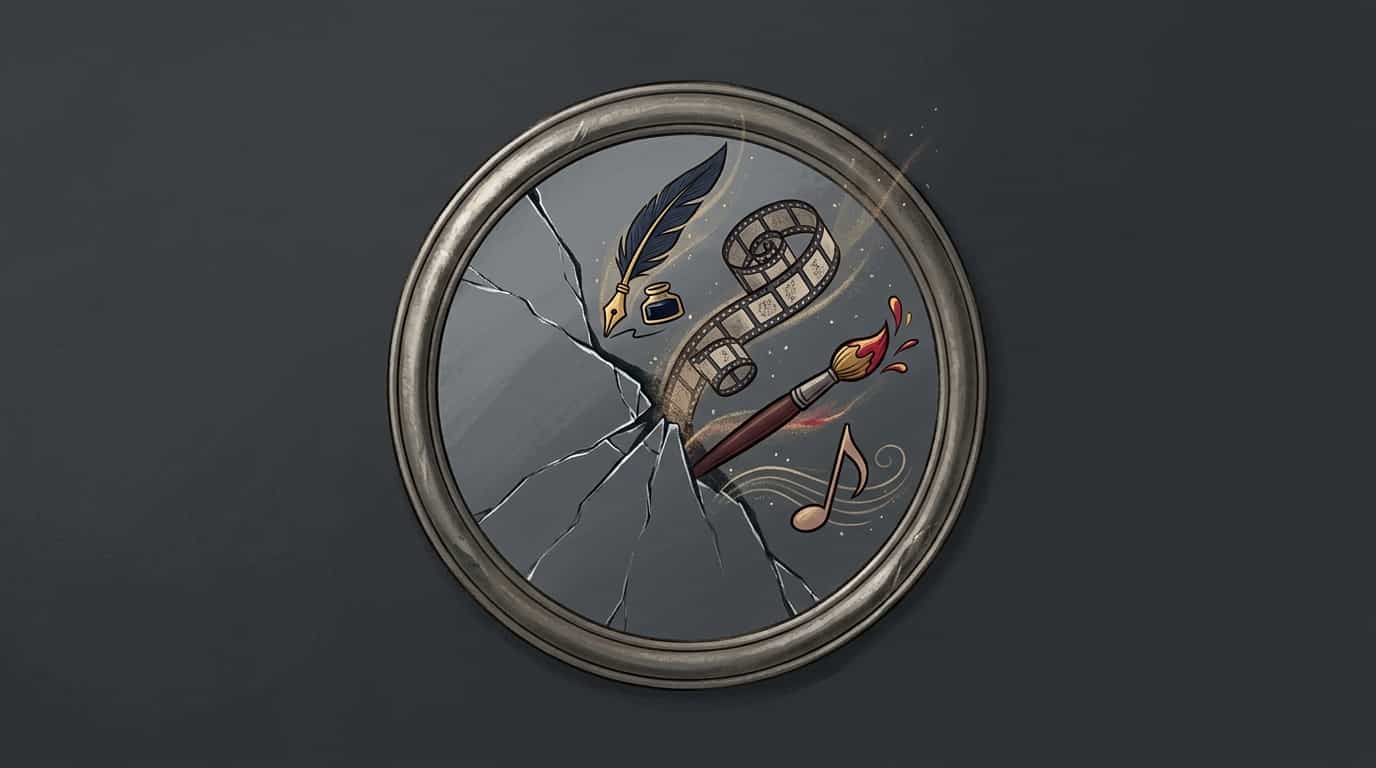
For centuries, humanity has viewed the mirror as an object of magic and mystery. It is a tool of vanity, a window into the soul, and, according to superstition, a potential gateway to misfortune. But when that smooth, silvered surface cracks, the symbolism deepens dramatically. The broken mirror symbolism in art and literature represents far more than mere bad luck. It is a visceral metaphor for fractured identity, shattered truth, and the painful, sometimes liberating, process of self-reflection.
From the darkest corners of folklore to the cutting edge of contemporary cinema, creators have utilized the shattered reflection to tell truths that a perfect mirror cannot. A broken mirror does not lie; it reveals the cracks that already exist within the psyche, society, or the universe. In this article, we will explore how writers, filmmakers, artists, and musicians harness the power of the broken mirror to explore themes of mortality, madness, transformation, and the search for authenticity in a fragmented world.
Why Artists & Writers Are Drawn to Broken Mirrors
The allure of the broken mirror is rooted in its duality. A pristine mirror offers certainty. It is a tool of verification; we look into it to confirm that we are who we think we are. But when that mirror breaks, certainty shatters. Artists and writers are drawn to this state of ambiguity because life is rarely as tidy as a clear reflection.
The broken mirror serves as a visual or conceptual shorthand for a crisis of consciousness. It represents the moment the protagonist realizes that their self-perception is flawed, that their world is not as stable as it seemed, or that they are facing a fundamental split within themselves. Psychologically, this taps into what psychoanalyst Jacques Lacan termed the “mirror stage” —the moment an infant recognizes themselves in a reflection, forming the ego. To break that mirror is to symbolically dismantle the ego, inviting chaos, rebirth, or a more complex understanding of self.
Moreover, there is a practical aesthetic appeal. A shattered surface offers countless perspectives at once. Where a single mirror shows one angle, a broken mirror shows a mosaic of angles—fragments of reality, distorted and multiplied. This allows creators to visually or narratively depict a character’s fractured psyche, a society in disarray, or a truth that is too painful to be viewed whole.
The Folklore Roots: Seven Years of Bad Luck
Before exploring how artists wield the broken mirror, it is essential to understand the superstition that still lingers in the cultural background: the seven years of bad luck. This belief traces back to ancient Rome, where mirrors were considered vessels of the soul. Breaking one was thought to damage the soul itself, and since Romans believed life renewed every seven years, the curse lasted that duration. Later, during the Victorian era, mirrors were often draped after a death to prevent the deceased’s soul from becoming trapped in the glass.
This folklore establishes a baseline of fear and reverence. When modern creators use broken mirrors, they are either leaning into this ancient anxiety or subverting it—suggesting that the shattering of illusion might be a blessing, not a curse. Understanding this history deepens our appreciation of why the symbol carries such immediate, visceral weight.
Broken Mirror in Classic Literature
Classic literature provides the bedrock for our modern understanding of mirror symbolism. Long before cinema could show a shard of glass reflecting a distorted face, novelists and poets were using the concept of the cracked or broken reflection to explore the deepest human anxieties.
Snow White — The Cracked Vanity Mirror & Narcissism
One of the earliest and most pervasive examples of broken mirror symbolism in storytelling is the fairy tale of Snow White. The story hinges on the relationship between the Evil Queen and her “Magic Mirror on the wall.” While the mirror itself is not physically broken in the original Brothers Grimm tale, the relationship with it represents a fatal fracture. (In the iconic 1937 Disney film, however, the mirror does physically crack during a lightning storm—a visual cue that the Queen’s power is fracturing.)
The Queen’s identity is entirely dependent on the mirror’s validation. She asks the same question daily, seeking external confirmation of her worth. When the mirror finally replies that Snow White is “fairer,” the Queen’s psyche cracks. The broken mirror here is metaphorical; it symbolizes the shattering of the Queen’s narcissism. Unable to accept a truth that contradicts her self-image, she descends into madness and destruction.
This tale established a foundational trope: the mirror as a truth-teller, and the violent reaction that occurs when that truth is unwelcome. The Queen’s attempt to destroy Snow White is an attempt to repair her own reflection—a struggle that resonates through centuries of storytelling.
| Tale Element | Symbolic Meaning |
|---|---|
| The Magic Mirror | External validation; societal judgment |
| The Queen’s Question | Narcissistic dependence on approval |
| The Mirror’s Truth | Inescapable reality |
| The Queen’s Madness | Consequences of shattered self-image |
Sylvia Plath’s Mirror Poem — Identity & Aging
Sylvia Plath’s 1961 poem “Mirror” offers a more introspective and chilling exploration of the subject. Written from the perspective of the mirror itself, the poem presents the reflective surface as a neutral, honest entity—“not cruel, only truthful.” The mirror swallows whatever it sees without prejudice.
However, the horror of the poem emerges when the mirror becomes a “lake” (a nod to the myth of Narcissus) and reflects the face of a woman who has grown old. The woman turns to candles and the moon—distorting light sources—to seek a more flattering image. But the mirror always brings her back to reality. The poem culminates in the haunting line:
“In me she has drowned a young girl, and in me an old woman / Rises toward her day after day, like a terrible fish.”
Here, Plath uses the mirror to symbolize the relentless passage of time. The “broken” aspect is not the glass, but the woman’s identity. Her self-image is shattered by the reality of aging, creating a painful dichotomy between who she feels she is and who the world (via the mirror) tells her she has become. Plath’s work is a masterclass in using reflective surfaces to confront existential dread.
Oscar Wilde & The Picture of Dorian Gray
While Oscar Wilde’s The Picture of Dorian Gray famously uses a portrait as the repository of the protagonist’s sins, the novel is deeply intertwined with mirror symbolism. The portrait acts as a magical mirror, showing Dorian the true state of his soul that his physical appearance—the standard mirror—hides.
This presents an interesting tension for a discussion of broken mirrors. The portrait remains physically intact for most of the novel, yet it functions as a shattered reflection of Dorian’s identity. The fracture exists not in the glass but in the gap between his unblemished face and his corrupted soul. Dorian is living a lie that the common mirror supports; the portrait is the truth he refuses to see whole.
When Dorian first sees the finished portrait, he gazes upon it as one would a mirror, and he experiences a “sense of joy.” But as he descends into hedonism and cruelty, the portrait becomes a “foul mirror” reflecting his degradation. The fracture between his outward beauty and inward corruption is the novel’s central conflict. When he finally stabs the portrait—attempting to destroy the truth—he effectively destroys his own soul, dying a hideous, aged man while the portrait returns to its pristine state.
Wilde uses this as a critique of Victorian hypocrisy. The society in which Dorian moves is obsessed with surface appearances. The portrait—the “broken mirror”—shatters that illusion, revealing that the polished surface of high society often hides a monstrous reality. It suggests that the true horror is not the broken reflection, but the lie of the perfect one.
Broken Mirror in Film & Television
Film and television, being visual mediums, have a unique relationship with mirror symbolism. The camera can linger on a fractured reflection, creating immediate, visceral tension. Directors use the broken mirror to externalize a character’s internal state, often serving as a pivotal visual motif in moments of crisis.
Horror Films — Mirror as Portal to Evil
In the horror genre, the mirror is rarely a friend. It is often depicted as a thin veil between our world and a darker one. The trope of the mirror as a portal is best exemplified in classics like Poltergeist III (1988) and Candyman (1992). In these films, mirrors are not merely reflective surfaces but thresholds. Breaking them does not seal the portal; it often shatters the barrier, allowing evil to flood into the real world.
The 2013 film Oculus takes this concept to its logical extreme. The plot revolves around a haunted antique mirror, the Lasser Glass, that drives its owners mad by distorting their perceptions. The mirror doesn’t just show a false reflection; it breaks reality itself—manipulating time, space, and memory. The protagonists attempt to “prove” the mirror is evil by smashing it with a counterweight, but the mirror fights back by creating a fractured, untrustworthy reality.
In horror, the broken mirror symbolizes the collapse of reliable reality. Once the reflection is shattered, the audience, like the characters, can no longer trust what they see.
Drama Films — Mirror as Symbol of Breakdown
In dramatic cinema, the broken mirror is a potent symbol of psychological disintegration. Martin Scorsese’s Taxi Driver (1976) features one of the most iconic mirror scenes in film history. As Travis Bickle (Robert De Niro) prepares for a violent confrontation, he stands in front of a mirror and asks, “You talkin’ to me?” The scene is a masterclass in fractured identity. Travis is rehearsing a persona, talking to a reflection that is both himself and an imagined adversary.
Here, Lacan’s mirror stage theory finds its dark inversion. Travis has passed beyond the stable “ideal-I” formed in childhood; the mirror no longer confirms a coherent self but reveals a splintered psyche. He is trapped in what Lacan called the corps morcelé—the fragmented body image—unable to unify his violent impulses into a stable identity. The mirror becomes a stage for his descent into psychosis.
Similarly, in Darren Aronofsky’s Black Swan (2010), mirrors are everywhere, constantly reflecting the protagonist Nina’s fractured sense of self. She sees her own reflection acting independently, scratches appearing on her back in the mirror that aren’t there in reality, and finally, she confronts her doppelgänger in a shard of broken glass.
Aronofsky employs a specific cinematic technique: he frequently shoots Nina so that the camera rests on the “real” side while the mirror shows a different action, breaking the 180-degree rule of continuity editing. This formal choice disorients the audience, mirroring Nina’s own confusion. The constant use of reflective surfaces—and their eventual shattering—visually represents her struggle to reconcile her “white swan” innocence with her “black swan” sensuality and darkness. When the mirrors break, so does the boundary between her competing identities.
| Film | Broken Mirror Function |
|---|---|
| Taxi Driver | Rehearsal of violent persona; fragmented masculinity |
| Black Swan | Doppelgänger confrontation; dissolution of self |
| Oculus | Unreliable reality; memory manipulation |
| Candyman | Portal between worlds; summoning evil |
Broken Mirror in Visual Art
Visual artists have long been fascinated by the interplay of perception, reality, and reflection. The broken mirror allows them to deconstruct traditional representation and challenge how viewers see themselves and the artwork.
Salvador Dalí & Distorted Reflections
The Surrealist movement was obsessed with dreams, the subconscious, and distorted realities, making the broken mirror a natural subject. Salvador Dalí, in particular, frequently used melting, fractured, and distorted reflections to challenge the rigidity of reality. His work often features reflections that do not match their subjects, suggesting the instability of identity and memory.
Dalí’s painting The Face of War (1940) uses a disembodied, skeletal face with snakes writhing in its mouth and a desert landscape in its eye sockets—a reflection of the horrors of war. While not a literal broken mirror, the piece acts as a “broken reflection” of humanity. Dalí argued that a world without chaos and contradiction was a lie. His distorted reflections served as a more honest depiction of the human condition than a straightforward portrait could ever achieve. For Dalí, the broken mirror was a tool of truth, revealing the nightmares lurking beneath the surface of polite society.
Contemporary Mirror Art Installations
Contemporary artists have taken mirror symbolism out of the frame and into the gallery space, using it to create immersive experiences. Artist Robert Smithson’s Mirror Displacements (1969) involved placing mirrors in natural landscapes, breaking the continuity of the environment and forcing viewers to see nature through a fragmented, human-made lens.
In the modern era, artists like Daniel Arsham use broken, eroded mirrors to explore themes of archaeology and decay. His works often appear as architectural elements—walls or sculptures—made of shattered glass, reflecting the viewer back at themselves amidst a scene of ruin. These installations force an interaction. The viewer doesn’t just look at a broken mirror; they see themselves inside the destruction.
Similarly, artist Anish Kapoor’s highly polished, concave and convex stainless steel sculptures act as distorted mirrors. While not shattered, they twist and fracture the viewer’s reflection, creating a fun-house effect that destabilizes the ego. These works challenge the notion of a singular, stable self, suggesting that identity is a malleable, multi-faceted construct. In contemporary art, the broken mirror becomes a tool for social commentary, forcing viewers to confront their role in a fragmented society.
Broken Mirror in Music & Lyrics
In the world of music, the broken mirror is a powerful lyrical metaphor for heartbreak, loss, and the search for identity. Because music appeals directly to emotion, the symbol is often used rawly to express the pain of a shattered relationship or a broken life.
Perhaps no band has explored this symbol more extensively than Black Sabbath in their song “Paranoid.” The lyrics culminate in the image of a broken mirror:
“I tell you to enjoy life, I wish I could but it’s too late / A broken mirror is all I see.”
Here, the broken mirror represents a state of severe depression and hopelessness—a self-image that is so damaged it cannot be repaired.
In pop and rock, the metaphor persists. The Smashing Pumpkins’ song “Disarm” uses the lyric:
“The killer in me is the killer in you / My love / I send this smile over to you / Disarm you with a smile / And cut you down / It looks like a broken mirror.”
The “broken mirror” here symbolizes the shared toxicity and mutual destruction within a dysfunctional relationship. The reflection is not just one person’s fault; it’s a shared shattering.
Even in hip-hop, the broken mirror motif signifies a fractured ego or a life split between different personas. J. Cole’s “Middle Child” explores the duality of being caught between generations and identities, while Kendrick Lamar’s “u” (from To Pimp a Butterfly) presents a harrowing dialogue with a broken, self-loathing reflection—a man confronting the fragmented pieces of his own psyche in a hotel room mirror. In these contexts, the broken mirror is a confessional device, an admission that the reflection presented to the world is not whole.
| Artist | Song | Broken Mirror Meaning |
|---|---|---|
| Black Sabbath | “Paranoid” | Hopelessness; fractured self-image |
| The Smashing Pumpkins | “Disarm” | Mutual destruction in relationships |
| J. Cole | “Middle Child” | Duality; generational fracture |
| Kendrick Lamar | “u” | Self-loathing; fragmented identity |
What These Creative Works Tell Us About Our Mirror Fears
After exploring the breadth of broken mirror symbolism in art and literature, from fairy tales to installation art, a common thread emerges: the mirror, whole or broken, is rarely just a thing. It is a threshold. Our collective fascination and fear surrounding broken mirrors speak to deeper existential anxieties.
The Fear of Fragmentation
At our core, we fear that we are not a single, coherent self, but a collection of conflicting fragments. A broken mirror gives form to this fear, showing us a face split into pieces. It visualizes the anxiety that our identity is unstable—that the “I” we present to the world is a fragile construct. Artists from Aronofsky to Dalí exploit this fear to force viewers and characters to confront the pieces they would rather ignore.
The Fear of Truth
The Queen in Snow White was not afraid of the mirror; she was afraid of the truth it told. A perfect mirror promises objective reality, which can be terrifying. A broken mirror, ironically, often tells a more complex truth. It shows that reality is subjective, that aging is inevitable, and that our perception is fallible. Creators use it to suggest that the most dangerous thing is not a shattered reflection, but the illusion of a perfect one.
The Fear of the Other
Mirrors are liminal spaces—boundaries between what is known and unknown. They have long been associated with the supernatural, serving as portals for spirits, doppelgängers, and the “other.” To break a mirror is to confront what lies on the other side. In horror, it’s a demon; in drama, it’s a repressed part of the self. The mirror becomes a site where the familiar becomes terrifyingly unfamiliar.
The Promise of Reconstruction
Finally, while broken mirrors are often associated with “seven years of bad luck,” creators also use them to hint at the possibility of reconstruction. The shattered image forces a reckoning. In therapy and personal growth, one must often break down a flawed self-perception to build a healthier one. In art and literature, the moment of shattering is often the catalyst for transformation. It is the ugly truth that precedes genuine change.
The enduring power of the broken mirror lies in its honesty. A pristine mirror can be a liar, flattering us with perfect symmetry and clear definition. A broken mirror shows the cracks, the multiplicity, and the jagged edges of existence. It reminds us that truth is often not a single image, but a mosaic—and that sometimes, the only way to see ourselves clearly is to look through the cracks.
Conclusion
From the cautionary tales of the Brothers Grimm to the psychological horror of modern cinema, from the surrealist canvases of Salvador Dalí to the confessional lyrics of rock anthems, the broken mirror remains one of the most potent symbols in the creative arsenal. It serves as a visual and conceptual shorthand for the moments that define us: the shattering of innocence, the fracture of the psyche, and the painful confrontation with reality.
The broken mirror symbolism in art and literature endures because it reflects a universal human experience. We all experience moments when our self-image cracks, when the world reveals itself to be less stable than we believed, or when the truth cuts through our illusions. Creators use the shattered reflection not to leave us in despair, but to show us the pieces, forcing us to confront them. And in that confrontation, there is the potential for a new kind of wholeness—one built not on the fragile perfection of a smooth surface, but on the resilience found in embracing our beautifully fractured truths.