

Standing in front of a mirror, staring into your own eyes, and repeating phrases like “I love you” or “I am enough” can feel profoundly empowering—or profoundly uncomfortable. For many, the concept of mirror affirmations straddles a fine line between a deeply spiritual practice and an exercise in self-deception.
Is it merely “fake it till you make it” with a reflection, or is there genuine psychological and spiritual merit to this ritual?
In recent years, the mirror affirmations spiritual practice has moved from the fringes of self-help into the mainstream, largely thanks to the work of pioneers like Louise Hay. To understand whether this practice is valid—and how to use it effectively—we need to separate the science from the spirituality, and the hype from the healing.
This article explores the truth behind mirror work, what research says about self-compassion, the spiritual layers that make mirrors such potent tools, and—most importantly—how to practice mirror affirmations properly so they lead to transformation, not frustration.
What Are Mirror Affirmations?
At its core, mirror affirmations are a technique where an individual speaks directly to their own reflection. Unlike standard affirmations, which can be whispered while driving or thought internally during meditation, mirror affirmations require active eye contact with oneself.

The premise is simple: by looking at yourself while vocalizing a positive statement, you are attempting to bypass the intellectual mind and speak directly to the subconscious. The mirror acts as a conduit, forcing you to confront the part of yourself that often hides—your own image.
However, the simplicity of the act belies its complexity. For some, looking in the mirror and saying, “I am successful,” feels like a lie, creating cognitive dissonance. For others, it feels like a homecoming—a moment of genuine connection.
To understand why this practice has such polarizing effects, we have to look at where it came from.
The Origin of Mirror Work — Louise Hay’s Method
No discussion on the mirror affirmations spiritual practice is complete without acknowledging Louise Hay. The late author and founder of Hay House Publishing popularized “Mirror Work” in her 1984 classic, You Can Heal Your Life, and later in her dedicated book, Mirror Work: 21 Days to Heal Your Life.

Hay’s philosophy was rooted in the idea that our relationship with ourselves is reflected in our relationship with the outside world. She argued that the mirror is the ultimate tool for self-awareness because it shows you exactly where you are resisting love.
Hay taught that the most powerful affirmation is looking into your own eyes and saying, “I love you. I really, really love you.” She believed that if you could do that—truly do it without flinching—you could heal every aspect of your life, from health issues to financial woes.
For Hay, mirror work wasn’t about narcissism; it was about self-acceptance. She viewed the mirror as a “spiritual witness”—a tool that reflects not just your physical appearance, but your internal state of being. If you winced while saying “I love you,” she noted, that wince was more honest than the words. The goal was to practice until the wince disappeared.
But is there any scientific backing to this seemingly esoteric practice, or is it purely metaphysical?
What the Research Actually Says
Critics often dismiss mirror affirmations as pseudoscience. However, emerging research in psychology and neuroscience suggests that self-directed eye contact and mirror exposure have measurable effects on the brain and behavior.
Studies on Mirror Exposure and Self-Compassion
One of the most compelling arguments for mirror affirmations comes from studies on self-compassion and body image. A 2016 study published in Frontiers in Psychology (Luberto, et al.) examined the effects of a brief mirror exposure intervention on women with high levels of body dissatisfaction.

The study found that non-judgmental mirror exposure (looking at oneself without criticism) led to significant reductions in body dissatisfaction and anxiety. While this study did not specifically focus on affirmations, it highlighted a crucial point: how you look at yourself matters. When participants were instructed to observe themselves neutrally or compassionately, their self-perception improved.
Furthermore, research into self-affirmation theory suggests that affirmations work best when they align with one’s core values and are practiced during moments of self-threat. Mirror affirmations amplify this effect because they introduce a visual component that activates the “self-concept” regions of the brain, specifically the medial prefrontal cortex (mPFC) .
Why Eye Contact With Yourself Is Powerful
You may have heard that eye contact with others triggers a chemical reaction—often bonding or threat detection. The same applies when you make eye contact with yourself.
Dr. Tara Well, a psychologist at Columbia University, developed “Mirror Meditation” based on her research. She posits that self–eye contact increases interoception—the sense of what is happening inside your body. When we look into our own eyes, we often activate the parasympathetic nervous system (the “rest and digest” mode) if we do it with compassion. Conversely, if we do it with judgment, we activate the stress response.
The power lies in the visual feedback loop. When you say, “I am calm,” while looking at a face that looks panicked, the mirror shows you the truth. It forces integration. Research suggests that this dual input—verbal and visual—creates a stronger neural imprint than verbal affirmations alone. In essence, you cannot lie to yourself as easily when your reflection is staring back at you.
The Spiritual Layer — Why Mirrors Amplify Affirmations
While science explains the neurological impact, the spiritual layer of mirror work delves into the metaphysical properties of reflection. Across cultures and traditions, mirrors have been considered portals, symbols of truth, and tools for introspection.
The Mirror as a Witness to Your Soul’s Intentions
In many spiritual traditions—from Taoism to ancient Egyptian practices—the mirror is viewed not just as a physical object, but as a tool of discernment. It is believed that mirrors reflect your energetic state. If you approach a mirror with fear or shame, it reflects that energy back to you, reinforcing it. If you approach it with love, it acts as an amplifier of that love.

In the context of a mirror affirmations spiritual practice, the mirror serves as a “witness.” In spiritual disciplines, having a witness to a vow or intention makes it more potent. When you speak your affirmation into the mirror, you are making a covenant with yourself. You are telling your higher self, your subconscious, and the universe simultaneously: This is who I am choosing to be.
Eye Contact as a Form of Self-Recognition and Love
Spiritually, eye contact is considered the gateway to the soul. When we avoid our own gaze, we are often avoiding aspects of ourselves we deem unworthy. To look oneself in the eye is to say, “I see you. I acknowledge your existence.”
Many mystics believe that the inability to hold one’s own gaze is directly correlated with the inability to receive love from others. The practice of mirror affirmations is therefore an act of self-recognition. In the Hindu tradition, the greeting “Namaste” translates to “the divine in me bows to the divine in you.” Mirror work is essentially performing Namaste with your own reflection—acknowledging the divinity within the physical form.
How to Practice Mirror Affirmations Properly
If you want to move beyond the awkwardness and actually harness the power of this technique, structure is key. Here is how to practice mirror affirmations properly to ensure you are engaging in a transformative spiritual practice rather than a frustrating exercise in self-deception.
What to Say — Examples for Different Goals
The language you use matters. Generic affirmations like “I am rich” often fail because they feel like lies. Instead, use bridging affirmations—statements that feel believable and slightly aspirational.
| Goal | Bridging Affirmation Examples |
|---|---|
| Self-Worth | “I may not feel worthy yet, but I am practicing loving you.” |
| Anxiety | “I am safe. I am breathing. I am right here, right now.” |
| Healing (Louise Hay method) | “I am willing to release the need for this illness/pain. I love you, and I am listening.” |
| Confidence | “I admire the strength in your eyes. You have survived 100% of your worst days.” |
| Love | “I am opening my heart to receive love. I am worthy of connection.” |
How Long and How Often

Consistency trumps duration. Louise Hay recommended 21 days to create a neural pathway shift.
- Duration: Start with 2 to 5 minutes daily. If you attempt to stare at yourself for 30 minutes on day one, you may trigger a stress response. Short, compassionate bursts are more effective than long, confrontational sessions.
- Frequency: Ideally, practice first thing in the morning before your ego builds its defensive walls, or at night to integrate the day’s experiences. For specific manifestations, you can practice morning and evening.
If You Can’t Look Yourself in the Eye

For many people, the intensity of self–eye contact is too much to begin with. This is not a sign of weakness; it is a sign that you are approaching a tender boundary. Use these graded exposure techniques to ease in:
- Start with a blur: Look at the mirror but unfocus your eyes, so you see a soft shape rather than a sharp image. Say your affirmation from this softened gaze.
- Focus on the mouth: Instead of the eyes, watch your own mouth say the words. This builds the auditory-visual connection without the intensity of eye contact.
- Use a candle: Place a small candle between you and the mirror. Look at the flame’s reflection in your eyes. This diffuses the intensity and adds a calming focal point.
What to Do When Resistance Comes Up
Resistance is not a sign that mirror work isn’t working; it is a sign that it is. If you cry, feel disgust, or cannot hold your gaze, you have hit a tender spot.
Do not look away. Instead, acknowledge the feeling.
Say to the reflection: “I see the fear in your eyes. It’s okay to be scared. I am here with you.”
Breathe deeply. If the resistance is too overwhelming, reduce the intensity. Instead of saying “I love you,” try “I am willing to love you” or “I am neutral toward you.”
Resistance is the armor you have been wearing. Mirror work is the process of gently removing it, piece by piece.
When Mirror Affirmations Don’t Work — Why
A Note of Caution: While mirror work can be transformative, it is not a substitute for professional mental health care. If you have a history of trauma, body dysmorphic disorder, or severe depression, please consult a therapist before beginning this practice, or consider using the modified techniques mentioned above.
Despite the benefits, there are scenarios where mirror affirmations fail or even cause harm. It is crucial to recognize these pitfalls.
1. Using It as a Tool for Suppression If you use mirror affirmations to suppress anger, sadness, or grief by plastering on a fake smile and chanting toxic positivity, the practice will backfire. The mirror reflects the suppression, creating internal conflict. Effective mirror work requires acknowledging the negative emotion first.
2. Underlying Trauma For individuals with severe PTSD, body dysmorphic disorder, or major depressive disorder, forced self–eye contact can be retraumatizing. If looking in a mirror triggers dissociation, panic, or self-harm urges, this practice is not advisable without professional therapeutic support.
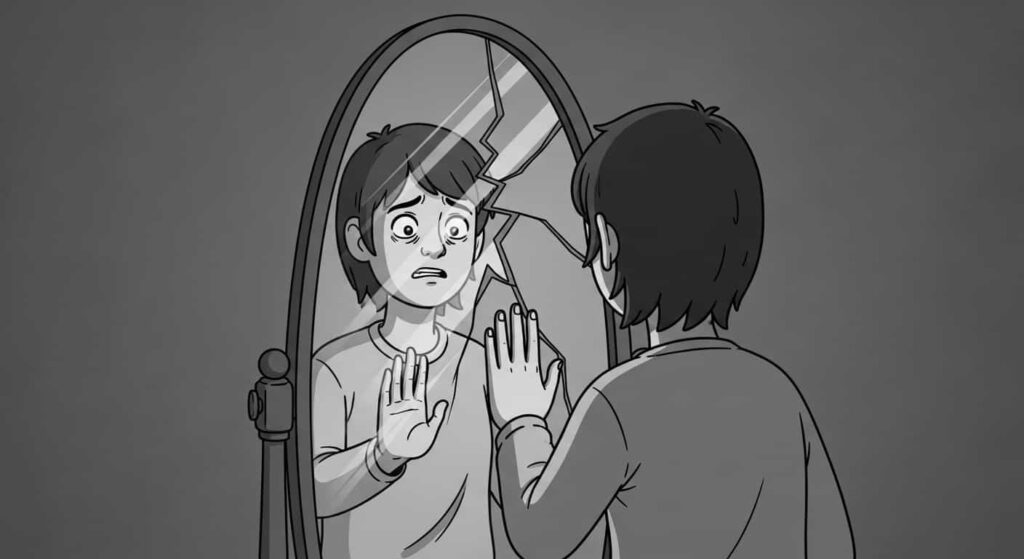
3. Vanity vs. Presence If you are using the mirror to admire your physical appearance or critique your flaws, you are not doing mirror work. You are doing vanity or self-criticism. The practice is about connecting with the self behind the eyes, not the skin covering the bones.
4. Inconsistency Doing mirror work once when you feel sad and then abandoning it for three months will yield little to no results. Neuroplasticity requires repetition. If you treat it like a quick fix, it will feel like a gimmick.
Mirror Affirmations vs Regular Affirmations — Is There a Difference?
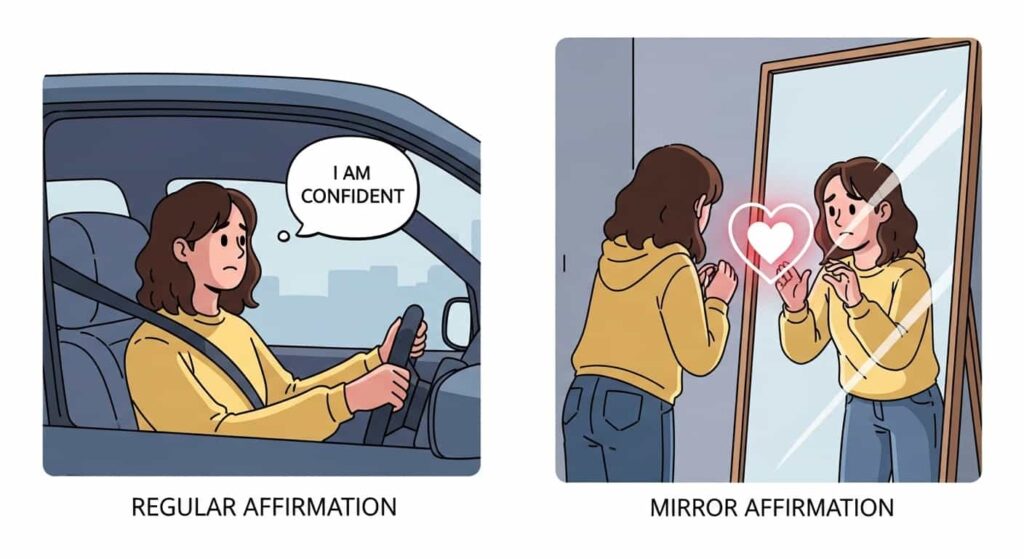
This is the pivotal question. Are mirror affirmations truly superior to simply repeating phrases in your head or out loud while driving?
The short answer is: They are different tools for different depths.
| Aspect | Regular Affirmations | Mirror Affirmations |
|---|---|---|
| Primary Function | Cognitive restructuring | Identity-level transformation |
| Sensory Engagement | Auditory (or internal thought) | Visual + auditory + somatic |
| Best For | Interrupting negative thought loops, quick mindset shifts | Deep-seated self-worth issues, healing childhood wounds, self-disconnection |
| Portability | Can be done anywhere, anytime | Requires a mirror and privacy |
| Emotional Intensity | Generally low to moderate | Can be high; surfaces resistance quickly |
Regular Affirmations are excellent for cognitive restructuring. They are portable. You can use them to interrupt negative thought loops throughout the day. They work on the level of thought.
Mirror Affirmations work on the level of identity. By introducing the visual element of your own face, you are engaging the limbic system (emotions) and the visual cortex simultaneously. This creates a more holistic integration.
Think of it this way: Regular affirmations are like telling a friend you are happy. Mirror affirmations are like looking that friend in the eye and telling them you love them. The message is the same, but the felt experience is entirely different.
For those engaged in a serious mirror affirmations spiritual practice, the difference is akin to praying silently versus praying in a sacred temple. The mirror becomes the altar, and you are the deity being worshipped—and the worshipper.
When to Use Which
- Use regular affirmations: When you need a quick mindset shift, during meditation, or while journaling.
- Use mirror affirmations: When you are working on deep-seated self-worth issues, healing childhood wounds (as Louise Hay emphasized), or when you feel disconnected from yourself.
Conclusion: The Truth About Mirror Work
So, is mirror affirmations a powerful spiritual practice or self-deception?
The truth is that it can be either, depending entirely on the intention behind it.
If you use mirror work to pretend you are something you are not—to bypass pain, to ignore reality, or to force positivity—then yes, it is self-deception. You are simply adding a layer of denial on top of existing wounds.
However, if you approach the practice with humility, consistency, and a willingness to meet yourself exactly where you are—flaws, fears, and all—then mirror affirmations are one of the most potent spiritual tools available.
The research supports the idea that compassionate self–eye contact regulates the nervous system and improves self-image. The spiritual traditions support the idea that recognizing oneself in the reflection is the first step toward enlightenment. And the legacy of Louise Hay proves that for millions of people, looking in the mirror and choosing love changed their lives.
Ultimately, the mirror does not lie. It shows you your resistance and your capacity for love simultaneously. The practice of mirror affirmations is not about convincing yourself of a reality that doesn’t exist. It is about aligning your internal reality—your self-perception, your worthiness, your love—with the truth that has been there all along.
When you can look into your own eyes and truly mean the words you speak, you are no longer practicing self-deception. You are practicing self-realization. And that is a spiritual practice worth committing to.
Frequently Asked Questions (FAQ)
How long does it take for mirror affirmations to work?
Most practitioners and experts, including Louise Hay, suggest a 21-day commitment to see noticeable shifts in self-perception. However, emotional releases (like crying or laughing) can happen immediately during the first session.
Can I do mirror affirmations if I hate my appearance?
Yes, but with caution. If you struggle with body dysmorphic disorder or severe self-hatred, it is often helpful to start by looking at a specific feature you are neutral about (like your hands or your eyes only) rather than your full face, or to work with a therapist alongside the practice. The graded exposure techniques mentioned earlier (unfocusing your eyes, focusing on the mouth) can also help.
Do I have to say affirmations out loud?
While whispering or mouthing the words can be effective, speaking out loud is generally recommended. The vibration of your voice and the auditory feedback add another sensory layer to the practice, strengthening the neural imprint.
What if I laugh or cry during the practice?
Both are perfectly normal. Laughter is often a defense mechanism against vulnerability, while crying is a release of stored emotional pain. Allow both to happen without judgment. Simply continue breathing and return to the affirmation when you are ready.
Can mirror work be dangerous?
For most people, no. However, for individuals with a history of trauma, PTSD, or body dysmorphic disorder, the practice can sometimes trigger distress. If you have concerns, consult a qualified mental health professional before beginning. You can also try the modified techniques mentioned in this article, such as focusing on your mouth or using a candle, to reduce intensity.
Do I need a special mirror?
No. A standard mirror where you can see your eyes clearly is sufficient. Some practitioners prefer a mirror they can stand or sit comfortably in front of without straining. The tool itself matters less than your presence and intention.