
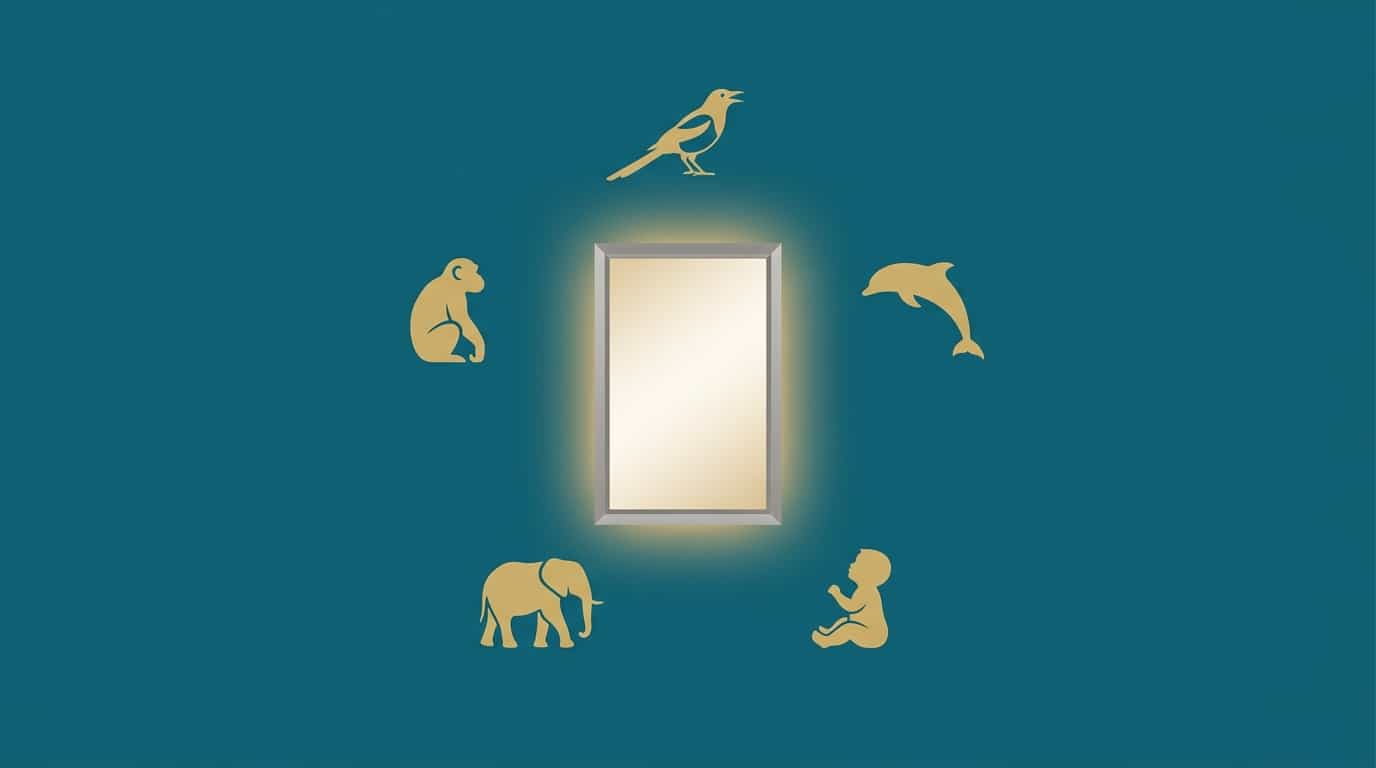
When we gaze into a mirror, we rarely question what we are seeing. We fix our hair, check our teeth, or offer ourselves a reassuring smile before a big meeting. But that simple act of recognition—knowing that the reflection staring back is you—is a cognitive feat so complex that for centuries, philosophers and scientists have used it as a benchmark for consciousness.
What does it mean to know oneself? Is it merely a biological function of a developed brain, or does it hint at something deeper, something we might call a soul? The intersection of developmental psychology, animal cognition, and existential philosophy reveals a fascinating landscape where science and spirituality converge.
In this article, we will explore the science behind the mirror test, the animals who pass it, the moment an infant discovers “me,” and what various spiritual traditions—from mysticism to indigenous wisdom—believe about the significance of self-recognition.
What Is the Mirror Test?
The mirror test, formally known as the “mirror self-recognition test” (MSR), was pioneered by psychologist Gordon Gallup Jr. in 1970. At its core, the test is deceptively simple. A researcher places a mark—often a non-toxic dye or a sticker—on a subject’s body in a spot that can only be seen with the aid of a mirror. If the subject, upon seeing their reflection, touches the mark on their own body rather than the mirror, they are considered to have passed.
This behavior indicates that the subject understands that the reflection is not another individual, but a representation of themselves. It is a hallmark of physical self-awareness.
For decades, the mirror test has been the gold standard for measuring self-awareness in non-human animals. However, it is not without its critics. Some argue that the test relies heavily on visual cues, potentially penalizing species whose primary senses are smell or sound. Others suggest that self-awareness exists on a spectrum, and the mirror test is merely one way to measure a single facet of it.
Despite these limitations, the implications of the test are profound. It forces us to ask: Who has a “self”? And what does it mean to possess one?
Which Animals Pass the Mirror Test?
The list of animals who pass the mirror test is surprisingly exclusive. For a long time, it was believed that only humans and great apes possessed the capacity for self-recognition. However, as research methods have refined, a handful of other species have joined the ranks, challenging the anthropocentric view of consciousness.
Great Apes
Chimpanzees, bonobos, orangutans, and gorillas have been extensively studied. Chimpanzees and orangutans are the undisputed champions of the mirror test. They respond to the mark test with curiosity, often using the mirror to inspect their teeth, ears, and other parts of their bodies they have never seen before. Gorillas have historically shown mixed results; many researchers believe this is due to cultural factors—they often avoid direct eye contact as a sign of aggression—rather than a lack of self-awareness.
Dolphins and Orcas
Marine mammals like bottlenose dolphins pass the mirror test convincingly. However, since they lack limbs to touch a mark, researchers used a different method. They marked the dolphin’s body with ink and observed the dolphin twisting and turning in the water to examine the marked area in the mirror. Dolphins also display “contingency testing”—making exaggerated movements to see if the reflection mimics them perfectly.
Elephants
In 2006, a landmark study showed that Asian elephants pass the mirror test. Happy, a female elephant at the Bronx Zoo, was observed repeatedly touching a white “X” painted on her head after seeing it in a massive, elephant-proof mirror. Some researchers cautioned that Happy might have simply been using the mirror as a tool to inspect a physical sensation rather than demonstrating a conceptual understanding of “self.” Regardless, the study opened new doors in understanding pachyderm cognition. Elephants are highly social and empathetic creatures, and their ability to self-recognize aligns with their reputation for complex mourning rituals and altruism.
Magpies
Perhaps the most surprising addition to the list is the Eurasian magpie. Birds do not have a neocortex, the part of the brain long thought to be necessary for self-awareness. Yet, when researchers placed a colored sticker on the magpie’s feathers, the birds scratched at it until it was removed. This suggests that self-awareness may have evolved independently in different lineages—a concept known as convergent evolution—implying that consciousness might be a fundamental property of complex nervous systems, not just mammalian brains.
What It Means
The fact that such diverse creatures—primates, cetaceans, pachyderms, and corvids—all share this capacity suggests that self-awareness is a useful evolutionary tool. It allows for complex social manipulation, cooperation, and empathy. For these animals, knowing “I am separate from you” is crucial for survival in complex social groups.
| Species | Mirror Test Result | Significance |
|---|---|---|
| Chimpanzees & Orangutans | Pass | Use mirror to inspect hidden body parts; clear self-directed behavior |
| Gorillas | Mixed | Likely cultural factors (eye contact avoidance) rather than lack of awareness |
| Dolphins & Orcas | Pass | Contingency testing; twist to view marks in water |
| Asian Elephants | Pass | Touch marks on own body; though some debate remains |
| Eurasian Magpies | Pass | First bird species to pass; suggests convergent evolution |
| Dogs & Cats | Fail | Rely on scent rather than vision; may have other forms of self-awareness |
When Human Infants Recognize Themselves — Developmental Milestone
For human beings, the journey to self-awareness is a developmental rite of passage. While adults take mirror recognition for granted, it is a skill that takes time to emerge.
Around 18 to 24 months of age, a human infant will begin to pass the mirror test. Before this stage, a baby may smile at the “other baby” in the mirror or try to reach behind the glass to touch them. This behavior is categorized as “pre-self-awareness.”
The moment a toddler touches the rouge on their own nose—rather than the mirror—marks a cognitive leap. It coincides with:
- The development of language
- The use of personal pronouns like “me” and “mine”
- The emergence of complex emotions like embarrassment, shame, and pride
This milestone is a cornerstone of what psychologists call the “social self.” Once a child knows they are a distinct entity, they begin to understand that others are also distinct entities with their own thoughts and feelings—a skill known as Theory of Mind.
The mirror test in infants is not just about vanity; it is the foundation of empathy. Without the knowledge of self, there can be no true understanding of another’s suffering.
What the Mirror Test Reveals About Consciousness
The mirror test forces a refinement of the definition of consciousness. It highlights a distinction between two types of awareness:
- Primary Consciousness: This is a basic awareness of the world. A dog chasing a ball has primary consciousness—it sees the ball, feels the grass, and wants to catch it.
- Self-Consciousness: This is the ability to reflect on oneself as an entity. A dolphin inspecting a mark on its body in a mirror is demonstrating that it is not just aware of the world, but aware of its place in the world.
In the scientific realm, passing the test indicates that a being possesses a sense of identity that persists over time. In the spiritual realm, this persistence of identity is often linked to the concept of the eternal self, or the soul.
However, scientists are quick to point out that failing the mirror test does not mean an animal lacks consciousness. Many highly intelligent animals, such as dogs and cats, consistently fail the mirror test because they rely on scent rather than sight. Similarly, some humans with specific cognitive conditions may fail the test while retaining a rich inner life.
Spiritual Interpretations of Mirror Self-Recognition
Across history, the mirror has been a powerful spiritual symbol. In mythology, mirrors are portals to other worlds, tools for divination, and symbols of truth. When we apply spiritual thinking to the mirror test, we move beyond biology and ask: What does it mean to see yourself?
Many spiritual traditions view the act of self-recognition as the beginning of the spiritual journey. In mysticism, the “self” you see in the mirror is often an illusion—the ego. The work of spirituality is to see beyond the reflection to the true Self, or the soul.
Does Passing the Mirror Test Indicate a Soul?
This question is one of the most contentious intersections of science and religion. If a chimpanzee or an elephant possesses self-awareness—if they can recognize their own body and likely have a sense of their own history—does that imply they possess a soul?
In many Western religious traditions, the “soul” was historically considered a uniquely human gift. However, as scientific evidence mounts, theological perspectives are evolving.
This remains a point of significant tension. While a Hindu philosopher might see the dolphin’s self-recognition as evidence of Atman, a strict Cartesian dualist might argue that self-awareness is merely a sophisticated biological program, distinct from an immortal soul. The mirror test, in this view, measures cognition, not divinity.
- Eastern Perspectives: In Hinduism and Buddhism, the concept of Atman (soul/self) is not exclusive to humans. All sentient beings possess a spark of the divine, though they are trapped in cycles of rebirth. A dolphin passing the mirror test would not surprise a Hindu philosopher; it would simply affirm that the dolphin is a sentient being worthy of compassion.
- Modern Spirituality: Many contemporary spiritual thinkers argue that the mirror test doesn’t prove a soul, but it does indicate the presence of a being capable of relationship with the Divine. If self-awareness is required to experience love, suffering, and joy, then those who pass the mirror test—human or non-human—deserve moral and spiritual consideration.
Indigenous Beliefs About Animals & Reflective Recognition
Indigenous cultures around the world have long held beliefs that align surprisingly well with the findings of the mirror test—though they arrived at these conclusions through observation and spiritual connection rather than laboratory science.
For many Indigenous peoples, animals are not soulless automatons but “non-human persons.” They possess spirits, intelligence, and the ability to make choices.
- Totemism: In many Native American and Aboriginal Australian traditions, animals are seen as ancestors or guides. The idea that a magpie or an elephant possesses self-awareness would not be a revelation; it would be a confirmation of oral traditions that have existed for millennia.
- Animism: The belief that a spirit or soul exists in all things—animals, plants, rivers, and stones—is central to animistic traditions. From this perspective, the mirror test is a “colonial” way of proving something that was never in doubt. The ability to recognize oneself is seen as a given for all sentient life; the test merely reveals the bias of those who assumed it was exclusive to humans.
These traditions often caution against the arrogance of the mirror. When we look into the reflection, if we only see our own ego—our own human superiority—we miss the point. True spiritual self-awareness, in many Indigenous traditions, involves recognizing not just yourself in the reflection, but your relation to everything around you.
“The mirror is not meant for admiring the self. It is meant for seeing through the self.” — Indigenous teaching wisdom
What Happens When Humans With Certain Conditions Can’t Recognize Themselves?
If self-recognition is a hallmark of human development, what does it mean when it is absent? There are several conditions where individuals fail to recognize themselves in the mirror, and studying these cases offers a sobering counterpoint to the spiritual idea of the “soul.”
Alzheimer’s Disease and Dementia
In the advanced stages of dementia, a patient may not recognize their own reflection. They may scream at the “stranger” in the house, try to fight the mirror image, or ask who the person is looking back at them. This is not merely a failure of eyesight; it is a dissolution of the narrative self. The autobiographical memory—the story of “who I am”—has eroded.
From a spiritual perspective, this poses profound questions. If the soul is the eternal “I,” does dementia diminish the soul? Most spiritual traditions argue it does not. In many beliefs, the soul is separate from the ego or the memory. The inability to recognize one’s face is seen as a stripping away of the ego, leaving behind a purer state of being. For caregivers, this is often described as a lesson in unconditional love—loving the being even when they no longer know themselves.
Autism Spectrum Disorder (ASD)
The relationship between autism and the mirror test is complex. Some individuals with autism fail the mirror test as toddlers, not necessarily due to a lack of self-awareness, but due to differences in social motivation and sensory processing. They may see the mark but not care to touch it because they do not feel the social pressure to look “clean.”
Some autistic individuals describe their relationship with their reflection as a different kind of awareness—one that may be less focused on social conformity and more on sensory experience or internal selfhood. This serves as a crucial reminder that the mirror test measures a specific, socially-cued type of self-awareness, not the richness of one’s inner world. Spiritually, this suggests that the soul’s awareness may manifest differently in different bodies. A lack of mirror recognition does not equal a lack of soul; rather, it signifies a different way of being in the world.
Psychopathy and the “Self”
Interestingly, psychopaths pass the mirror test easily—they know exactly who they are in the reflection. However, they often lack the empathy that typically accompanies self-awareness. This reveals a crucial spiritual truth: recognizing the self is not the same as transcending the self.
The goal of spiritual traditions is rarely just to recognize the self (the ego), but to realize the interconnectedness of all selves. A psychopath sees themselves in the mirror but cannot feel the suffering of others. A mystic sees themselves in the mirror and sees the reflection of God in every other face. Recognizing the self in the mirror is an act of the ego, but true spiritual awareness is the recognition of the inseparability of all selves.
Beyond the Reflection
We have seen that the ability to recognize oneself in a mirror is a rare and precious cognitive skill, shared by a handful of animals—apes, dolphins, elephants, and magpies—and emerging in human infants around the age of two. It marks a pivotal moment in consciousness, the birth of the “I.”
But if we stop there, we miss the deeper message. Spiritual traditions—whether Eastern mysticism, Indigenous animism, or contemplative Christianity—invite us to go further. They remind us that while the ego recognizes the face in the glass, the soul recognizes the light behind the face.
Perhaps the true spiritual meaning of the mirror test is this: Self-awareness is a gift, but it is only the first step. The real test is what we do with that awareness. Do we use it to separate ourselves from others, to hoard resources, and to build walls? Or do we use it to empathize with the dolphin, respect the elephant, and care for the elderly person who no longer remembers their name?
When we look in the mirror, we are not just looking at a body. We are looking at a being capable of choice, of love, and of connection. Whether you call that a soul, a spirit, or simply consciousness, it is the most sacred thing in the universe.
So the next time you glance in the mirror, pause for a moment. Don’t just fix your hair. Recognize the self that is looking back—and then recognize that same self in the eyes of everyone else you meet. That is the ultimate mirror test. And it is one we are all capable of passing.