
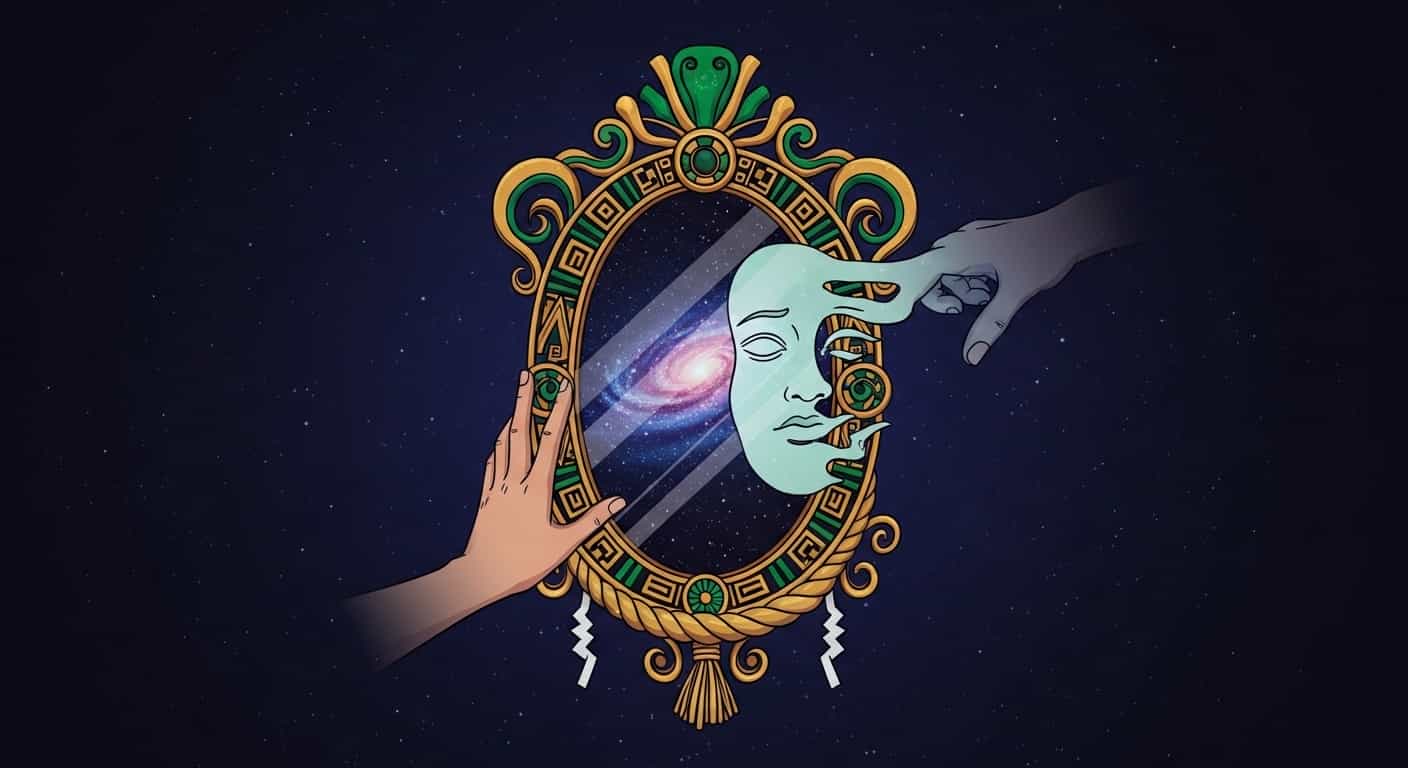
From the polished obsidian of ancient Anatolia to the sacred bronze of Shinto shrines, humanity has always been captivated by reflection. We are the only species that can recognize ourselves in a mirror, and for millennia, that ability has felt less like biology and more like magic. Across the globe, the mirror has never been merely a tool for grooming; it has served as a divine portal, a tool for deception, a shield against evil, and a metaphor for the soul.
In this deep dive into mirror symbolism in different cultures, we will explore how ancient Egyptians, Chinese philosophers, Islamic mystics, and Indigenous shamans interpreted the reflective surface. Despite vast geographical distances, a surprising consensus emerges: the mirror is a threshold. It is the boundary between the seen and the unseen, the self and the spirit, the mortal and the divine.
Why Mirror Symbolism Matters Spiritually
Before traversing the globe, it is essential to understand why the mirror holds such primal spiritual weight. Unlike a painting or a sculpture, a mirror does not merely represent reality; it duplicates it. For spiritual traditions, this duplication presented a profound theological problem: if the physical world is a reflection of a higher truth, then the mirror becomes a tool for accessing that truth.
Spiritually, mirrors are associated with truth, illusion, and consciousness. In many traditions, the ability to look into a mirror without flinching is equated with the ability to face one’s own soul. However, this power is inherently dualistic. Because a mirror shows what is, it can be used for honest self-reflection (catharsis). But because it shows a world that is reversed and intangible, it can also be a source of vanity, entrapment, and confusion—a gateway for spirits to cross over.
Across shamanic traditions, it is believed that mirrors can “steal” souls or, conversely, capture evil spirits before they can enter a home. This duality makes mirror symbolism one of the most complex and consistently preserved symbols in human history.
Ancient Civilizations & the Sacred Mirror
The earliest mirrors were not glass but highly polished stones—obsidian, copper, and bronze. In the ancient world, these objects were rare, expensive, and considered imbued with supernatural properties. They were the possessions of royalty, priests, and oracles.
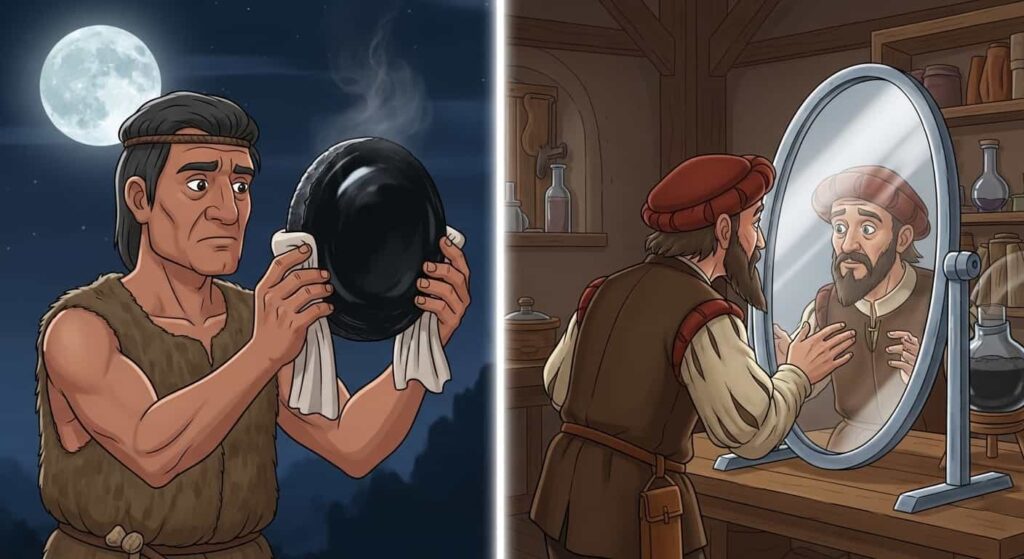
It is worth noting a crucial historical shift: when we speak of mirrors in antiquity, we are speaking of polished metal, which gave a dim, imperfect reflection compared to modern glass. When glass-backed silver mirrors emerged in the late medieval and Renaissance periods, they were considered a new, more perfect technology, which only intensified the existing magical associations. The symbolism often carried over, but the material itself carried its own weight of wonder.
Egypt — Mirrors as Windows to the Soul
In ancient Egypt, the mirror was far more than a cosmetic accessory. Typically made of polished bronze or copper with a handle carved in the shape of a papyrus stem or the goddess Hathor, the mirror was a symbol of the sun and the cycle of life.
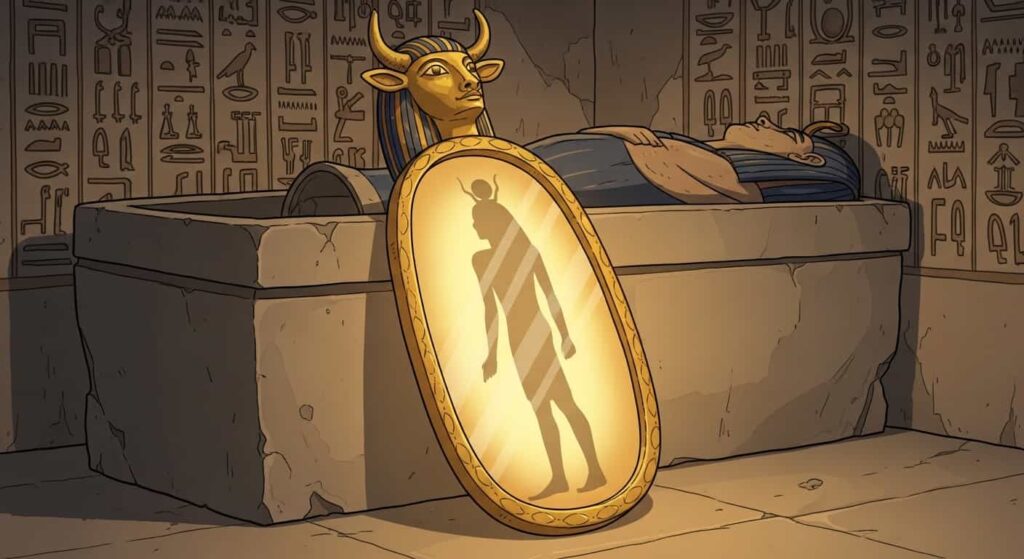
For the Egyptians, the mirror represented the breath of life and the promise of resurrection. Hathor, the goddess of love, beauty, and motherhood, was often referred to as the “Lady of the Mirror.” Mirrors were placed in tombs alongside the dead, not for vanity, but as a magical tool to allow the deceased’s ka (spirit) to regenerate itself in the afterlife.
Furthermore, the reflective surface was seen as a “window to the soul.” To gaze into a mirror was to confront the truth of one’s heart. In the Book of the Dead, the deceased must pass the judgment of Osiris, where the heart is weighed against the feather of Ma’at (truth). In this context, the mirror served as a pre-judgment tool—a way to ensure that one’s reflection matched the purity of the inner self.
The Egyptian mirror was not merely an object of beauty but a vessel of resurrection, allowing the spirit to recognize itself in the afterlife.
Mesopotamia — Divination & Reflective Bowls
While the Egyptians focused on the afterlife, the civilizations of Mesopotamia (Sumer, Akkad, Babylon) viewed reflective surfaces through the lens of magic and divination. The practice of catoptromancy (divination by mirrors) is believed to have originated here.
Priests and seers would use bowls filled with water, oil, or polished metal to “scry”—to gaze into the depths to receive visions of the future or to locate lost objects. These reflective surfaces were considered liminal spaces. The Mesopotamians believed that the boundary between the human world and the world of demons was thin, and a reflective surface could be a doorway.
Interestingly, they also used mirrors for protection. “Demon bowls” or “incantation bowls” were buried under homes with writing spiraling inward. The reflective interior was meant to trap evil spirits, confusing them so they could see only themselves and could not escape to harm the inhabitants. This protective function of the mirror is a thread that runs consistently through later cultures.
Greece — Truth, Vanity & Self-Knowledge
In ancient Greece, the mirror became a philosophical paradox. The Greeks were fascinated by the concept of mimesis (imitation). The myth of Narcissus—who fell in love with his own reflection in a pool of water and wasted away—served as a warning against vanity (hubris) and the dangers of mistaking reflection for reality.

However, the mirror also had a sacred function. The most famous oracle in the world, the Oracle at Delphi, was said to utilize a reflective surface. According to Plutarch, the Pythia (priestess) would gaze into a sacred bowl of water—or, in some interpretations, a polished surface—to receive visions from Apollo. Here, the mirror was not a symbol of self-absorption, but of self-knowledge. The Delphic maxim “Know Thyself” (Gnothi seauton) was inscribed at the temple. To the Greeks, knowing oneself required the brutal honesty of the mirror.
Furthermore, the mirror was associated with Hephaestus (Vulcan), the god of the forge. The blacksmith’s art produced the polished bronze mirrors, linking the symbol to creation, transformation, and the fire of the divine craftsman.
Eastern Mirror Symbolism
Moving eastward, the symbolism of the mirror shifts slightly from self-knowledge to cosmic order and emptiness. In Eastern traditions, the mirror is often “empty”—it reflects everything but holds nothing, making it the perfect metaphor for the enlightened mind.
China — The Feng Shui Mirror & Protection
In Chinese culture, the mirror is a potent symbol of protection, truth, and the warding off of evil, particularly within the framework of Feng Shui and Taoism.
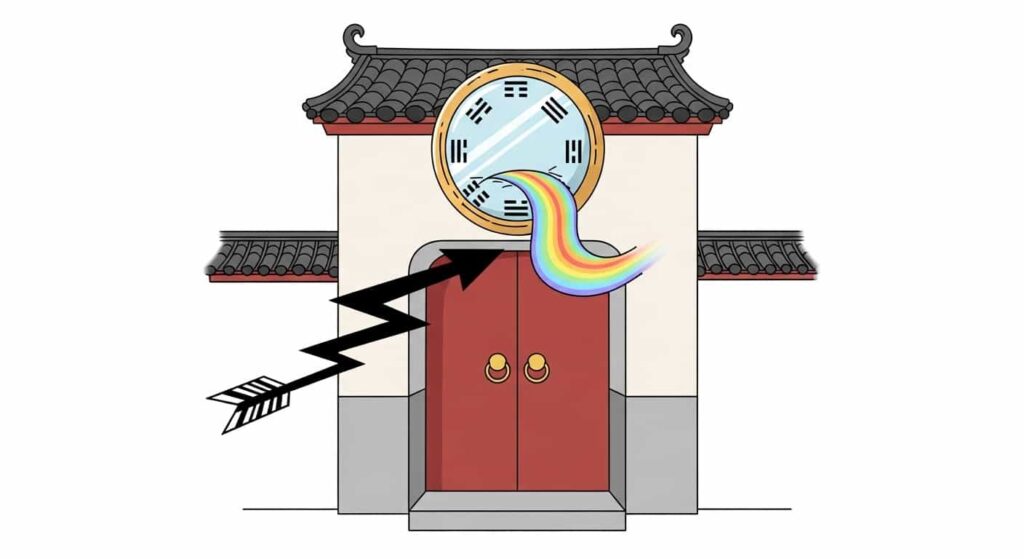
The Bagua mirror is one of the most recognizable talismans in the world. It is an octagonal mirror (often concave or convex) surrounded by the eight trigrams. Unlike a standard mirror, the Bagua is not meant for self-reflection; it is meant to be hung outside a home or business to deflect Sha Chi (negative energy or “killing breath”).
The shape determines the function:
- Convex Bagua Mirrors: Scatter negative energy. Used when a home faces a sharp corner, a cemetery, or a “poison arrow” of energy.
- Concave Bagua Mirrors: Absorb negative energy.
- Flat Mirrors: Rarely used in exterior Feng Shui, as they can bounce energy back and forth.
Beyond Feng Shui, Taoist mythology holds that mirrors reveal the true form of demons. In the Journey to the West, the deity Erlang Shen uses a magical mirror to expose the true identity of the Monkey King. The mirror, in this context, represents the ultimate truth that cannot be deceived by illusions or shapeshifting.
Japan — Yata no Kagami (The Sacred Mirror)
Perhaps no other culture elevates the mirror to such a high status as Japan. The Yata no Kagami (The Eight Span Mirror) is one of the three Imperial Regalia of Japan, alongside the sword Kusanagi and the jewel Yasakani no magatama. These items are the symbols of the Japanese emperor’s divine authority and legitimacy.
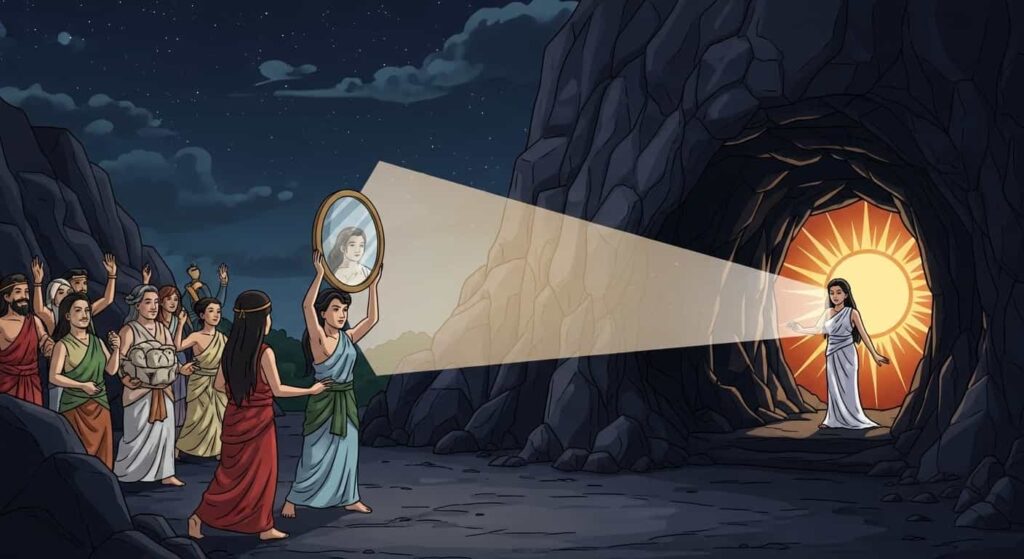
According to Shinto mythology, when the sun goddess Amaterasu retreated into a cave, plunging the world into darkness, the other gods created the Yata no Kagami to lure her out. Fascinated by her own reflection, she emerged, bringing light back to the world.
Because of this origin story, the mirror in Shinto is not merely a reflective object; it is a representation of Amaterasu herself and a symbol of wisdom, honesty, and the divine conscience. In Shinto shrines, the shintai (sacred object housing the kami or spirit) is often a mirror. Worshippers do not pray to the mirror; rather, the mirror represents the clarity of their own heart. The act of seeing oneself in the mirror is supposed to inspire moral purity and introspection.
India — Mirrors in Temple Ritual & Vastu
In Indian culture, mirrors are deeply integrated into both religious ritual and the architectural science of Vastu Shastra.
In Hinduism, mirrors are often used in aarti (rituals of light). A mirror may be used to reflect the flame of the lamp back toward the deity, symbolizing the reciprocal relationship between the worshipper and the divine—the reflection of the divine light within the human soul. This connects to the concept of darshan: the auspicious sight of the deity. The mirror facilitates a mutual gaze, allowing the divine to behold the devotee as the devotee beholds the divine.
Mirrors are also prevalent in temple architecture, particularly in the Sheesh Mahals (Palaces of Mirrors) found in Rajasthan. These intricate mosaic mirrors are not purely decorative. In Vastu Shastra, mirrors are considered to multiply energy. If placed correctly (usually north or east walls), they attract prosperity and abundance by doubling the positive energy entering the space.
However, Indian traditions also come with strong superstitions about mirrors. It is considered inauspicious to look into a broken mirror, as it is believed to fracture the soul. Similarly, mirrors in the bedroom are often covered at night, as it is believed that the soul can become trapped in the reflective surface during sleep, leading to nightmares or astral projection.
Western & Abrahamic Religious Mirror Symbolism
In the Abrahamic traditions—Judaism, Christianity, and Islam—the mirror takes on a more metaphorical role, often bridging the gap between humanity and the incomprehensible nature of God.
The Biblical Mirror — James 1:23 & Corinthians
The Bible makes fascinating use of mirror symbolism, though it must be understood in context: the mirrors of the ancient Near East were polished metal, which gave a dim, imperfect reflection compared to modern glass.
The most famous reference is in 1 Corinthians 13:12: “For now we see through a glass, darkly; but then face to face: now I know in part; but then shall I know even as also I am known.”
Here, the Apostle Paul uses the mirror to symbolize the limited human perception of God. In the present mortal life, our understanding is murky and distorted—like looking into a poor-quality bronze mirror. Only in the afterlife will we see God “face to face” with perfect clarity.
Conversely, in James 1:23-24, the mirror is used as a challenge to integrity. James writes that anyone who hears the word of God but does not act on it is like a man who looks at his face in a mirror, walks away, and immediately forgets what he looks like. In this context, the mirror is the moral law—it shows us our flaws, but it is useless if we do not take action to correct them.
Islamic Sufism — The Polished Heart
In Islamic mysticism (Sufism) , the mirror is one of the most profound metaphors for the spiritual path. The goal of the Sufi is to polish the “heart-mirror” (qalb) until it reflects the Divine Truth.
This concept is rooted in the idea that the human heart is like a mirror that has become rusted by sin and worldly attachment. Through dhikr (remembrance of God) and righteous action, one polishes the rust away. When the heart is perfectly polished, it reflects the attributes of God (Allah) perfectly, just as a mirror reflects the sun.
The Sufi master Ibn Arabi wrote extensively about mirrors. He posited that God created humanity as His mirror. Because God is the “Hidden Treasure” that wished to be known, He created man to reflect His names and attributes. Thus, the human being—particularly the Insan al-Kamil (the Perfect Human) —serves as the mirror through which the Divine contemplates itself.
Kabbalah — Mirrors & the Sefirot
In Jewish mysticism (Kabbalah) , mirrors are associated with prophecy and the structure of the divine emanations.
There is a distinction made between two types of mirrors. The Talmud describes that Moses prophesied through an aspaklaria ha-me’irah (a “luminous mirror”) —a clear, polished lens that gave him a direct and clear vision of God. Other prophets, however, prophesied through an aspaklaria she’eina me’irah (a “non-luminous mirror”) —a cloudy or dim lens, symbolizing the fragmented visions and allegories received by prophets like Ezekiel or Isaiah.
Kabbalists also view the Sefirot themselves as a system of vessels that receive the Infinite Light (Ein Sof) and refract it down through the spiritual realms into the physical world. Studying these emanations is a way of understanding how a perfect, unified God can manifest in a fragmented, imperfect world.
Indigenous & African Mirror Traditions
Outside of the formalized religions of the East and West, indigenous traditions maintained the mirror’s function as a spirit portal, using reflective surfaces to communicate with ancestors, nature, and the divine. This is also where we find some of the oldest and most powerful mirror traditions in the Americas, long predating European contact.
Mesoamerica — Tezcatlipoca & the Smoking Mirror
Long before glass arrived in the Americas, the civilizations of Mesoamerica created mirrors from polished obsidian, pyrite, and hematite. These were not merely decorative; they were objects of immense spiritual and political power.
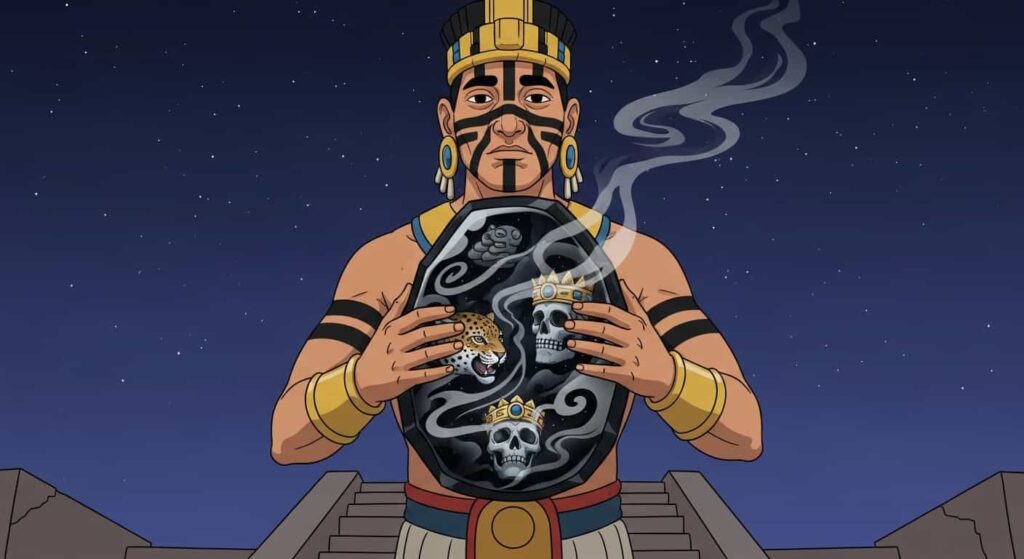
The most profound example is the Aztec god Tezcatlipoca, whose name translates to “Smoking Mirror.” He was one of the most powerful deities in the Aztec pantheon—a god of night, sorcery, destiny, and kingship. His name derived from the obsidian mirrors he was said to wield. These mirrors were used for divination: a priest or seer would gaze into the polished black surface to see the thoughts, deeds, and fates of humanity. To look into the Smoking Mirror was to confront the unknowable and the absolute truth of one’s destiny.
In Inca civilization, polished metal mirrors (made of copper, silver, or a copper-silver alloy) were considered portals to the huaca—sacred realms and objects inhabited by spirits. These mirrors were used in royal rituals and were often buried as offerings to ensure communication with the ancestral and spiritual worlds.
Vodou — The Reflective Spirit
In Haitian Vodou and Louisiana Voodoo, mirrors are ubiquitous on altars and paket kong (spirit packets). The mirror serves as a gateway for the lwa (spirits) . When a practitioner calls a spirit, it is believed the spirit crosses through the reflective surface to enter the physical world.
The most famous depiction of this is in the veve (ritual drawings) associated with the spirit Papa Legba, the gatekeeper. While not always drawn with a mirror, the concept of the threshold is paramount. Mirrors are often placed on graves or in homes to give the ancestors a way to “see” back into the world of the living.
Unlike in some traditions where mirrors are avoided to prevent spiritual kidnapping, in Vodou they are actively used as beacons—tools to attract specific spirits who are drawn to their own reflection, recognizing the power of their own image.
Native American Water-Gazing Traditions
Many Native American tribes utilized natural reflective surfaces, primarily water, for vision quests and divination. While glass mirrors were introduced later by Europeans, the tradition of water-gazing (scrying) is ancient.
In Apache tradition, the Diyin (medicine man) might use a bowl of water or a piece of polished quartz to “see” the location of lost objects, enemies, or the source of a patient’s illness. The reflection of the water represented the subconscious mind—the depths beneath the surface of reality.
Similarly, for many tribes in the Pacific Northwest and the Southwest, reflective surfaces were viewed with caution. It was believed that one’s reflection could capture a fragment of the soul. Elders often advised against staring into water for too long or allowing infants to see their own reflection before a certain age, lest their developing spirits become confused or trapped.
What All These Cultures Agree On
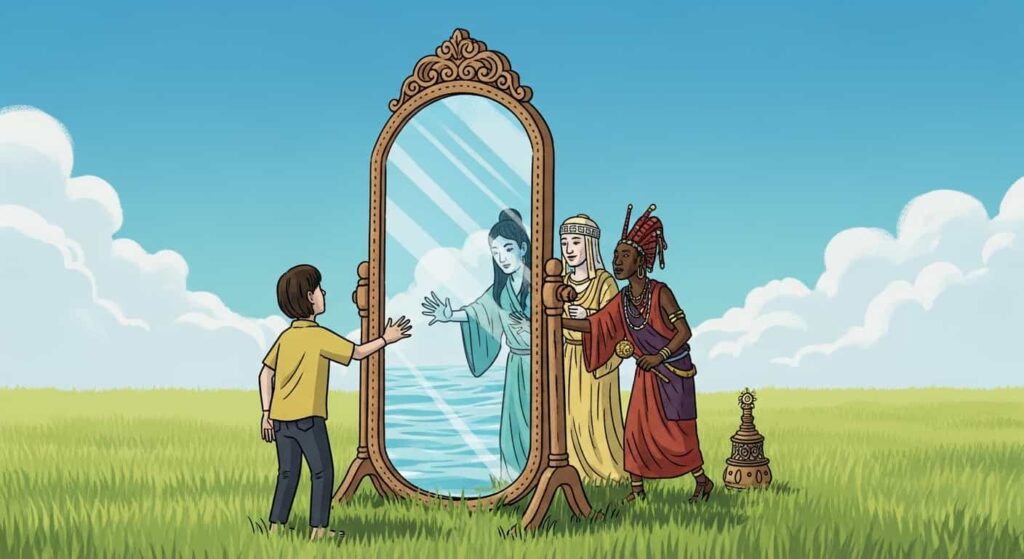
After surveying the globe—from the pyramids of Egypt to the shrines of Ise, from the Bagua mirrors of China to the obsidian mirrors of Tezcatlipoca—a fascinating convergence emerges. Despite having no contact with one another for thousands of years, human civilizations have consistently agreed on several core truths regarding mirror symbolism in different cultures.
| Core Principle | Cultural Expression |
|---|---|
| The Mirror is a Threshold | Japanese Yata no Kagami luring Amaterasu from a cave; Mesopotamian demon bowls trapping evil; Vodou altars using mirrors as spirit gateways. |
| Truth Requires Reflection | Greek “Know Thyself”; Islamic Sufism’s polished heart-mirror; Egyptian “window to the soul.” |
| Vanity is a Trap | The myth of Narcissus; Chinese Feng Shui warnings against mirrors facing the bed; Hindu and Christian cautions against fixation on surface appearance. |
| The Mirror is a Tool, Not an Idol | Taoist Bagua deflecting Sha Chi; Shinto mirrors representing Amaterasu; Aztec obsidian mirrors used for divination, not worshiped themselves. |
1. The Mirror is a Threshold Whether it is the Japanese Yata no Kagami luring the sun goddess from a cave, or the Mesopotamian demon bowl trapping evil, the mirror is universally seen as a membrane between worlds. It is neither fully in the physical realm nor fully in the spiritual. Because of this, it requires respect. Every culture has rules: cover mirrors during death, avoid sleeping in front of them, or use them specifically to ward off negative energy.
2. Truth Requires Reflection From the Greek “Know Thyself” to the Islamic concept of the polished heart-mirror, the mirror is the ultimate symbol of accountability. It does not lie; it shows the face as it is, and the soul as it is. Spiritual growth, in almost every tradition, requires the courage to look into the mirror and confront the “rust” that obscures clarity.
3. Vanity is a Trap The myth of Narcissus resonates across cultures. While the mirror is sacred, becoming fixated on the surface of the reflection is universally condemned. In Chinese Feng Shui, a mirror facing the bed is considered bad luck because it doubles the self in a state of sleep—a state of unconscious vanity and spiritual vulnerability. In Hindu and Christian traditions, excessive focus on physical appearance is seen as a distraction from the inner work that the mirror demands.
4. The Mirror is a Tool, Not an Idol Finally, no major culture worships the mirror itself; they worship through it. Whether it is the Taoist using the Bagua to deflect Sha Chi, the Shinto devotee bowing before the mirror that represents Amaterasu, or the Aztec priest gazing into obsidian to perceive destiny, the mirror is always a conduit. It is a piece of technology for the soul—a tool designed to help humanity navigate the precarious boundary between the material and the divine.
Practical Wisdom: Mirror Placement in Modern Life
While we no longer bury demon bowls beneath our homes, the ancient wisdom surrounding mirrors has survived in cultural traditions and is now finding new relevance in modern wellness practices. Here is a summary of practical guidelines distilled from centuries of global tradition:
- Do NOT place mirrors directly facing the bed. Rooted in: Chinese Feng Shui, Indian Vastu Shastra, and European folk traditions. This is believed to disrupt sleep, create restlessness, or double the self in a state of spiritual vulnerability.
- Do NOT hang mirrors directly opposite the front door. Rooted in: Feng Shui. This can cause positive energy (or opportunities) to bounce back out of the house before it can circulate.
- DO use mirrors to double natural light and prosperity. Rooted in: Vastu Shastra and Feng Shui. Placing mirrors on north or east walls can amplify positive energy, abundance, and the feeling of spaciousness.
- DO cover mirrors during times of mourning or grief. Rooted in: Jewish tradition (sitting shiva), Victorian European customs, and various folk practices across the American South. Covering mirrors prevents the grieving soul from being distracted or, in some beliefs, prevents the spirit of the deceased from becoming trapped in the reflection.
The Broken Mirror: A Unified Superstition
Few superstitions are as globally recognized as the belief that breaking a mirror brings seven years of bad luck. While this was mentioned in passing earlier, its origins deserve attention because they tie together several threads from this article.
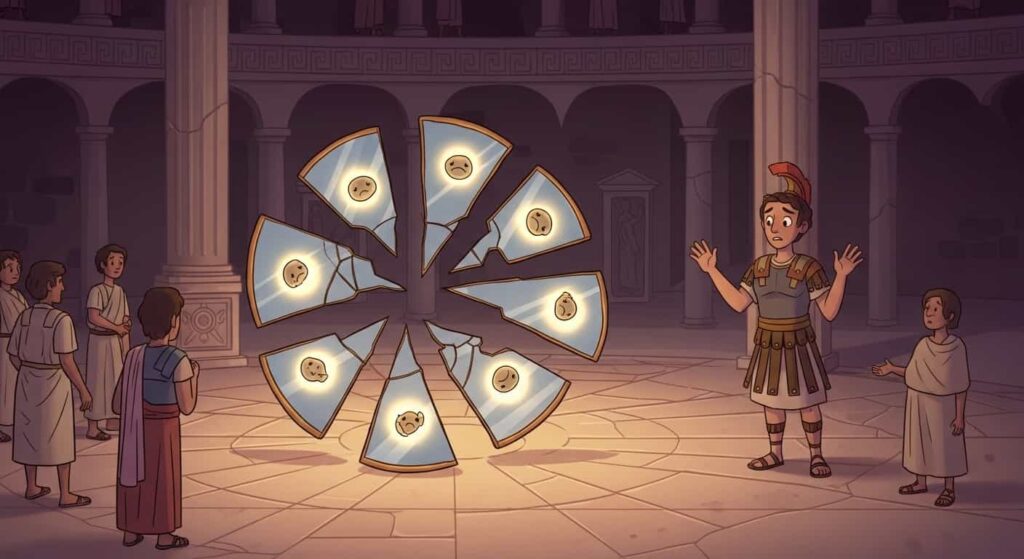
The Romans believed that life renewed itself every seven years and that a mirror held a fragment of the soul of its owner. To break a mirror was not merely to damage an object but to wound the soul and disrupt its cycle of renewal for a full seven-year period. This belief, carried forward through European folklore and into the modern era, demonstrates how an ancient synthesis of soul-theory and numerology continues to shape human behavior thousands of years later.
Conclusion

In our modern world, where mirrors are cheap, mass-produced, and often overlooked, we have lost some of this ancient reverence. Yet, the symbolism remains ingrained in our superstitions (the “seven years bad luck” for breaking a mirror) and our language (reflection as thought). By understanding what every civilization believed, we can reclaim the mirror not just as a tool of vanity but as a sacred instrument of self-discovery, protection, and spiritual clarity.
The mirror waits for no one. It reflects without judgment, duplicates without pride, and reveals without mercy. Whether you see it as a portal, a shield, or a window to the soul, one truth remains across all cultures: when you look into the mirror, you are standing at the threshold of something far greater than your own face.