No Reflection in Mirror Dream: Meaning, Spiritual Readings, and What It Signals
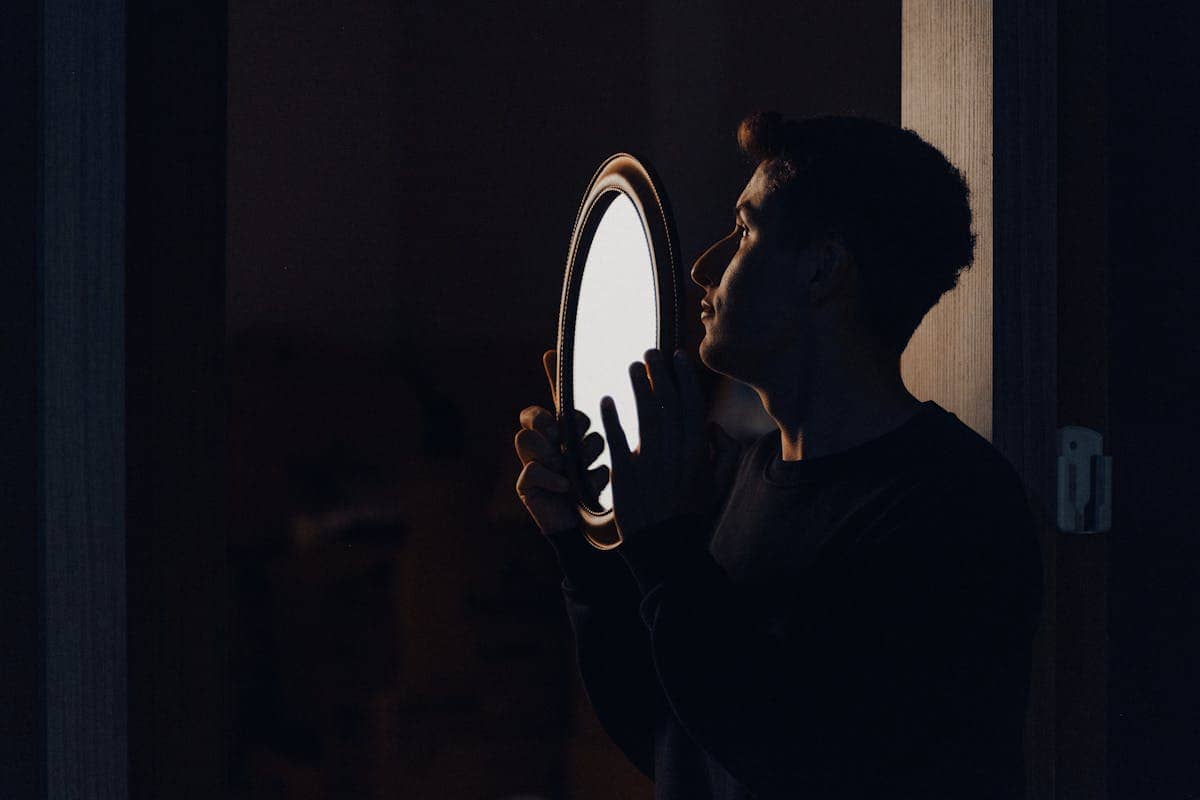
The experience is specific enough that it stays with you: standing in front of a mirror in a dream, waiting to see your own face, and finding nothing looking back. No outline. No shadow. Just the room reflected behind you, as if you were not there.
It is unsettling in a particular way — not like danger, but like a conversation that suddenly has no one on one side. If you woke up looking for the no reflection in mirror meaning, the honest answer is that there is no single fixed one. But the readings from psychology and spiritual traditions converge on a few clear themes, and most of them point toward identity under pressure rather than toward anything you need to fear.
What the Empty Mirror Is Usually Processing
Mirrors in waking life serve as a constant low-level confirmation: you are here, you look like this, the image matches what you expect. When that confirmation disappears in a dream, the mind has staged an absence that carries weight.
Psychologically, what surfaces most often is a disruption in self-perception — the face you have been presenting to the world no longer matches something underneath it, or a role that defined your sense of self has ended and a replacement has not formed. Neither of those is a crisis requiring a name; both are normal features of a life in motion.
What the empty mirror is rarely pointing to: a literal supernatural message, a sign of soul damage, or evidence that something is fundamentally wrong with you. Dreams borrow the most emotionally charged imagery available. A missing reflection is charged. That is why the sleeping mind reaches for it — not because it is true, but because it is vivid.
Eight Readings of a Dream With No Reflection

Read these as lenses, not a diagnostic checklist. Most people find one or two that have obvious electricity in relation to waking life.
1. A role that defined you has dissolved — and the new one has not formed yet
The most common reading. Divorce, a career ending, a child leaving home, a relationship that changed the terms of who you are — any of these can blank the mirror until a new self-image has time to develop. The emptiness is not permanent; it is the gap between identities.
2. The fear that your presence does not register
The dream may be staging a feeling you have been carrying without naming: that you contribute invisibly, that your effort goes unacknowledged, that you could be absent and no one would notice. That is a painful feeling. The dream makes it literal because the mind sometimes speaks bluntly.
3. Distance from whatever usually grounds you
Some spiritual traditions would describe this as disconnection from a higher self or inner life. Psychologically, it can track with burnout or prolonged performance — spending so much time being what other people need that you have lost contact with what you actually think and feel.
4. A performance becoming unsustainable
If you have been wearing a version of yourself for long enough that it started to feel like your real face, the dream may be registering the cost. The mirror that refuses to show a reflection can be the inner life insisting that a constructed identity is not the same as an actual one.
5. A spiritual tradition's positive reading: the self being defended was never the full picture
Several Buddhist and non-dual traditions would read the empty mirror as pointing toward something useful rather than threatening — the constructed self-image is not the whole of what you are. From that frame, no reflection is not a loss; it is a reminder that what you have been identifying with is a representation, not the thing itself.
6. The fear that your life does not leave a mark
On a more primal register, the mirror is one of the objects humans use to confirm existence. An empty glass touches the fear that existence itself is not secured — that dying without significance is possible. That fear is worth facing directly; running from it by dismissing the dream tends to produce the same image again.
7. A direction that conflicts with what matters most to you
If you are making choices that contradict your stated values — compromising on something you said you would not compromise on, or sustaining a situation that requires you to be smaller than you are — a missing reflection can be the mind's compressed version of that conflict. Not a cosmic warning; more like an internal alarm you have already been ignoring.
8. The gap between identities — in transition, not destroyed
A blank mirror can represent a liminal state: between the person you were and the one you are becoming. The emptiness is not absence in the sense of loss; it is absence in the sense of space not yet filled. Some people experience this dream during the most productive transitions of their lives.
Why Some Traditions Say Never Look Into a Mirror in a Dream
The belief that you should never look into a mirror in a dream — that doing so opens something, or shows you something dangerous — appears across traditions that had no contact with each other.
In certain Eastern European and Slavic folk traditions, mirrors in dreams are treated as thresholds. Looking into them risks seeing your "true form," or something that was not meant to be visible. The anxiety is about involuntary revelation — not a supernatural attack, but the exposure of something hidden.
In Western horror mythology, the vampire who casts no reflection became one of the most durable images in the genre. That story seeded a broad cultural association: empty mirror equals something morally or spiritually absent. Looking into a dream mirror and finding nothing is the vampire's condition confirmed in reverse — you feared it might apply to you.
The psychological kernel in the warning is real even if the supernatural frame is not. Mirrors in dreams do force confrontation. Some people are not ready for the image that would appear if they looked closely. The "warning" about looking is often encoding that readiness question — not a rule about the glass, but a question about whether you can handle what reflection reveals right now.
How Jung's Framework Reads the Missing Reflection
Jung's work treats dreams as compensation for what consciousness has been refusing to see. A missing reflection, in that frame, can point toward an identity that has become too rigid to match the actual person — the face the ego presents has grown so managed that the unconscious no longer recognises it as complete.
What that framework asks practically: what aspect of yourself have you most consistently refused to claim? The missing reflection is less a horror image in this reading than an invitation — the glass is waiting for something more honest.
The integration that resolves the dream is not about seeing a more flattering image. It is about showing up with less performance.
Why the Missing Reflection Carries So Much Weight Historically
Here is the piece of context that most mirror dream articles skip entirely.
For most of human history, people could not see their own faces clearly. Still water gave a rough, distorted image — enough to notice a wound or smooth a hair, but not enough to study the face that others saw. Polished copper and bronze improved things but remained imperfect. A clear, accurate reflection of your own face was unavailable to ordinary people until glass-backed mirrors became affordable household objects in the 19th century.
Which means: humans have been a self-aware species for hundreds of thousands of years. We have been a mirror-gazing species for a fraction of that. Everything we now do with mirrors — the morning routine, the self-comparison, the identity confirmation — is historically very new.
The weight that lands when the glass shows nothing in a dream is partly the weight of this: we only recently acquired the ability to see ourselves, and something in the nervous system still treats that reflection as fragile. The absence activates a very old anxiety — not about the glass, but about whether we are visible at all.
What to Do When You Wake
Write down two things: the emotional quality of the absence — did it feel like loss, peace, dread, or something more neutral — and the area of your waking life that is most in motion right now. Nine times out of ten, those two things are connected.
If the dream recurs, the question it is asking has not been answered. That answer is usually not found by analysing the symbol more carefully. It is found by being more honest in one specific waking relationship, decision, or conversation.
If the absence felt peaceful rather than frightening, sit with that before rushing toward a problem-solving frame. Not every empty mirror is a crisis. Sometimes it is the mind pointing at space rather than absence — pointing at the part of you that is not yet defined, which is also the part with the most room.
The reflection in the glass has always been a representation — not the person, but a particular view of them, at a specific moment, in available light. Its absence in a dream does not mean you have ceased to exist. It usually means the representation stopped being accurate before you noticed, and the mind is asking you to catch up.
What you do with that is more interesting than any single interpretation of the image.
Mirror FAQ
What does no reflection in a mirror mean in a dream?
No reflection in a mirror dream most commonly signals disruption in self-perception — a role that defined you has dissolved, a belief about yourself has stopped holding, or a transition is underway that has not yet produced a stable new self-image. It is almost never a literal omen. The emotional tone of the dream matters: if the absence felt peaceful, it tends to track with release or transition; if it felt frightening, it usually maps to something in waking life that the identity has been avoiding.
Why should you never look into a mirror in a dream?
The belief that you should never look into a mirror in a dream comes from several folk and spiritual traditions, not from a single source. In some Eastern European and Slavic traditions, dream-mirrors are treated as thresholds — looking into them risks seeing your "true form" or something that was meant to stay unseen. In certain folk Islamic traditions, mirrors in dreams carry significance as revealing surfaces. In Western horror mythology, the tradition of vampires casting no reflection seeds a general anxiety about what a dream-mirror might show. Psychologically, the warning may encode something real: mirrors in dreams force confrontation, and some people are not ready for what the image represents. The "warning" is usually not about the glass itself — it is about what you might have to acknowledge if you look.
Does the vampire myth connect to dreaming of no reflection?
Yes, in a culturally specific way. The folklore that vampires cast no reflection because they have no soul gave the empty mirror one of its most persistent symbolic readings: absence of reflection as absence of humanity or moral standing. In dreams, this sometimes translates to a fear of being "spiritually drained" or of having lost essential qualities to a person or situation. It is worth naming as cultural context rather than as psychological diagnosis — but naming it clearly can defuse the fear.
Is no reflection in a mirror dream a bad omen?
No, not reliably. While it tends to feel unsettling in the moment, most people experience it during periods of genuine transition rather than during stable periods where everything is fine. The image of a missing reflection is more accurately read as information about internal state than as a prediction about external events. Treat it as a question worth sitting with, not as a verdict already handed down.
What does no reflection in a mirror mean spiritually?
Spiritual readings vary considerably by tradition. Some Buddhist frameworks read the absence of a fixed reflection as pointing toward non-attachment to self-concept — consistent with teachings about the constructed nature of identity. Some Western esoteric traditions treat it as a threshold image, a sign that you are between identities. Some folk traditions treat it as a warning about spiritual disconnection or vulnerability. None of these readings are interchangeable, and none are established physical facts — they are lenses that different traditions bring to the same image.
Why does no reflection in a dream feel frightening?
The fear is partly neurological: mirrors are one of the objects humans use most consistently to confirm existence and identity. When the confirmation does not arrive, the brain registers something wrong in the same way it registers any uncanny mismatch — familiar context, impossible content. The fear is also cultural: decades of vampire folklore, horror films, and superstition around mirrors have primed the association between empty glass and something threatening. Both explanations can be true simultaneously. Neither requires a supernatural source.