Mirror Spiritual Meaning and Symbolism: What Mirrors Represent
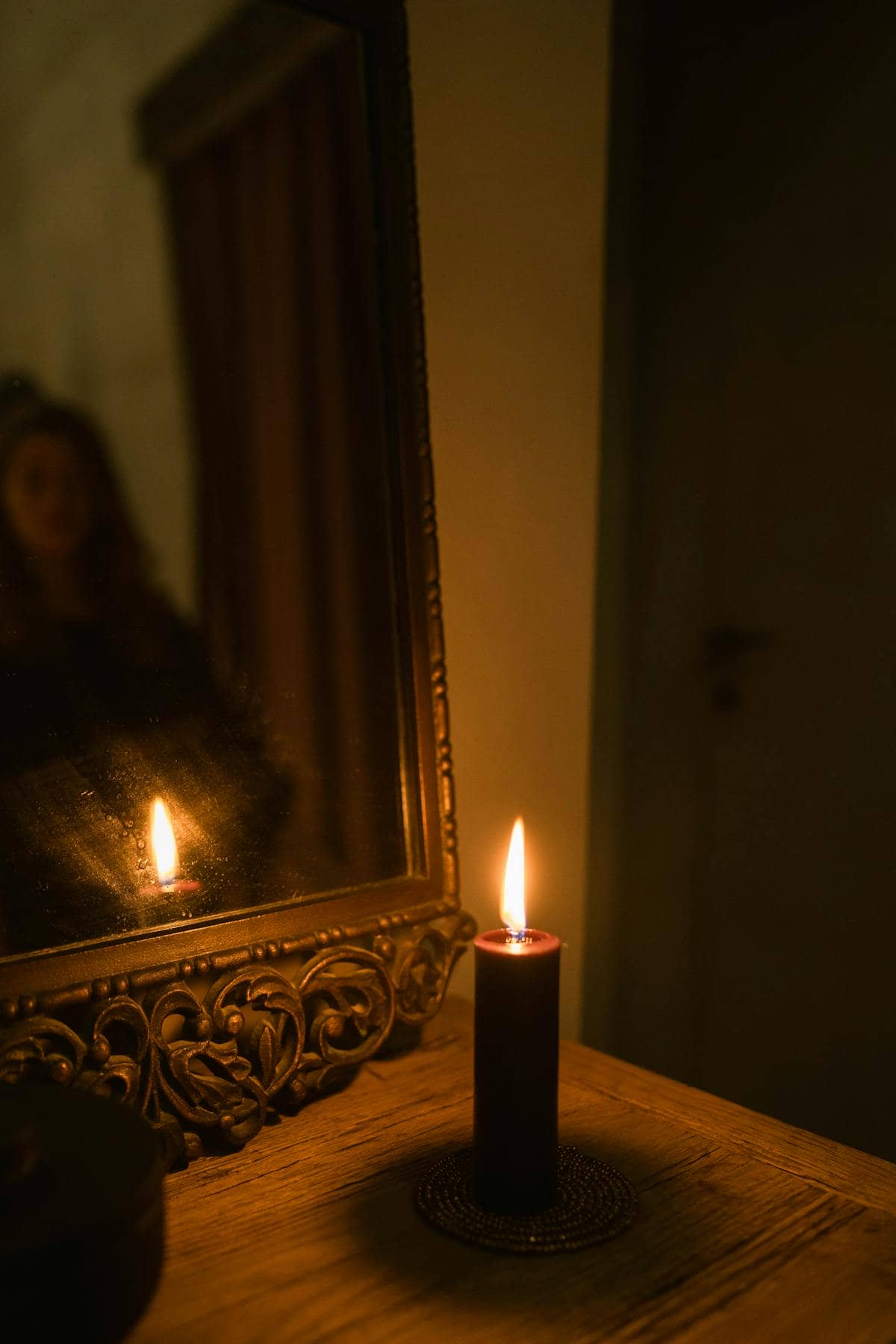
Most people have had the experience at least once: standing in front of a mirror and feeling, briefly, that the question was larger than the reflection. Not "do I look presentable" but something closer to "is this actually who I am?" That moment — small, familiar, usually dismissed before it fully forms — is exactly where mirror symbolism lives.
The symbol appears in places that had no contact with each other. Roman law. Buddhist metaphysics. Sufi poetry. Renaissance painting. Jungian psychology. All of them return to the same object and the same move: looking at a surface as an occasion for looking inward. The details of what each tradition says the mirror reveals vary considerably. The impulse is constant.
What mirrors symbolize — and why the meaning runs so deep
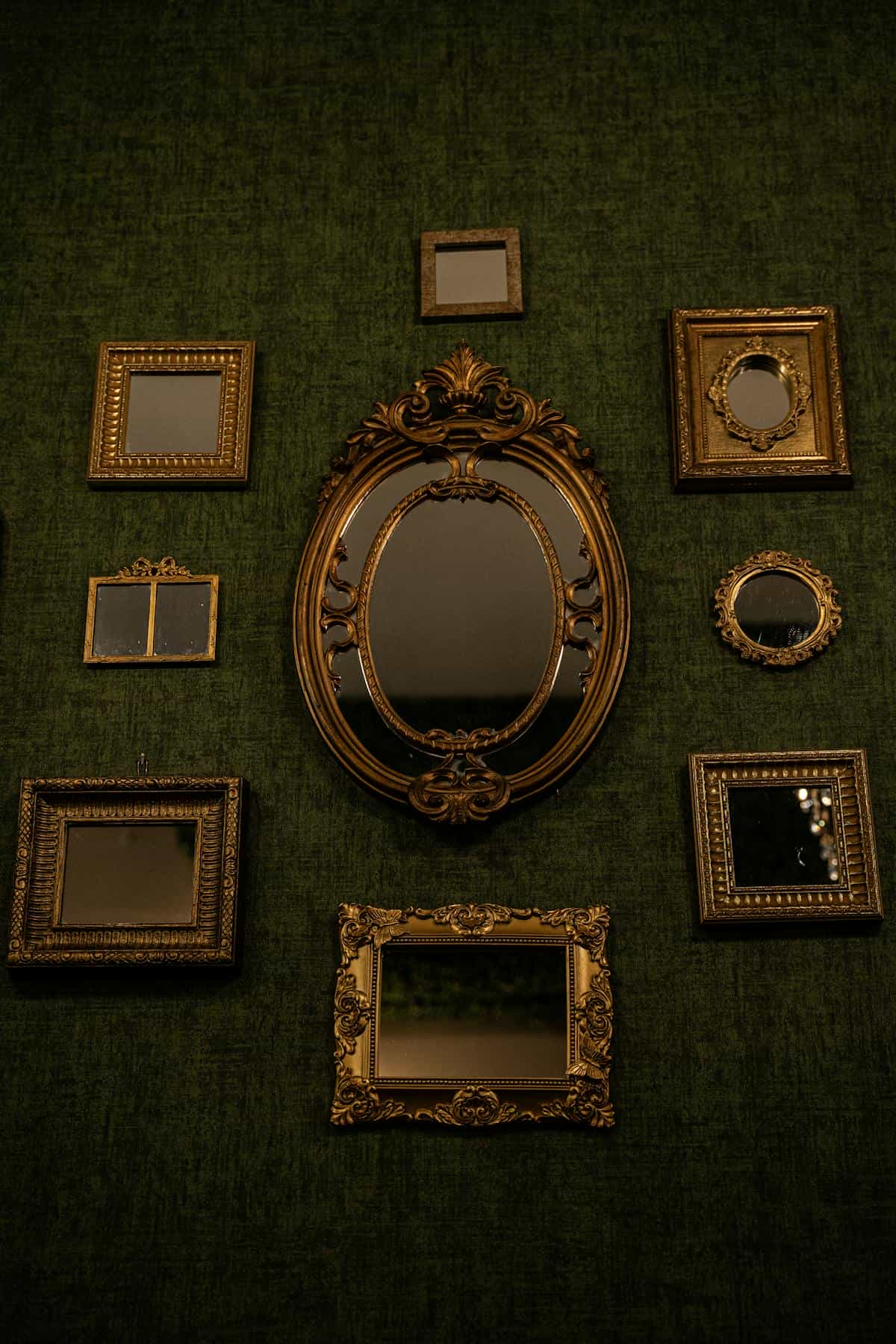
The central symbolic meaning of mirrors, across cultures and centuries, clusters around three ideas that layer on top of each other.
Truth without an audience. A mirror shows what is there regardless of how you would prefer to appear. It does not soften an expression or correct posture on your behalf. Symbolically, that indifference becomes a model for honest self-examination: what do you look like when no one is adjusting their perception to accommodate you? Religious language then maps seeing onto knowing — the same move James makes when he compares forgotten self-knowledge to walking away from your own face without acting on what you saw (James 1:23–25).
Threshold and boundary. Many traditions associate mirrors with the border between what is visible and what is not. A reflection is familiar but reversed, present but untouchable, detailed but somehow not quite real. That quality makes mirrors natural symbols for liminal experience: transitions, the border between conscious thought and whatever lies below it, the line between the living and the dead that folklore encodes in covered-mirror practices.
Partial sight. The part most mirror symbolism articles skip: every mirror shows only part of the picture. One viewpoint, reversed along one axis, in whatever light is available. Spiritually, this is often read as a feature rather than a limitation — the mirror as a reminder that all self-knowledge is incomplete, that what you see is a representation rather than the full person.
What mirrors represent is not identical across traditions, but this three-part structure — truth, threshold, partial sight — appears in some form almost everywhere the symbol turns up.
The spiritual meaning of reflection

"Reflection" is doing double work in most spiritual writing, and that doubling is intentional.
The optical meaning is straightforward: light strikes a surface and returns at the same angle it arrived. The reflective quality of still water, polished metal, or glass makes images visible because photons are organised rather than scattered.
The introspective meaning is what most spiritual traditions are actually discussing when they use mirror language: turning attention back on yourself, examining motivations, looking at patterns of behaviour with something like the impartiality a mirror gives to a face. This is reflection symbolism in its deepest form — not the glass, but the practice the glass represents.
The reason the two meanings coexist so productively is that the optical process is a precise metaphor for the introspective one. Both involve returning something to its source. Both require a surface capable of clarity. Both produce an image that resembles the original without being identical to it. When traditions describe spiritual reflection — the Quaker practice of sitting with what is true, the Buddhist instruction to observe the mind without attachment, the Jewish practice of cheshbon hanefesh (literally, "accounting of the soul") — they are describing the introspective version. The mirror gives the practice a concrete image, but the practice itself is attention, not glass.
"The eyes are the mirror of the soul" — what the phrase actually means

The phrase "the eyes are the mirror of the soul" — sometimes rendered as "the eyes are the window of the soul" — is one of the oldest and most persistent claims about human perception. A version of it appears in Latin attributed to Cicero: Ut imago est animi voltus sic indices oculi — roughly, the face is the image of the soul, but the eyes are its interpreters.
The idea runs through Platonic philosophy, where eyes were understood as the seat of intellectual light. It appears in the Gospels — "the eye is the lamp of the body" (Matthew 6:22). It shaped Renaissance portrait painting, where the sitter's gaze became a measure of moral character visible to any viewer who looked carefully enough. It persists in contemporary psychology, where it is no longer metaphor but measurable fact.
Here is what makes the claim interesting: it is not entirely wrong. Humans are exceptionally attuned to eyes — we read gaze direction, pupil dilation, and micro-expressions with a speed and accuracy that no other object in the visual field receives. Involuntary responses — the pupil widening with genuine interest, the gaze aversion that accompanies shame or deceit — carry real information that other facial muscles can mask more easily.
"Mirror of the soul" works as a description of this perceptual reality: something true is communicated through the eyes that people correctly sense but cannot always articulate. Calling it a soul is the metaphysical reach. Calling it something genuinely worth attending to is plain observation. The phrase survives across two thousand years because it names something people actually notice.
Mirror symbolism across spiritual traditions
Different traditions have given the mirror very different specific meanings, even when they agree on the general symbolic territory.
Buddhism uses the mirror as a metaphor for the mind in its natural state: clear, undistorted, capable of reflecting whatever appears without preference or distortion. A mirror does not prefer one image over another — it shows what is there. The Zen tradition uses this as an image of awareness before attachment and aversion cloud it. One famous exchange between Huineng and Shenxiu in the Platform Sutra turns on exactly this image: Shenxiu writes that the mind is like a bright mirror that must be polished regularly; Huineng responds that originally there is no mirror, and nothing to polish.
Sufism and Islamic mysticism return constantly to the heart as a mirror. Rumi writes of the heart as a surface that requires polishing through love and remembrance — and once polished, becomes a mirror for the divine. Hafiz uses the same image to describe the moment of inner clarity where separation dissolves. The mirror in this tradition is not a metaphor for vanity but for receptivity: a polished surface transmits light; a clouded one cannot.
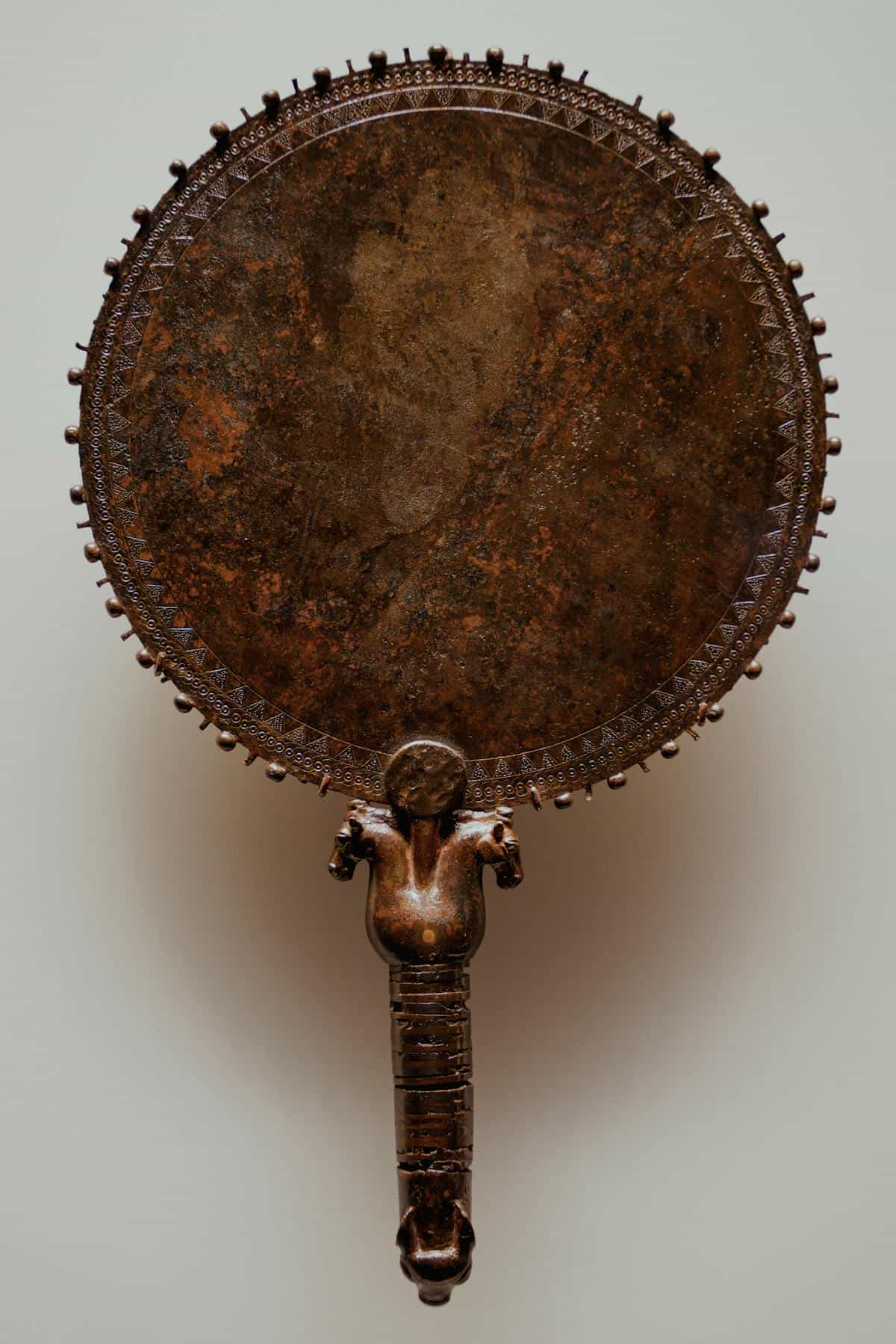
Ancient Egypt provides some of the earliest physical mirrors — polished copper, dating to around 3100–2900 BCE — and used them in funerary ritual. Mirrors were placed with the dead as instruments of protection and passage. The association of reflective surfaces with the boundary between life and death runs deep in the archaeological record.
Ancient Rome took a different view entirely: mirrors captured part of the soul. Breaking one damaged that fragment. This is why seven years of bad luck follows a broken mirror — the injured soul piece needed time to recover. The superstition is ancient, but it became widespread only after affordable mirrors became common in the late 1800s. The fear is old; the scale is industrial.
Christian scripture uses mirror imagery with lasting effect. James 1:23–25 compares moral self-deception to glancing in a mirror and immediately forgetting what you look like. Paul's "through a glass, darkly" (1 Corinthians 13:12) uses the mirror as a metaphor for indirect, partial knowledge — compared to the direct knowledge Paul anticipates. Both passages use the mirror as a tool for describing the limits of human self-understanding.
For a deeper survey of what specific civilizations believed, the mirror symbolism across cultures guide covers this in full.
Mirror as portal and threshold

The idea of mirrors as gateways appears across folk traditions that had no contact with each other. In certain West African and Afro-Caribbean traditions, mirrors function as surfaces through which ancestors can be contacted or through which spiritual energy moves. In European folklore, covering mirrors after death prevents the soul of the deceased from becoming trapped in the glass. Scrying — gazing into dark or candlelit reflective surfaces to access intuition or vision — appears in Celtic, Romany, and Renaissance magical practice independently.
The psychological explanation and the spiritual one can coexist without either cancelling the other. Mirrors are high-salience attention objects — they pull gaze and hold it in ways other surfaces do not. In conditions of low light, grief, or altered attention, they can lower the threshold between ordinary waking thought and whatever lies below it. Folklore then encodes that experience in behaviour: cover the mirror during mourning, consult the dark glass for guidance, feel watched by the reflection at night.
Treat "portal" as descriptive psychology when you need grounding. Treat it as sacred threshold when your tradition does. The mirror as a portal guide goes further into the specific folklore.
Mirror symbolism in personality — what your relationship to your reflection reveals

In Jungian psychology, the mirror appears as a tool for encountering the shadow — the qualities, impulses, and self-images you have not consciously acknowledged. Mirror work in this tradition is not about admiring or criticising the surface; it is about staying present with what the reflection triggers. What feelings arise? What narrative starts before you have had time to actually look? Whose voice is narrating what you see?
The Narcissus myth is the most famous Western mirror story, and its lesson is often misread. Narcissus does not know himself — he falls in love with an image and mistakes it for a person. The mirror symbolism there is about the trap of fixation, not self-awareness: confusing a representation with the real thing. The myth warns against mistaking the reflection for a relationship.
Mirror symbolism in personality is fundamentally about this: how you meet yourself when no one is watching, adjusting, or evaluating. Survey research from 2024 found that 73.03% of college students reported negative body-image perception. That is not a number about vanity — it is a number about the accumulated weight of comparison, social performance, and self-judgment that most people bring to the mirror before they have even focused on their face. What the mirror reveals about personality is less about the image it shows and more about the story that immediately begins.
What is mirror work spiritually — and how it actually functions

Mirror work as a named practice was developed by Louise Hay in the 1980s, built around a simple mechanism: sustained eye contact with your own reflection while speaking intentions or affirmations aloud. The idea is that the mirror prevents the easy drift of attention that happens when you read from a page or speak to a ceiling — you are looking at yourself, which makes avoidance harder.
At its most basic, mirror work is a form of focused self-attention. The spiritual meaning comes from the intention the practitioner brings, not from anything the glass does independently. Prayer spoken to a reflection is still prayer. Gratitude offered toward the face you have spent years criticising is still gratitude. Ritual cleansing gestures that use the mirror as a focal point are attention practices wearing the object as an anchor.
What the practice is not: a metaphysical mechanism that works regardless of intention. A mirror does not cleanse energy by existing on a wall. It does not accumulate negative spiritual residue in the way some popular accounts describe. These are beliefs held across multiple traditions, and they deserve to be described as beliefs — not dismissed, but not presented as documented physical phenomena either.
One practical note worth keeping: short, purposeful sessions — 2–5 minutes with a specific focus — tend to produce more useful results than open-ended gazing, which drifts toward self-criticism. If sessions consistently produce distress rather than calm, that is information worth attending to rather than pushing through. For a research-grounded approach to affirmations specifically, the mirror affirmations guide covers evidence and method. For the full range of practice, see mirror as a spiritual tool.
Keeping the physics honest

One distinction worth stating clearly, because it affects how you read almost everything else on this page.
A mirror's "truth" is optical, not moral. It shows a laterally reversed image of whatever is in front of it, in available light, at the distance you choose. A photograph shows a different projection, with different distortions from the lens and compression from the format. Neither is more "accurate" as a representation of you — they are different views, each incomplete in different ways. When poetry says the mirror cannot lie, it is describing moral confrontation — the absence of flattery in how light behaves — not arguing with ray optics.
Keeping this distinction in place protects both the physics and the metaphor. The physics does not need metaphysical weight to be interesting. The metaphor does not need to be dressed as physics to be meaningful. They do different work, and both are worth having. Use physics when someone confuses reflection with judgement. Use metaphor when someone needs language for integration that science has not named cleanly.
For most of human history, people could not see their own faces clearly. Polished obsidian by around 6000 BCE, copper by 3100 BCE, glass only from the 1st century CE — and for ordinary people, a clear, accurate reflection was unavailable until industrial glass production reached households in the 19th century. We have been a self-aware species for hundreds of thousands of years. We have been a mirror-gazing species for a fraction of that.
That gap — between the antiquity of self-awareness and the recency of the mirror — is why the symbol carries so much weight. Everything humans had already been doing with identity, soul, truth, and self-knowledge for millennia landed on this glass surface the moment it became available.
The mirror did not create the questions. It gave them a face to ask against.
Mirror FAQ
What does a mirror symbolize spiritually?
Across most traditions, mirrors symbolize three overlapping things: truth and self-knowledge (the mirror as the object that shows you without an audience), threshold or boundary (the surface as a "thin place" between the visible and something harder to name), and the limits of self-knowledge (the reflection is faithful but incomplete — it shows a face, not an interior). The symbolic weight shifts by tradition: Buddhist teaching emphasizes the undistorted mind, Sufi poetry emphasizes the heart polished by devotion, Christian scripture uses mirror language for partial knowledge and self-deception. What they share is the impulse — looking in a mirror as an occasion to look inward.
What is the spiritual meaning of reflection?
"Reflection" carries two meanings that spiritual writing deliberately layers: the optical process (light bouncing back from a surface) and the introspective one (turning attention inward to examine thoughts, actions, and motivations). Spiritually, the symbolism of reflection points toward honest self-examination — looking at your own patterns with the same impartiality a mirror shows the face. Most traditions that use mirror imagery are really talking about this second kind of reflection: the willingness to look clearly at what you would rather soften or avoid.
What does "the eyes are the mirror of the soul" mean?
The phrase describes the belief that eyes reveal inner character and emotional truth in ways the rest of the face cannot disguise. A version of it appears in Latin attributed to Cicero — "Ut imago est animi voltus sic indices oculi" (the face is the image of the soul, the eyes its interpreters) — and the idea runs through Platonic philosophy, Islamic mysticism, and Renaissance portraiture. Psychologically, eye contact does carry real social information: humans are exceptionally attuned to gaze direction, pupil response, and micro-expression. The phrase names something real about human perception and frames it in soul-language; both the observation and the framing are worth taking seriously.
What does a mirror represent in the Bible?
The Bible uses mirror imagery in two notable passages. James 1:23–25 compares hearing God's word without acting on it to someone who glances in a mirror and immediately forgets their own face — a lesson about self-deception and follow-through, not about the object itself. Paul's "through a glass, darkly" (1 Corinthians 13:12) contrasts partial human knowledge with the fuller knowledge he anticipates. Both passages use the mirror as a metaphor for epistemology and accountability. Neither endorses nor condemns mirror use as a spiritual practice.
Are mirrors good or bad luck spiritually?
Folk traditions disagree substantially. Western superstition links broken mirrors to seven years of bad luck — a belief that originated in ancient Rome, where mirrors were thought to hold part of the soul. In some Indian traditions, a broken mirror releases accumulated negative energy, making it good luck. Chinese feng shui treats mirror placement as affecting energy flow in a space. None of these readings are interchangeable, and none are documented physical phenomena — they are culturally specific beliefs, each with its own internal logic, worth understanding on their own terms.
What is mirror work spiritually?
Mirror work is the practice of using deliberate, intentional mirror gazing as a spiritual or psychological exercise — most commonly, sustained eye contact with your own reflection while speaking affirmations, prayers, or intentions aloud. The practice differs from ordinary mirror use in that it is purposeful rather than functional: the goal is honest self-attention rather than appearance management. Short sessions with a specific focus (a phrase to hold, a feeling to acknowledge) tend to produce more useful results than open-ended gazing, which often drifts toward self-criticism. If the practice consistently triggers distress rather than calm, that is information worth attending to.
Why do mirrors feel spiritual or unsettling at night?
Low light, peripheral vision, sleep debt, and cultural stories about mirrors as portals stack together in the dark. The brain is highly attuned to faces — even in low resolution — and in dim conditions it may resolve ambiguous reflections into perceived movement or gaze. Cultural conditioning (horror associations, folklore about covered mirrors) amplifies the physiological response. The unsettled feeling is real; its explanation is neurological and cultural rather than paranormal, though you do not need to choose between those descriptions.