Ancient Egyptian Mirrors: The Ka, Hathor, Funerary Magic, and How Bronze Discs Lit the Tombs
If you have seen a polished bronze disc shaped like an Ankh handle in an Egyptian museum and wondered what it was — you were looking at a mirror. Not a vanity object. Not decoration. A mirror that simultaneously served as a symbol of life, a potential dwelling for the soul, and — in one of the more underreported details in the history of ancient technology — a device for redirecting sunlight into the darkness of a sealed tomb.
Most writing about ancient Egyptian mirror symbolism stops at "they believed the mirror held the soul." That is true, but it is roughly one-quarter of the actual picture. The Ka, Hathor, funerary spells, and the use of Egyptian mirror lighting to illuminate tomb chambers — each of these is a distinct claim with its own logic, and treating them as one ambient "spiritual belief" flattens the most interesting parts of the story.
What the Ankh-Shaped Handle Actually Meant
The most immediately recognisable feature of ancient Egyptian mirrors is their shape. The disc — typically circular or slightly oval — attached to a handle formed in the shape of an Ankh. The mirror disc was the loop. The stem was the handle. You held life in your hand while looking at your reflection.
This was not incidental design. In Egyptian theology, the Ankh (ꜥnḫ) was the hieroglyph for life itself — among the most loaded symbols in the entire writing system. Shaping a mirror handle as an Ankh was a physical argument: reflection and life are the same kind of thing.
The disc had its own name: iat — a term with associations to the solar disc of Ra. Polished copper mirrors appear in the Egyptian archaeological record from around 3100–2900 BCE, which makes them among the oldest precision-reflective objects known. The earliest mirrors of any kind were polished obsidian in Anatolia around 6000 BCE; Egyptian copper mirrors represent the next major development in human mirror-making. By the New Kingdom period, the most prestigious ancient Egyptian mirrors were made of electrum — a natural alloy of gold and silver — which Egyptians described as the literal flesh and bones of the gods.
The Ka — Why Looking in a Mirror Was Seeing Your Spiritual Double
Central to understanding any ancient Egypt mirror is the Ka — the life force or spiritual double that every person carried. The Ka was not the soul in the Western sense. It was more like a sustaining second self that continued to exist after physical death and required a physical anchor: a statue, the preserved mummy, or a reflective surface.
When an Egyptian looked into a polished bronze mirror, they were not thought to be checking their appearance. They were seeing the Ka made visible. The reflection was the spiritual double, briefly perceptible to the living eye.
This is a specific theological claim, not a vague idea about mirrors being "sacred." It carries a direct implication: damaging a mirror was a symbolic attack on the Ka's integrity. Allowing an ancient Egyptian mirror to tarnish was, in this framework, allowing your spiritual double to lose definition and coherence.
Hathor as the Lady of the Mirror — What the Title Actually Means
Hathor — the goddess referred to as the "Lady of the Mirror" — was the Egyptian deity of love, beauty, music, and the afterlife. That combination looks odd to modern eyes until you understand the underlying logic: beauty, music, and passage into the afterlife were all expressions of Ra's sustaining light, and Hathor was that light in its nurturing form.
Her specific connection to Egyptian mirrors operated on two levels.
For the living. Mirrors were Hathor's sacred instruments in rituals of feminine grace and fertility. In Egyptian art, the handles of bronze mirrors frequently bore Hathor's face — the cow-eared deity gazing back at the woman gazing in. Her emblem, the menat necklace, was a common design element engraved on handles. To use a Hathor-engraved mirror was not a cosmetic act in the modern sense; it was a ritual of receiving her blessing.
For the dead. Hathor's funerary role was as a guide through the Duat, the Egyptian underworld. The reflective disc in a tomb context represented her "nurturing solar eye" — the watching, protective light that accompanied the soul through the dark passages of the afterlife. A mirror in a tomb was not only a Ka vessel; it was a piece of Hathor's active protection.
Why Mirrors Were Buried with the Dead — and What the Spells Actually Said
The burial of ancient Egyptian mirrors with the deceased was one of the most consistent funerary practices across Egyptian history — documented from the Early Dynastic period (around 3100 BCE) through the Late Period. The practice had three distinct purposes, each recorded in the textual and archaeological record.
Ka housing. If the mummy were damaged or the Ka statue broken, the polished reflective surface was the fallback. A reflection could house the Ka when no other anchor was intact.
Resurrection catalyst. Spell 166 of the Book of the Dead directly addresses the mirror. The spell describes the mirror as capable of "opening the mouth" and providing breath to the deceased — the reflected light of the iat disc was believed to reanimate the soul and allow it to open its eyes in the afterlife. The fact that this function appears in the Book of the Dead — the central mortuary text of Egyptian civilization — indicates how seriously the mirror's role was taken, not as a folk belief but as codified theological practice.
Apotropaic defense. In the darkness of a sealed tomb, a mirror positioned to catch even a flicker of lamplight could direct reflected light at threatening entities. Egyptian theology treated the chaotic forces of the Duat as beings that retreated from the solar light of Ra. A mirror carrying the iat's solar associations was, in this framework, a weapon as well as a vessel.
How Ancient Egyptians Used Bronze Mirrors to Light Tomb Chambers
Here is the detail most writing on ancient Egyptian mirrors omits entirely — including most articles focused on spiritual meaning.
Egyptian mirror lighting was documented practical engineering. Bronze mirrors were positioned at the entrances to tomb shafts and corridors to capture sunlight and redirect it deep into chambers that had no natural light source. A chain of carefully angled mirrors could carry solar illumination far enough inward to light a burial chamber or a painter's working surface.
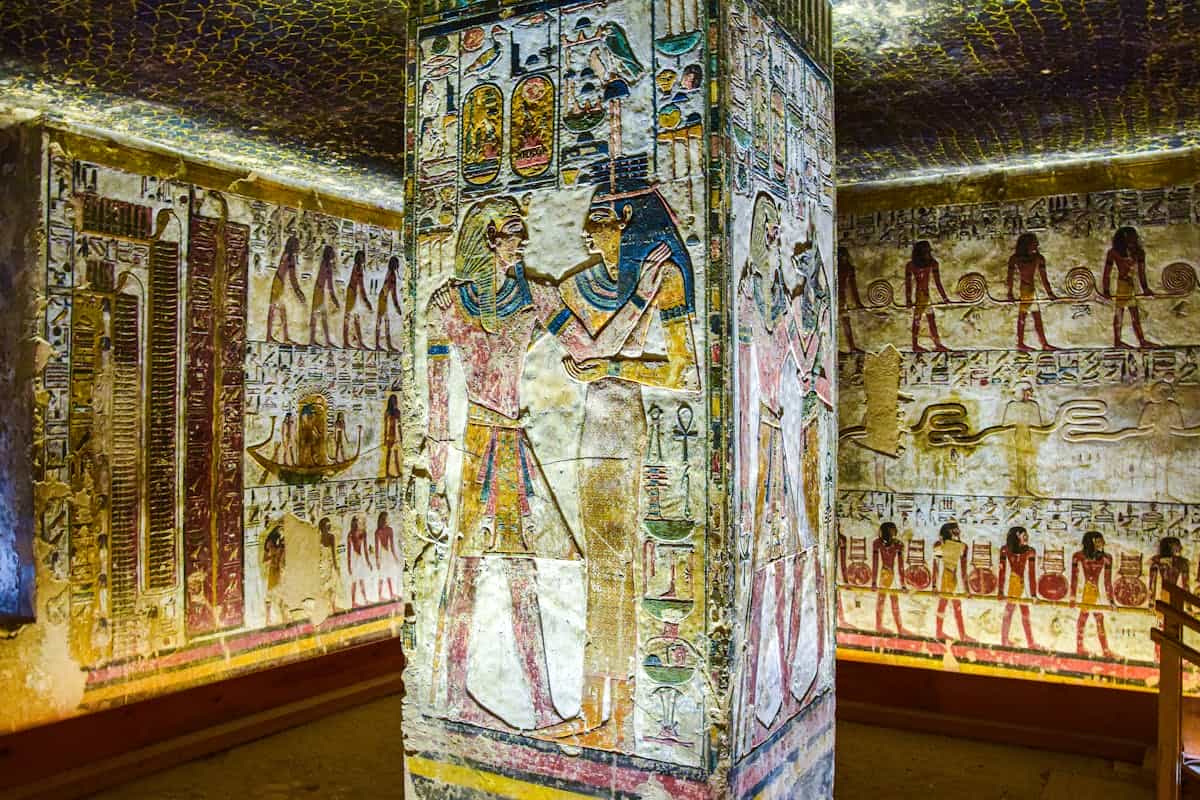
The evidence is visible in the tombs themselves: many deep chambers — including chambers in the Valley of the Kings — show remarkably little smoke residue. Painted surfaces that cover walls in meticulous detail, far from any opening, could not have been created by torchlight alone. Torches produce smoke, consume oxygen, and flicker; none of those conditions produce the precision visible in the finest tomb paintings.
The engineers who painted the elaborate scenes in tombs like that of Seti I almost certainly used reflected sunlight to work. And they used the same polished bronze discs that priests dedicated to Hathor, that mourners placed in graves, and that practitioners used for divination. Egyptian culture did not separate the sacred from the practical in the way modern categories encourage. The iat disc was a single object doing several kinds of work.
The Magic Mirror in Ancient Egypt — Scrying and the Threshold of the Duat
The magic mirror in ancient Egypt refers most specifically to catoptromancy — the practice of divination through a polished reflective surface.
Priests and priestesses attached to Hathor's temples would gaze into highly polished, dark bronze mirrors in sustained trance states. The goal was not casual vision. It was deliberate liminal perception: using the shimmer of the polished surface to cross the threshold into the Duat, where the Akhu (the blessed dead and deified ancestors) resided and where the deities could be consulted.
The practice shared its theological logic with Ka theology: if the mirror's surface could show you your spiritual double, it could also show you what inhabited the realm that double would eventually enter. The same reflective technology that served as a funerary tool served as a portal for the living.
Modern descriptions sometimes call this practice superstitious. That reading misses what was actually happening: Hathor's priests were using the most optically sophisticated surface available to induce altered states of consciousness in a methodical, ritualised way. Whether the Duat was literally accessible through a bronze disc is a separate question from whether the practitioners were serious. They were.
When Seeing Your Own Face Was a Rare Privilege
The glassmakers of Murano — a small island near Venice — held a monopoly on European mirror production from the 13th to 17th century, long after ancient Egypt's era had ended. In that period, a Venetian mirror could cost as much as a painting by a major artist. Royalty paid enormous sums. Common people went entire lifetimes without owning one. The Venetian government allegedly threatened glassmakers who defected with assassination — the secret was that economically valuable.
Go further back to Egypt. Polished copper mirrors first appearing around 3100–2900 BCE were available only to the wealthy and the priestly class. Still water gave a rough, distorted image. Polished metal gave clarity — but polished metal was expensive, labour-intensive to produce, and even more labour-intensive to keep bright. A clear, accurate image of your own face was not a daily experience for most Egyptians. It was rare, and it was charged.
When a craftsman or noblewoman gazed into a polished bronze disc and saw a clear image of their own face, and assigned to that image the significance of the Ka — the spiritual double, the reflection of the divine — they were responding to an experience that most people had seldom or never had. The theology of the ancient Egyptian mirror grew out of an encounter with genuine rarity. That history does not diminish the spiritual meaning. It explains why the meaning had such weight.
| Function | What it represented | Evidence |
|---|---|---|
| Ankh-shaped handle | Life force; solar disc of Ra | Physical artifacts from 3100 BCE onward |
| Ka vessel | Spiritual double made visible | Ka theology across funerary texts |
| Hathor emblem | Nurturing solar protection for the dead | Engraved handles; Hathor temple inscriptions |
| Funerary object | Ka housing; resurrection catalyst | Book of the Dead Spell 166 |
| Light redirector | Practical solar engineering for tomb work | Absence of smoke in deep chambers |
| Scrying instrument | Threshold to the Duat | Catoptromancy in Hathor priestly tradition |
The mistake most modern summaries make is treating these six functions as one thing: "the Egyptian mirror was spiritual." That collapses six distinct claims — each with its own logic, its own practitioners, and its own textual basis — into one undifferentiated mysticism. The polished disc that a woman held up in the morning to dress her hair was the same form as the disc placed in her father's tomb, the disc the Hathor priest gazed into at the temple, and the disc the engineer angled at the corridor entrance to throw sunlight onto a painted wall. Same object. Different kinds of work.
That is what makes it worth understanding — not as proof of ancient beliefs about the supernatural, but as evidence of a civilization that took the act of reflection seriously enough to build a theology around it, bury it with their dead, and use it to illuminate the darkness.
The same sacred-reflection theme runs through Hindu Darpana ritual and Vastu Shastra, Feng Shui mirror placement, and the wider survey of mirror symbolism across world cultures.
Mirror FAQ
What did mirrors mean spiritually in ancient Egypt?
Ancient Egyptian mirrors served multiple distinct spiritual functions that most modern summaries collapse into one. The mirror disc was shaped like an Ankh handle — the symbol of life — making the act of holding a mirror an act of holding a miniature representation of vitality. The Ka (spiritual double) was believed to be visible in the reflection, making mirrors a form of soul contact. Mirrors were placed in tombs as Ka vessels and apotropaic devices. And Hathor, the primary deity associated with mirrors, used them as funerary protection tools. Each function came from a specific theological claim, not from a general belief that mirrors were "spiritual."
What is the magic mirror in ancient Egypt?
The magic mirror in ancient Egypt refers primarily to the practice of catoptromancy — divination through gazing into a polished reflective surface. Priests and priestesses, particularly those connected to Hathor, would gaze into highly polished dark bronze mirrors to achieve a trance state, seeking visions of the future or communication with the Akhu (blessed ancestors). The reflective surface was treated as a liminal threshold between the world of the living and the Duat (underworld). The same object that was a Ka vessel and a funerary tool was also a divination instrument. Ancient Egyptian mirrors were made of polished copper or bronze from around 3100–2900 BCE, and later of electrum — an alloy of gold and silver — which Egyptians considered the literal flesh and bones of the gods.
Who is the Egyptian goddess of mirrors?
Hathor is the primary Egyptian goddess associated with mirrors. She is described in texts as the "Lady of the Mirror" — the deity of love, beauty, music, and the afterlife. In Egyptian art, mirrors were often inscribed with her face or featured her emblem, the menat necklace, engraved on the handle. Hathor's connection to mirrors had two distinct aspects: mirrors were her sacred tools for feminine grace and fertility, and in funerary contexts the reflective disc represented her "nurturing solar eye" that watched over and guided souls through the Duat.
What were ancient Egyptian mirrors made of?
Most ancient Egyptian mirrors were made of highly polished bronze or copper. Polished copper mirrors appear in the archaeological record from around 3100–2900 BCE. The most sacred mirrors were crafted from electrum — a natural alloy of gold and silver — which Egyptians considered the literal flesh and bones of the gods, making an electrum mirror an exceptionally powerful ritual object. Glass mirrors did not exist in ancient Egypt; they were first produced in Sidon (modern Lebanon) in the 1st century CE, centuries after the height of Egyptian civilization.
How did ancient Egyptians use mirrors to light tomb chambers?
Egyptian mirror lighting was a documented practical technique. Bronze mirrors were positioned at the entrance to tomb corridors to capture sunlight and redirect it deep into chambers with no natural light source. A chain of angled mirrors could carry solar illumination far enough inward to light a burial chamber or a working surface where painters were adding inscriptions. The evidence includes the near-absence of smoke residue in many deep chambers — chambers that could not have been painted by torchlight alone. The same polished bronze disc that held theological significance as a Ka vessel was also a working optical instrument.
Why were mirrors buried with Egyptian dead?
Mirrors were placed in Egyptian tombs for three stated purposes. First, if the mummy or Ka statue were damaged, the reflective surface could serve as an alternative dwelling for the Ka — the soul's double that required a physical anchor. Second, Spell 166 of the Book of the Dead describes mirrors as resurrection catalysts: the reflected light was believed to "open the mouth" and restore breath to the deceased. Third, mirrors served an apotropaic function — positioned to reflect lamplight, they were believed to repel the chaotic entities that threatened the soul in the darkness of the Duat.