Mirrors in Hinduism: Why Mirrors Are Kept in Temples, Darpana in Sanskrit, and What the Traditions Mean
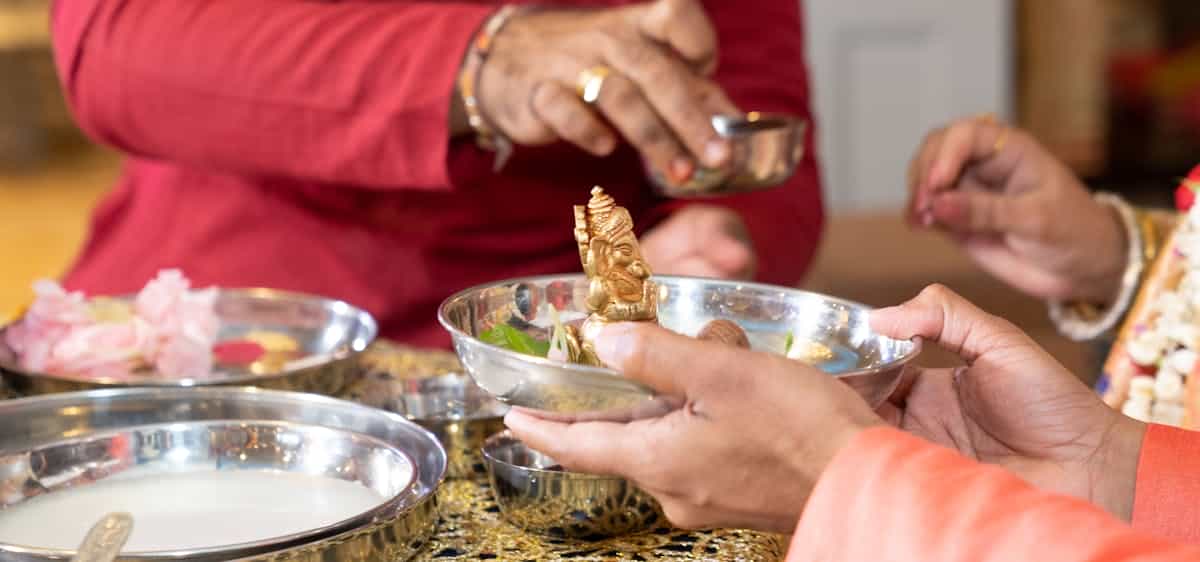
If you have seen a mirror placed behind or beside a deity during Hindu puja — or wondered why temples keep polished surfaces near the idol — you are looking at one of the oldest ritual uses of a mirror anywhere in the world. The practice has a name, a textual basis, and a philosophy behind it. It is not decorative.
The Sanskrit word for mirror, Darpana (दर्पण), already signals that something more than glass is at stake. The root darp relates to self-awareness and pride — the Darpana is the object that returns your own image to you. In Vedantic philosophy, that act of return became a metaphor for some of the most sophisticated thinking in any tradition about the relationship between the individual self and ultimate reality.
Three separate traditions are at work in how Hinduism uses mirrors: temple ritual, philosophical metaphor, and Vastu Shastra. They are not the same kind of claim, and collapsing them into one "Hindu belief about mirrors" misrepresents all three. Here is what each actually says.
What Darpana Means in Sanskrit — and the Two Words for Mirror
Sanskrit is precise about mirrors in a way that English is not. The two words used most often are Darpana and Adarsha.
Darpana (दर्पण) carries the sense of self-display — the surface that shows you to yourself. Adarsha (आदर्श) carries the additional meaning of "ideal" or "model," which is why the same word means both "mirror" and "exemplar" in several modern Indian languages. When philosophical texts use the mirror as a metaphor, they are drawing on both senses: the mirror reflects what is actually there, and in doing so points toward what clarity looks like.
The Yoga Sutras of Patanjali describe the goal of spiritual practice as Chitta Vritti Nirodhah — stilling the fluctuations of the mind. A recurring metaphor in the commentaries: the mind is like a mirror. When it is agitated by Rajas (passion) or clouded by Tamas (ignorance), the reflection of the Atman (the true self) is distorted or lost entirely. Through Sadhana (practice), the mirror of the mind becomes clear again. This is not ornamental language. It is the precise claim that self-knowledge requires a stilled mind the same way accurate reflection requires an undisturbed surface.
Why a Mirror Is Placed Behind the God Idol in Hindu Temples
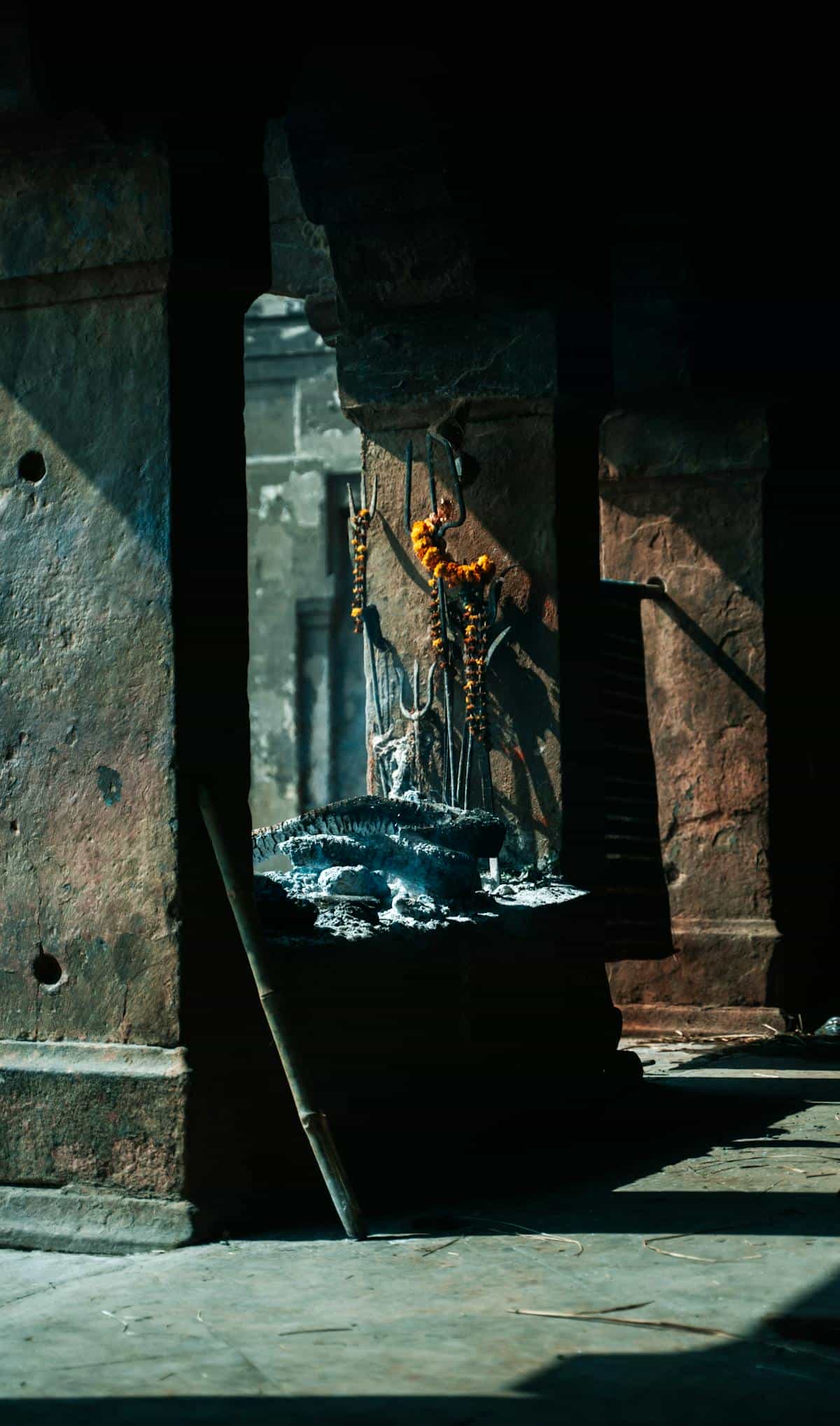
The mirror placed behind or before the god idol is called Darpana Samarpanam — the offering of the mirror. It is one of the Shodashopachara, the sixteen standard offerings in formal puja worship. The list includes water, flowers, incense, food, and cloth — the mirror sits alongside them as a recognized form of honoring the deity.
Three purposes are stated in the ritual texts:
The deity's self-beholding. The Murti (consecrated idol) is treated in traditional puja as the living presence of the divine, not merely a symbol. Offering a mirror allows the deity to behold its own form — an act that symbolizes the self-sufficiency and self-awareness of the Absolute. A being that knows itself completely needs no external confirmation; offering the mirror is acknowledging that self-knowledge.
Royal hospitality. The Shodashopachara is structured on the model of receiving an honored royal guest. A host of that era would provide everything a dignified visitor might require — including a mirror to check their appearance. Offering the Darpana treats the deity with the same attentiveness.
The devotee's purified mind. At the symbolic level, the polished surface represents the practitioner's mind in its clearest possible state — offered to the divine as the most honest gift a person can give.
Why Mirrors Are Kept in Temples: The Aranmula Tradition and the Question of Metal
In many traditional South Indian temples, glass mirrors are not used at all. The Aranmula Kannadi of Kerala — hand-crafted metal alloy mirrors that have been produced in the Aranmula region for centuries — are considered the correct material for ritual use.
The reasoning given in temple tradition is that polished metal is a "living" material that holds Prana, while glass backed with silver or mercury is considered spiritually inert or even disruptive. This distinction predates the widespread availability of glass mirrors by centuries.
Here is the piece of context that most writing on this topic omits entirely.
For most of human history, a clear and accurate reflection of a person's face was not available to ordinary people. Still water gave a rough, distorted image. Polished copper and bronze improved things, but the result remained imperfect. A clear, flat, accurate reflection of your own face was a luxury available only to the wealthy until glass-backed mirrors became affordable household objects in the 19th century. Before that, a well-polished metal surface was among the clearest reflections most people ever encountered.
The temple traditions that specify polished metal mirrors, and treat that metal surface as something worthy of presenting to a deity, developed at a time when such a surface genuinely represented the best available clarity. Offering the Darpana was not a modest gesture — it was offering the finest technology of self-reflection that existed. That history does not dissolve the spiritual meaning of the ritual; it grounds it.
What the Mirror Represents in Hindu Philosophy: Maya, Brahman, and the Individual Self
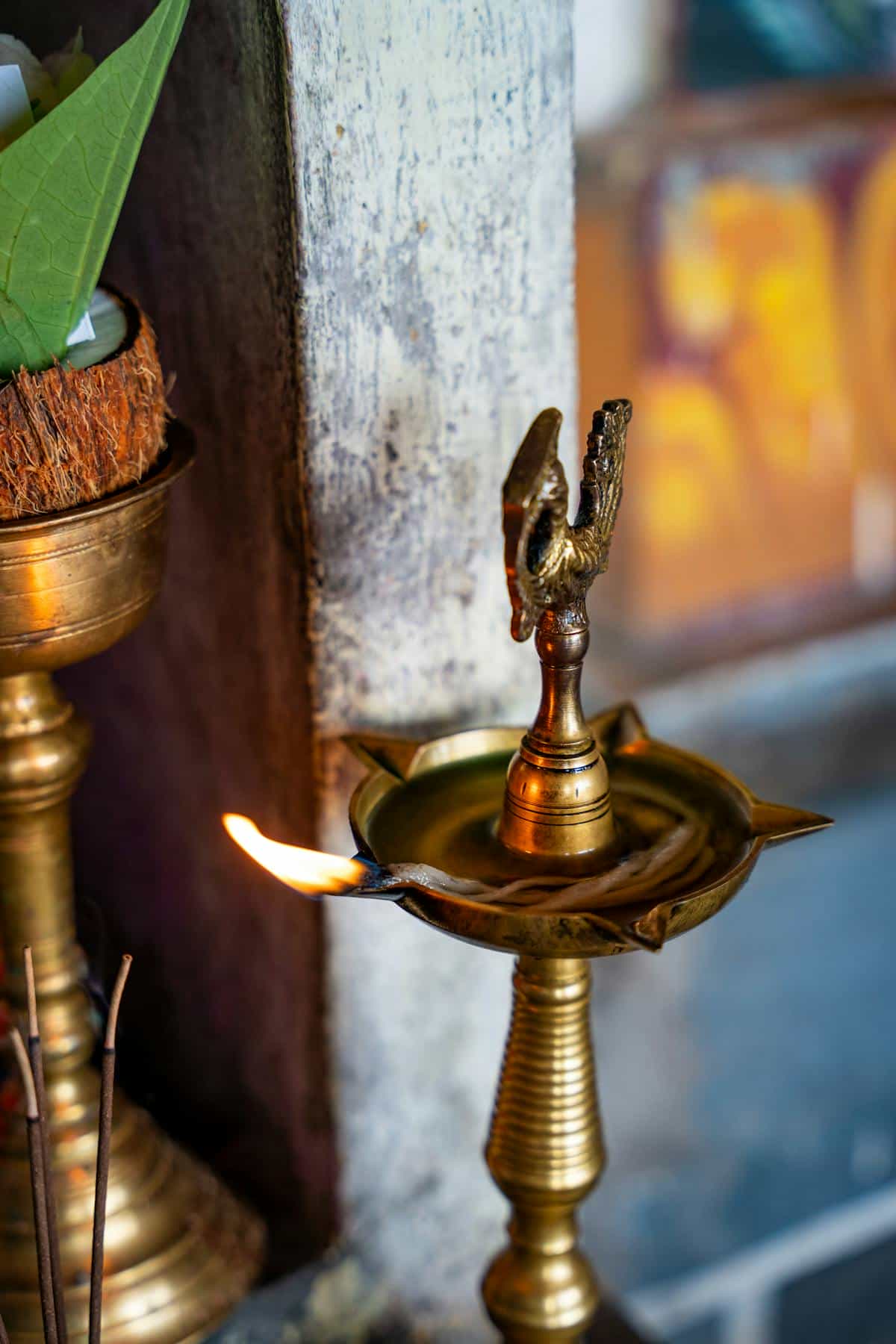
The deepest use of the mirror in Hindu thought is philosophical rather than ritual, and it comes from Advaita Vedanta — the school of non-dualism associated with Adi Shankaracharya.
The central problem Advaita is working on: why does the individual experience themselves as separate from ultimate reality (Brahman)? The answer involves Maya — the cosmic principle of illusion — and the mirror provides the most used metaphor for understanding how Maya works.
The reflection and the original. Pratibimba theory holds that the individual self (Jiva) is a reflection (Pratibimba) of the original consciousness (Bimba). Just as one sun appears as many when reflected in multiple pots of water — each reflection real, each partial, none the sun itself — the one Brahman appears as many individuals due to the mediating "medium" of the mind. The error the tradition diagnoses is not that the reflection exists, but that the reflection mistakes itself for the original.
The Vivekachudamani passage. Shankaracharya's text states it directly: a person who sees their reflection in a mirror and mistakes it for their actual self has made the same error as the soul that identifies with the body and ego rather than with pure consciousness. The body and personality are not fraudulent — they are reflections. But identifying them as the whole is the error that spiritual practice is meant to correct.
This is a precise metaphysical argument, not vague inspiration. The mirror as a physical object is doing serious philosophical work here: it is the closest available illustration of something that is genuinely real (the reflection exists) while being incomplete (the reflection is not the thing).
What Vastu Shastra Actually Says About Where to Place a Mirror
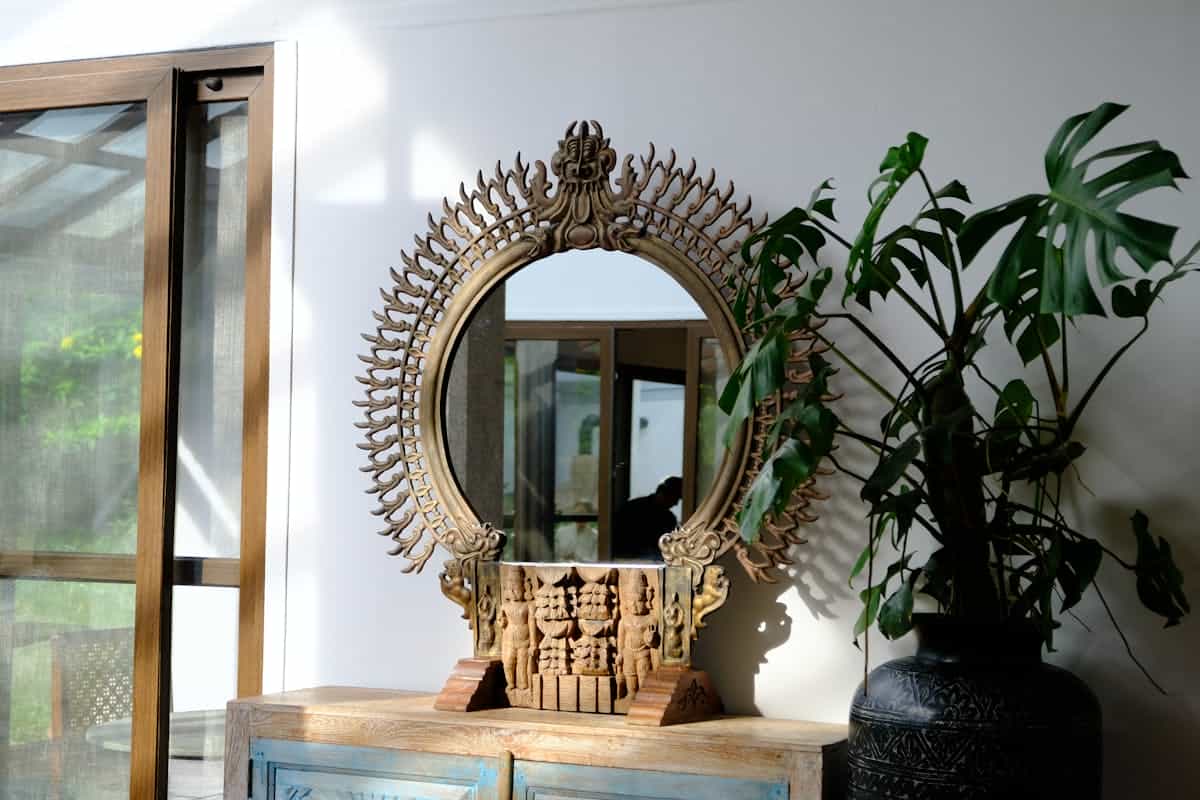
Vastu Shastra — the traditional Hindu system of architecture and spatial arrangement — treats mirrors as extensions of the Water Element because of their reflective properties. The placement rules that circulate most widely are these:
Preferred placements for mirrors in the home:
- North wall: Governed by Kubera, the deity of wealth. Mirrors here are said to attract and multiply prosperity.
- East wall: Governed by Indra and the rising sun. Mirrors here are associated with health and clarity.
Placements considered harmful:
- Facing the main entrance: A mirror directly opposite the front door is said to reflect incoming positive energy back out before it can settle in the home.
- Reflecting the bed: The most frequently cited prohibition. A sleeping person's reflection is thought to create an energetic disturbance that disrupts rest and, in some readings, marital harmony.
- Facing each other: Two mirrors set opposite each other create a corridor of infinite reflection that Vastu practitioners describe as chaotic and mentally unsettling.
It is worth being clear about what kind of claim Vastu is making. These are traditional architectural principles, developed over centuries, that operate within a framework of subtle energy (Prana) that cannot be measured by current instruments. They are not the same kind of claim as Advaita Vedanta's philosophical arguments, and they are not the same as the Darpana Samarpanam ritual. Treating them as equivalent collapses three different modes of knowing into one undifferentiated "Hindu belief."
Whether Vastu mirror rules produce demonstrable effects is genuinely unknown. What is clear is that the underlying principle — that spatial arrangement affects the quality of attention and rest — has some psychological resonance even outside a traditional framework.
Mirror Gazing in Yoga and Tantric Practice — and Why It Works

In certain Tantric and Yoga traditions, the mirror is used as a Yantra — a physical focus for sustained attention. The practice is called Trataka: gazing at a fixed point without blinking for an extended period. A candle flame is the most common object used; the mirror — specifically, one's own eyes in the mirror — is an advanced variation.
The stated goal is to confront the Atman behind the physical mask. As the Troxler Effect causes familiar features to blur and shift after sustained attention, the practitioner experiences a dissolution of the usual self-image — which is, in the Vedantic framework, precisely the point. The face you manage for daily life is not who you are; it is the reflection the ego has learned to present.
What the psychological literature adds: sustained, non-evaluative mirror gazing — particularly making steady eye contact with oneself — has been used in therapeutic contexts for exactly the reason that contemplative traditions identified. The features that usually trigger self-criticism (which is comparison-based and rapid) tend to recede when attention is sustained rather than scanning. The experience the Tantric tradition calls encountering the Silent Witness and the therapeutic tradition calls reduced self-objectification are describing something structurally similar.
What Covering Mirrors During Mourning and Eclipses Actually Means
Hindus traditionally cover mirrors in two circumstances: during the mourning period following a death in the household, and during a solar or lunar eclipse (Grahan).
During mourning. The belief is that the soul of the deceased is temporarily in a transitional state — between the physical world and whatever follows. A mirror that shows the soul its own reflection risks distracting or trapping it, drawing its attention back toward its physical appearance at a moment when it needs to be oriented toward what comes next. For the grieving family, covering the mirrors is also an act of practical inwardness: the household is not the moment for self-examination in front of glass.
During an eclipse. Eclipses are understood in traditional Hinduism as periods of increased cosmic instability — when the normal ordering of energies is temporarily disrupted. The mirror, as an object that captures and redirects whatever it reflects, is covered during this period as a precaution.
Neither of these practices requires agreement with the metaphysical framework behind them to notice what they are doing structurally: marking certain periods as different from ordinary time, and using the covering of a reflective surface as the physical act that makes that difference visible.
| Domain | What the mirror represents | What kind of claim this is |
|---|---|---|
| Advaita Vedanta | Individual self as reflection of Brahman | Philosophical metaphor |
| Yoga Sutras | Mind as a mirror that must be stilled | Meditative instruction |
| Temple ritual | Darpana Samarpanam — offering clarity to the deity | Ritual hospitality |
| Vastu Shastra | Mirror as Water Element energy director | Traditional spatial principle |
| Folk belief | Broken or covered mirror affects Prana | Cultural practice |
The mirror in Hindu tradition is doing five different things in five different registers — which is why a single-sentence answer to "what does the mirror mean in Hinduism" will always be incomplete. What holds them together is the one idea that appears across all five: a clear surface that returns an image honestly is, in this tradition, worth taking seriously.
What it reflects is the question. How honest you are willing to be when you look is the practice.
Mirror FAQ
Why is a mirror kept behind a god idol in Hindu worship?
A mirror placed behind or before the god idol during Hindu puja is part of the Darpana Samarpanam ritual — one of the sixteen standard offerings presented to the deity. The mirror allows the deity to behold its own divine form, an act of self-awareness that symbolizes the Absolute's self-sufficiency. It is also an act of royal hospitality, treating the Murti as an honored guest who wishes to see their own appearance. The polished surface — traditionally metal, not glass — represents the devotee's purified mind being offered to God.
What is the Sanskrit word for mirror?
The Sanskrit word for mirror is Darpana (दर्पण). The root "darp" relates to pride and self-awareness — the Darpana is literally the object that shows you yourself. In texts, the mirror also appears as Adarsha (आदर्श), which carries the additional meaning of "ideal" or "model" — a reflection that shows the highest standard. The philosophical use of the mirror metaphor throughout Vedantic texts draws on this dual sense: the mirror both reflects reality and points toward an ideal of clarity.
Why are mirrors kept in Hindu temples?
Mirrors are kept in Hindu temples as part of the Shodashopachara — the sixteen standard ritual offerings in formal puja worship. The Darpana Samarpanam specifically presents a polished surface to the deity for three stated purposes: allowing the deity to behold its divine form, offering royal hospitality, and symbolizing the devotee's purified mind. In traditional temples, particularly in South India and Kerala, the Aranmula Kannadi tradition uses hand-crafted metal alloy mirrors rather than glass because metal is considered to carry Sattvic (pure) vibrations.
What does Vastu Shastra say about mirrors in the bedroom?
Vastu Shastra advises strongly against placing a mirror in the bedroom that reflects the sleeping body. The belief is that a reflection of the sleeping person creates an "energetic split" that leads to disturbed sleep, restlessness, and marital tension. If a mirror must be present, it should be covered with a cloth at night. Mirrors are considered extensions of the Water Element in Vastu — their placement is thought to either direct or scatter the flow of Prana (life energy) through the home.
Is a broken mirror bad luck in Hinduism?
Yes, a broken mirror is considered inauspicious in Hindu tradition, though for reasons distinct from the Western "seven years of bad luck" belief. Hindu folk tradition connects the intact mirror to Prana (life energy) — a shattered surface is thought to fracture the subtle energy field of anyone who regularly looks into it. The broken pieces should be removed promptly and the space cleansed. The number seven appears here too, connected to the seven Chakras and the seven sages (Saptarishis), rather than to the Roman soul-regeneration cycle that produced the Western version of the belief.
Why are mirrors covered after a death in a Hindu home?
Mirrors are covered during the mourning period to prevent the soul of the deceased from becoming distracted or "trapped" by its own reflection as it transitions. The belief reflects a broader principle in Hindu mortuary practice: the period immediately after death is spiritually sensitive, and anything that draws attention toward the physical world — including a mirror showing the surviving family's grief-stricken faces — is temporarily removed. It is also a practical act of inwardness: the grieving household is oriented toward the spiritual, not the physical.