Broken Mirror Symbolism in Art and Literature: What the Motif Actually Means
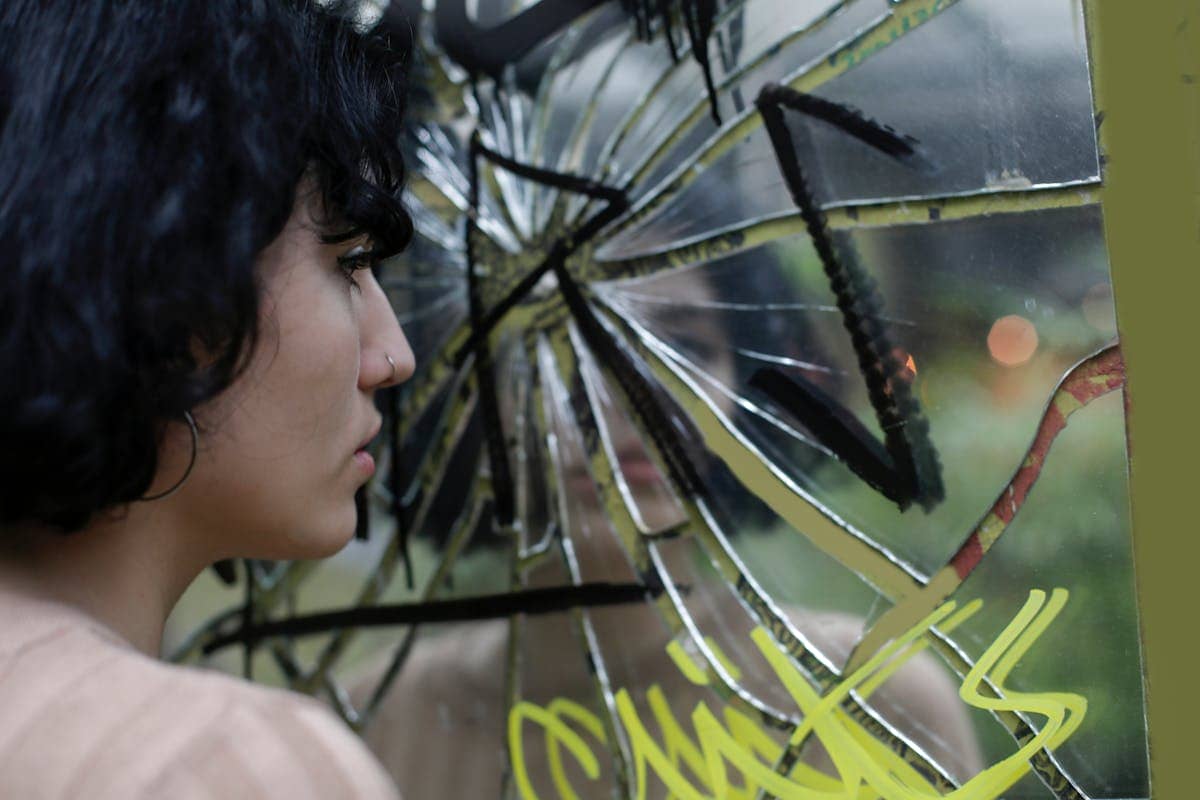
In art and literature, a broken mirror consistently signals one of four things: a self that can no longer hold together, a truth that has become partial or distorted, a moment of crisis that marks before from after, or vanity that has turned against its owner. The shards do not represent bad luck. They do conceptual work the whole mirror could not.
This is worth saying clearly because most writing on broken mirror symbolism stops at the superstition — seven years of bad luck, ancient Rome, the soul captured in glass. That history is real and worth knowing. But when a novelist places a shattered mirror in the room where a character's life breaks open, or when a painter shows a woman staring into cracked glass with her dress undone, they are not writing about luck. They are using the broken mirror as a compression device: a single image that does the argumentative work of three paragraphs.
Here is what that image is actually doing, across art, literature, film, and music — and how to read it when you encounter it.
What Broken Mirror Symbolism Means: Four Core Readings
Across centuries of art and literature, the broken mirror reliably signals one of these four meanings — sometimes in combination:
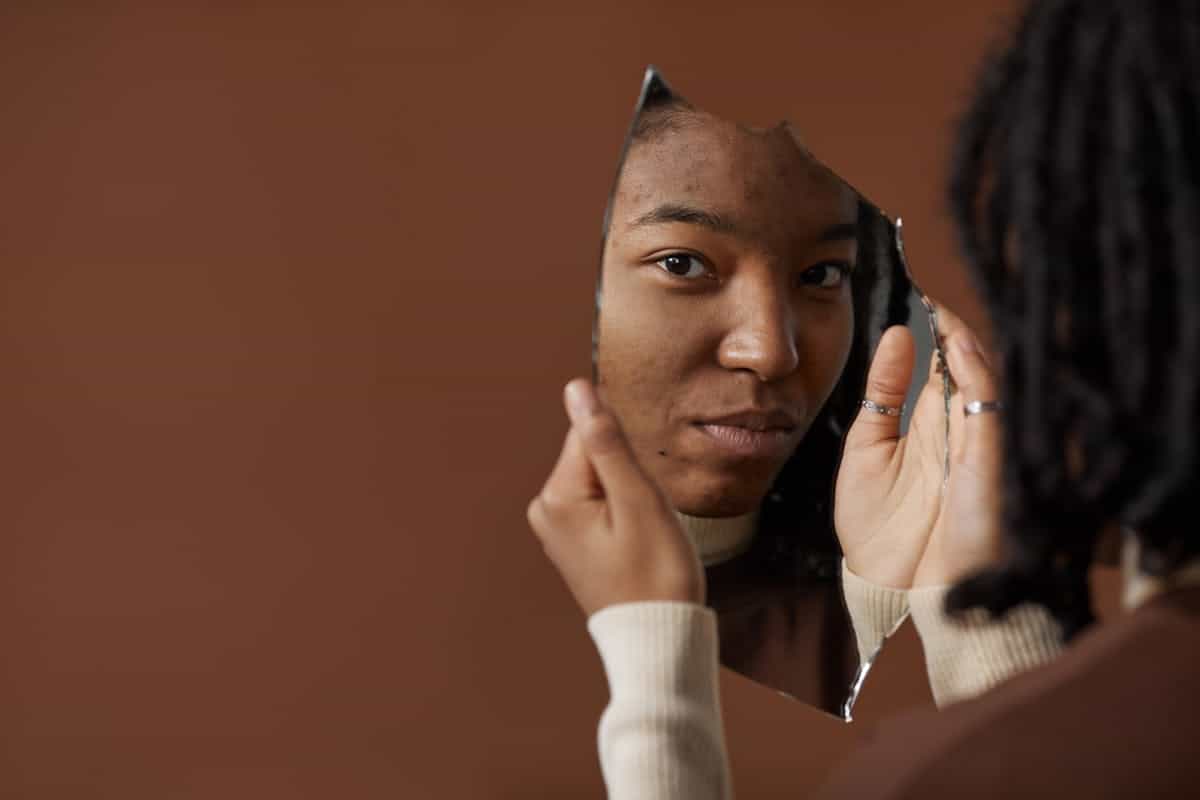
1. Fragmented selfhood. The subject no longer sees, or no longer trusts, a single stable version of themselves. The shards each show a different face, a different emotion, a different version of who the person is or has been. This is the most common reading, and it appears everywhere from Renaissance vanitas paintings to contemporary photography.
2. Ruptured truth. The mirror was the object that showed reality. Once it breaks, what you see is partial, distorted, or cruelly selective. In colonial and postcolonial literature, this reading appears often — the imposed mirror (the colonizer's version of the colonized) was always already cracked.
3. Crisis and transition. The break marks a before and after. Something happened here. The broken mirror is placed at the hinge of a narrative — a betrayal, a revelation, a collapse — to make that hinge visible. It is efficient staging: the audience understands the scale of the event from the image alone.
4. Vanity and its cost. Mirrors have been associated with vanity since antiquity. When vanity has destructive consequences — obsession with appearance, self-absorption that excludes others, beauty as control — artists break the mirror to show that cost. The punishment arrives via the object that enabled the vice.
Most uses of the motif activate at least one of these. Some activate all four at once, which is why the broken mirror can feel so dense as an image. It is not a symbol with a single locked meaning. It is a symbol with a consistent vocabulary that each work draws from differently.
Why This Symbol Became So Loaded: The Historical Roots

The superstition that breaking a mirror brings seven years of bad luck originated in ancient Rome. Romans believed mirrors did not merely show the face — they reflected the soul. Damaging the reflection damaged the soul itself. The seven-year timeline came from a separate Roman belief: that the body renewed itself in seven-year cycles. So the soul would recover, but only after seven years had passed.
The belief that breaking a mirror was genuinely catastrophic — not merely unlucky — was reinforced by material reality. For most of European history, mirrors were extraordinarily expensive. When the glassmakers of Murano, a small island near Venice, developed a superior process for making flat, clear mirrors using a tin-mercury amalgam backing in the 13th century, Venice effectively held a monopoly on European mirror production for over 400 years. The Venetian government guarded the secret so fiercely that glassmakers who attempted to share the technique with foreign buyers were allegedly threatened with assassination. A Venetian mirror in the 1600s could cost as much as a painting by a major artist. Royalty paid extraordinary sums. Common people went their entire lives without owning one.
This is the important context for understanding why broken mirror symbolism became so potent in European art and literature. A broken mirror was not just spiritually ominous — it was a financial catastrophe, a mark of extreme carelessness, a signal that something had gone seriously wrong in a household. Artists knew their audiences understood this weight instinctively. By the time glass mirrors became mass-produced in the late 19th century, the symbolism was so entrenched it persisted without the economic reality that had originally anchored it.
Different traditions drew different conclusions. In ancient Rome and medieval Europe, the broken mirror meant soul fracture and bad luck. In China, mirrors were considered spiritual portals, and breaking one symbolized disruption of harmony — though Chinese folklore also produced the story of Princess Lechang and Xu Deyan, who deliberately broke a mirror and each kept half as a token of reunion, giving rise to the phrase "broken mirror restored" as an idiom for separated lovers reuniting. In some parts of India and certain Japanese traditions, a broken mirror was reinterpreted as releasing accumulated negative energy — the crack as liberation rather than damage.
The cross-cultural range matters because no single tradition owns the meaning. The symbol is available to artists and writers precisely because it is not fixed.
Broken Mirror Symbolism in Literature
James Joyce and Oscar Wilde: The Cracked Lookingglass
The most economical use of broken mirror symbolism in English literature is a single phrase. In James Joyce's Ulysses (1922), Stephen Dedalus calls art "the cracked lookingglass of a servant." The phrase originates with Oscar Wilde, who used it to argue against the idea that art should simply mirror external reality — Wilde championed artistic genius over faithful reproduction.
Joyce repurposes the image with a specific edge: under colonial subjection, Irish art cannot offer a clean reflection of Irish reality because the conditions of its production are themselves distorted. The mirror is cracked not by accident or personal failing, but by structural condition. It is one of the most compressed political arguments in the language — all of it encoded in six words.
Mercè Rodoreda: The Broken Mirror as Life's Fragments
In the Catalan novelist Mercè Rodoreda's A Broken Mirror (1962), the symbol takes on a different register. When the character Armanda drops a mirror and watches it shatter, she sees in the fragments the pieces of her life with the family she has served — the good and the bad, impossible to reassemble into a coherent whole. Rodoreda's use is psychological rather than political: the mirror that breaks is not showing a cracked public reality but a cracked personal one, a life that cannot be held in a single image.
Fairy Tale and Gothic Fiction
The fairy tale tradition feeds literary uses of the broken mirror at every level. When the Evil Queen's magic mirror shatters, or when the enchanted glass in a Gothic novel cracks at the moment of revelation, these moments draw on a centuries-long vocabulary of mirrors as truth-tellers whose destruction signals the end of an illusion. Gothic and psychological fiction are especially rich in this symbolism because both genres work with doubles, hauntings, and unreliable perception — natural companions to cracked glass.
What to Look For in Literary Uses
Writers tend to deploy the broken mirror at turning points: after betrayal, after loss, after a character's self-concept collapses. The break is rarely decorative. If the mirror shatters on page one, something significant is opening. If it shatters in the climax, it marks the hinge the entire novel has been building toward. In verse, it can coincide with broken meter or interrupted dialogue — the formal break and the symbolic one reinforcing each other.
Broken Mirror Symbolism in Visual Art
Jean-Baptiste Greuze: The Painting That Set the Template
Jean-Baptiste Greuze's The Broken Mirror (c.1762–3, now at the Wallace Collection, London) is the canonical example of broken mirror symbolism in European painting. The work depicts a young woman in a dishevelled dress, her hair undone, leaning forward in her chair over a cracked mirror on the floor. A small dog in the corner — traditionally a symbol of fidelity — appears startled. Pearls spill from a half-open drawer.
Greuze was making an allegorical argument: the broken mirror represents broken morals. The dishevelled dress, the scattered pearls, the cracked glass — each element points in the same direction. We do not know whether the mirror was broken deliberately or by accident, and Greuze does not tell us. But the woman's expression — exhausted, downcast, having evidently wept — makes clear that whatever happened, it has cost her something she cannot recover. The painter did not need to show the cause. The broken mirror did that work.
This is the technique visual artists have used with the motif ever since: let the broken object carry the argument, and let the viewer's cultural knowledge fill in the meaning.
Photography and Contemporary Art
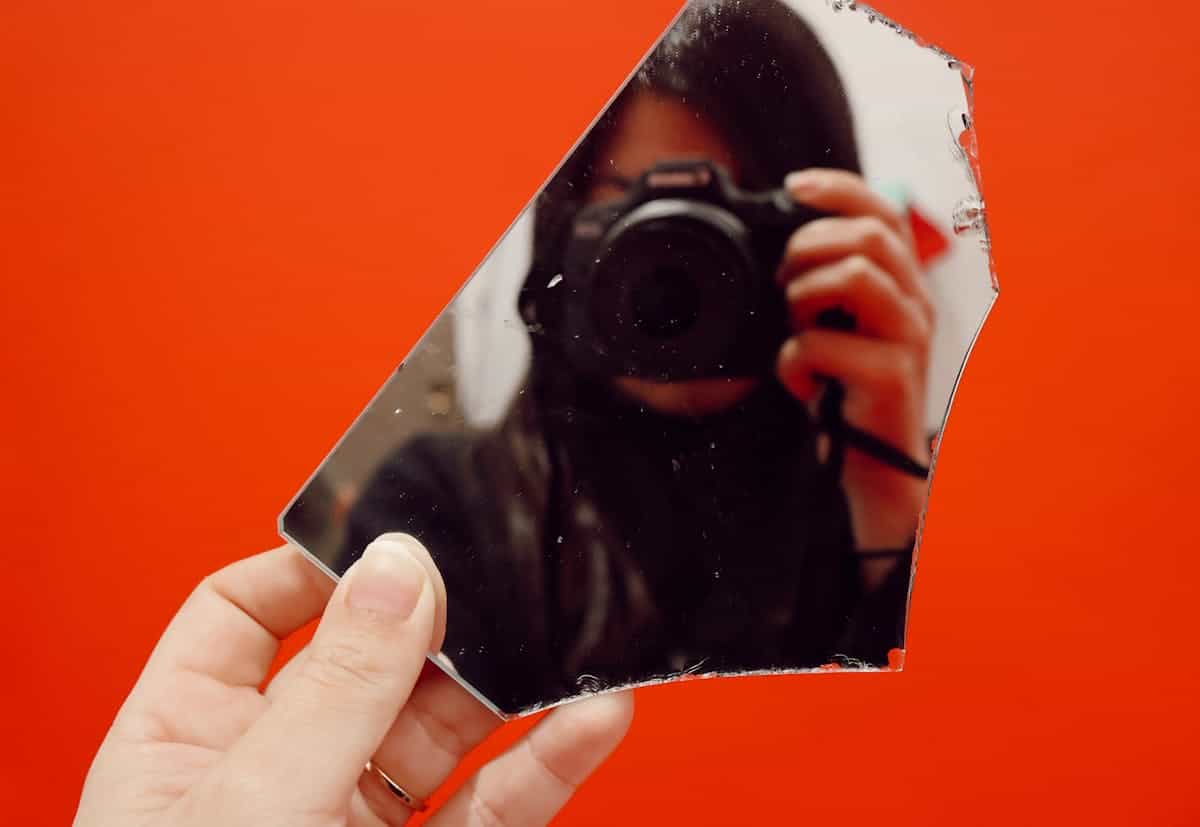
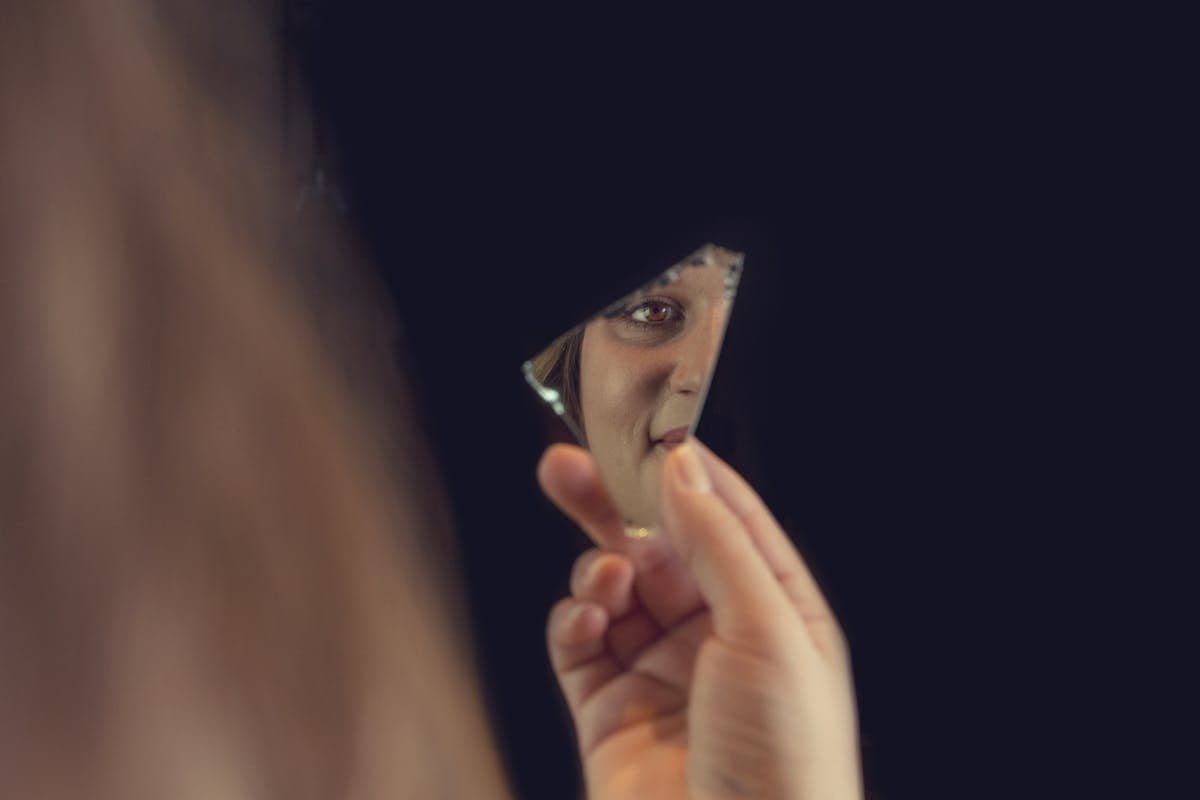
In contemporary photography, broken mirrors appear in staged and documentary work as metaphors for surveillance, identity politics, and psychological splitting. The face reflected in multiple shards becomes a visual argument: the subject cannot be held in a single image, cannot be reduced to a single version of themselves. Some photographers position a broken mirror to multiply the subject's expression — each fragment offering a different emotion simultaneously, where a whole mirror would offer only one.
Installation artists have pushed this further: rooms lined with cracked reflective panels where the viewer's own body becomes part of the fragmenting image, unable to see itself whole. The effect is disorienting in a way that connects to literature's broken-mirror moments — you are made aware of what it feels like not to be able to see yourself clearly.
What Viewers Should Ask
When examining a painting or photograph that uses a broken mirror, the relevant questions are: Who broke it? Does the work show the moment of breaking or the aftermath? Does the subject look at the broken glass or away from it? And — this is the most important question — how does the fragmentation change what we see of the person reflected? The answer to that last question is usually the argument the artist is making.
Broken Mirror Symbolism in Film
In film, the broken mirror is one of the most reliable signals of psychological fracture. Directors use it because it is fast, visually legible, and does not require dialogue to explain — audiences who have absorbed the symbol from art, literature, and cultural tradition understand instinctively that something has shattered beyond the glass.
Black Swan (Darren Aronofsky, 2010) is probably the most discussed recent example. As Nina's sense of self erodes across the film, mirrors track the breakdown: first showing her reflection behaving independently of her, then fracturing. The broken mirror is not a single moment in the film — it is a running condition, the visual grammar of a disintegrating identity. Aronofsky uses it as a diagnostic tool: the state of the mirror tells you the state of Nina's self.
Horror films have made the broken mirror a genre convention, which has somewhat diluted its impact — the cracked bathroom mirror is now almost a shorthand for "this character is in trouble." The more interesting uses are in psychological drama and noir, where the break is earned by what has happened in the narrative rather than deployed as a general atmosphere signal.
In film noir, broken mirrors appear at moments of moral compromise: the detective who has crossed a line, the femme fatale who has seen too much. The break coincides with the character's recognition that they cannot go back to who they were before the choice was made.
Music: The Medium That Rarely Gets Discussed
Broken mirror imagery appears in music in ways that rarely receive the same analysis as literary or visual uses, but the pattern is consistent.
In songwriting, a shattered mirror most often appears in lyrics about romantic disillusionment, self-perception, and identity collapse — the moment when the story a person has been telling themselves about who they are no longer holds. The mirror that once confirmed self-image becomes the object that proves the image was wrong. Breaking it is sometimes described as an act of anger (the smashing of the delusion along with the glass) and sometimes as something that happens to the character passively, as they watch the image they held of themselves fragment without choosing it.
What is consistent across musical uses, as in literary and visual ones, is this: the broken mirror marks the end of a version of the self that can no longer be maintained. Whether that ending is framed as liberation or loss depends on the song's perspective — but the symbol's function, the marking of a before-and-after, remains stable.
The Psychology of Why This Motif Works
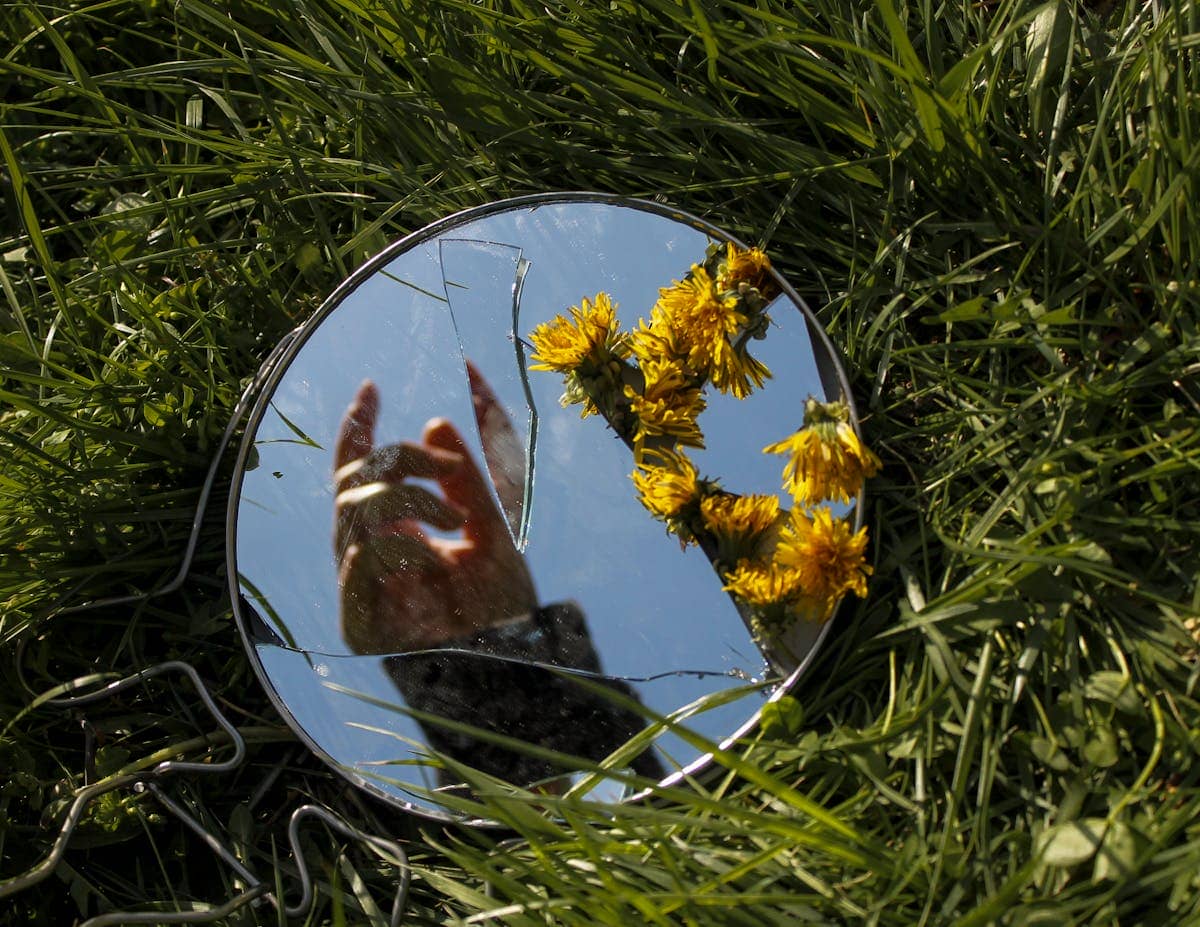
The broken mirror resonates psychologically because the mirror is already the object most directly associated with self-perception. We see ourselves in mirrors in a way we do not encounter ourselves otherwise — from the outside, as others see us, but reversed. A 2024 study found that self-focused mirror gazing reduces appearance satisfaction even in people without body image concerns. The mirror is already an object with the capacity to disturb.
When that mirror breaks, the disturbance becomes visible and literal. The fragments each show a partial version of the face — different angles, different expressions, different amounts of the whole. This maps directly onto the psychological experience of fragmented identity: the sense of being multiple, inconsistent, impossible to hold in a single coherent self-concept.
Artists and writers have used this correspondence instinctively for centuries. The broken mirror externalizes a subjective experience — the feeling of not being able to see yourself clearly — in a physical object that any viewer can understand. The symbol works because the psychology it represents is universal, even when the specific cause (betrayal, trauma, colonial subjection, obsession) varies across works.
Kintsugi: The Broken Mirror Reimagined
One angle that most treatments of this symbolism miss is what happens after the break.
The Japanese art of kintsugi repairs broken ceramics with lacquer mixed with gold or silver, deliberately highlighting the cracks rather than concealing them. The philosophy behind it holds that the history of an object — including its damage — is part of its value, not a defect to be hidden. A kintsugi-repaired bowl is considered more beautiful than an unbroken one because its survival is visible.
Applied to the broken mirror motif, kintsugi represents the reading that is missing from most Western treatments of the symbol: the crack as something that can be acknowledged, repaired, and transformed into a mark of authenticity rather than damage. Some contemporary artists have literally worked with this idea — mirror installations in which the cracks are gilded, the fragmented reflection displayed as a more honest self-portrait than the whole mirror could provide.
This is not a sentimental or consoling interpretation layered onto a dark symbol. It is a genuine alternative tradition that has existed alongside the bad-luck and soul-damage readings for centuries, simply in a different cultural context. The interesting thing about broken mirror symbolism is not that it means one thing across all contexts. It is that it means different things depending on what a culture believes about damage, repair, and the value of a visible history.
How to Read Broken Mirror Symbolism in a Specific Work

When you encounter a broken mirror in a work you are analyzing, four questions will usually get you to the argument:
1. Placement. Does the mirror break at the climax, in the opening, or quietly in the background? Climactic breaks are usually the point the entire work has been building to. Opening breaks set a condition the narrative will explore. Background breaks are often atmospheric, loading the work with symbolic weight without making the symbol the explicit subject.
2. Agency. Who or what breaks it — accident, anger, an external force, fate? A character who breaks a mirror in rage is usually destroying a self-image they can no longer accept. A mirror that simply falls and shatters suggests a more helpless or fated fragmentation. A mirror broken by another character complicates it further: whose selfhood has been shattered, and by whom?
3. Aftermath. What happens immediately after the break? Are characters cut by the shards? Do the fragments recur in the story? Does anyone try to repair or collect the pieces? The aftermath usually clarifies the symbolic direction — whether the break is loss, liberation, or something more ambiguous.
4. Medium. In literature, the sound of breaking glass, the glitter of fragments, and the blood from a cut can carry as much symbolic weight as the image itself. In visual art, the compositional choices — which part of the face falls in which shard, what the color of the background does to the light — are the argument. In film, the sound design around the break often tells you more than the image.
This is the practical version of the same observation James Joyce compressed into a single phrase. The cracked lookingglass is not an image with a fixed message. It is an image with a vocabulary — and every work draws from that vocabulary differently. Tracing how a specific work uses it is how the symbol opens into an argument rather than remaining a striking but unexamined image.
For a broader exploration of how the broken mirror functions within the full range of mirror beliefs and superstitions, the mirror symbolism across world cultures guide covers the traditions that feed these artistic uses in more depth. If you want to understand the specific superstition and where it came from, the history of the 7 years bad luck belief traces the Roman origin through to how it spread across Europe. And for the spiritual dimensions specifically — what different traditions say should be done after a mirror breaks — broken mirror spiritual meaning and what to do covers the practical and ceremonial responses across traditions.
For the academic perspective on the superstition's origins, USC's analysis of the broken mirror superstition is one of the clearest scholarly treatments available. The original painting by Greuze is held at the Wallace Collection in London; the Art Theoria analysis of The Broken Mirror examines what the painting is doing in detail. For the Chinese folklore dimension, The Broken Mirror Restored on Wikipedia covers the story of Princess Lechang in full.
The mirror that breaks in a story or painting is almost never about the glass. It is about whoever was looking into it — what they were seeing, what they were refusing to see, and what happens to a person's sense of themselves when the surface that was supposed to show them clearly can no longer hold. That is the argument the motif has been making since Greuze painted a dishevelled woman staring at cracked glass in 1762. The specific cause changes with every work. The core question stays the same.
Mirror FAQ
What does a broken mirror symbolize in art and literature?
In art and literature, a broken mirror most commonly symbolizes one of four things: fragmented identity (the self no longer holds together), ruptured truth (reality is no longer reliably reflected), crisis or transition (a decisive before-and-after moment), or vanity turned destructive. It is rarely decorative — artists and writers place it where they need to compress a large idea into a single image.
Why do so many artists use broken mirror imagery?
A broken mirror is already culturally loaded — mirrors carry centuries of association with truth, vanity, the soul, and self-image. Breaking one activates all of that symbolism instantly. Artists use it because it is a compressed metaphor: a single image that carries an argument without needing explanation. Jean-Baptiste Greuze used it in 1762 to signal moral collapse; contemporary photographers use it to explore fractured identity; filmmakers use it to mark psychological breakdown. The medium changes; the efficiency of the image stays constant.
What does the broken mirror mean in James Joyce's Ulysses?
In Ulysses, Stephen Dedalus calls art "the cracked lookingglass of a servant" — a phrase Stephen borrowed from Oscar Wilde. The image argues that Irish art, produced under colonial subjection, is inevitably distorted, unable to offer a clean and faithful reflection of reality. The mirror is cracked not by accident but by structural condition. It is one of the most economical uses of broken mirror symbolism in English literature.
What does a broken mirror mean in dreams?
Most psychological interpretations treat a broken mirror in dreams as representing self-doubt, confusion about self-image, or a sense that the dreamer's understanding of themselves is incomplete or shifting. Some traditions associate it with upcoming transformation — the old self-image shattering to make way for a revised one. These are interpretive frameworks, not established science, but they are consistent with how the symbol functions in waking art and literature.
Is broken mirror symbolism always negative?
No — and that is the more interesting answer. In Japanese kintsugi philosophy, broken objects repaired with gold are considered more beautiful than unbroken ones because their history is visible. Some traditions explicitly frame a broken mirror as releasing accumulated negative energy rather than causing misfortune. In literature and art, a broken mirror can signal liberation as readily as loss — the character who breaks the mirror is sometimes escaping a false self-image, not just suffering. The meaning depends entirely on who breaks it, why, and what happens afterward.
What is the broken mirror superstition's actual origin?
The superstition originated in ancient Rome, where mirrors were believed to reflect not just appearance but the soul itself. Romans thought the soul renewed itself every seven years — so a broken mirror meant seven years of damage to the soul before the cycle reset. The superstition became widely known in Europe after glass mirrors became mass-produced in the late 1800s, when breaking one was also genuinely expensive. Both the spiritual belief and the practical cost combined to make breaking a mirror feel significant.
How is broken mirror symbolism used in film?
In film, a broken mirror most often marks a moment of psychological fracture or identity crisis. In Black Swan, Nina's reflection splinters as her grip on her sense of self loosens — the broken mirror tracks the breakdown. In horror films, it signals danger and fractured reality. In noir, it appears at moments of moral compromise. Directors use it because it is fast, visually striking, and culturally legible — audiences understand something has shattered beyond the glass without needing dialogue to explain it.