Mirrors, Mind & Soul: Psychology Meets Spirituality

If you have looked in a mirror not to fix something specific but to actually look at yourself — and felt, for a second, something stranger than routine — you are not imagining it. That experience lands at the exact intersection this article covers: what psychology says is happening when you look, what spiritual traditions say the mirror reveals, and what the concept of spiritual mirroring means when it is used carefully rather than loosely.
These are not the same question. Psychology describes a mechanism; spirituality offers a frame for meaning. Both are worth understanding, and both are worth keeping separate rather than collapsed into one resonant-sounding claim that the mirror "shows the truth."
What mirror psychology actually says

Mirror psychology is not a single field — it is the intersection of developmental research, body image studies, social cognition, and clinical work, all converging on one ordinary object. What they collectively describe is this: recognising yourself in a mirror is not a passive act. It is a bundle of processes — visual matching, body schema, emotional memory, social comparison — that fire quickly enough to feel instant but are doing significant work underneath.
Research from 2024 found that 73.03% of participants in a college sample reported negative body-image perception. That number is not a surprise to anyone who has had an unkind morning in front of a bathroom mirror, but it is worth stating plainly: harsh mirror moments are not a personal failing. They are a population-scale pattern, shaped by culture, comparison, and the particular unkindness of catching a neutral expression and reading disappointment into it.
Here is what makes mirror psychology genuinely interesting: the same mirror, in the same light, on different days, can feel managerial, diagnostic, or hostile — depending entirely on what you bring to it. The surface has not changed. The emotional context has.
The looking-glass self: why the reflection carries other people's voices

Charles Horton Cooley's looking-glass self (1902) is quieter than Lacanian theory in most psychology writing, but it belongs in any serious answer to "why do mirrors hurt sometimes."
Cooley argued that self-image builds in three moves: imagining how you appear to someone else, imagining their judgment of that appearance, and feeling pride or shame from that imagined verdict. You do this constantly, mostly without noticing.
Translation for what happens at a mirror: when you look at yourself, you are frequently not only seeing features and expression. You are simulating audiences — a parent's tone from childhood, a peer's comment from years ago, a beauty standard currently circulating on social media. The reflection becomes a surface onto which those voices project.
This is why calling a mirror "the truth" is worth examining. Optically, a flat mirror shows one projection of your face — laterally reversed, at a distance you choose, in whatever light happens to be available. A photograph shows a different projection with different distortions. Neither is more accurate; they are different representations of the same face. When a mirror feels true, it is often because the emotional charge attached to it is loud. Volume is not accuracy.
When "that's me" first begins
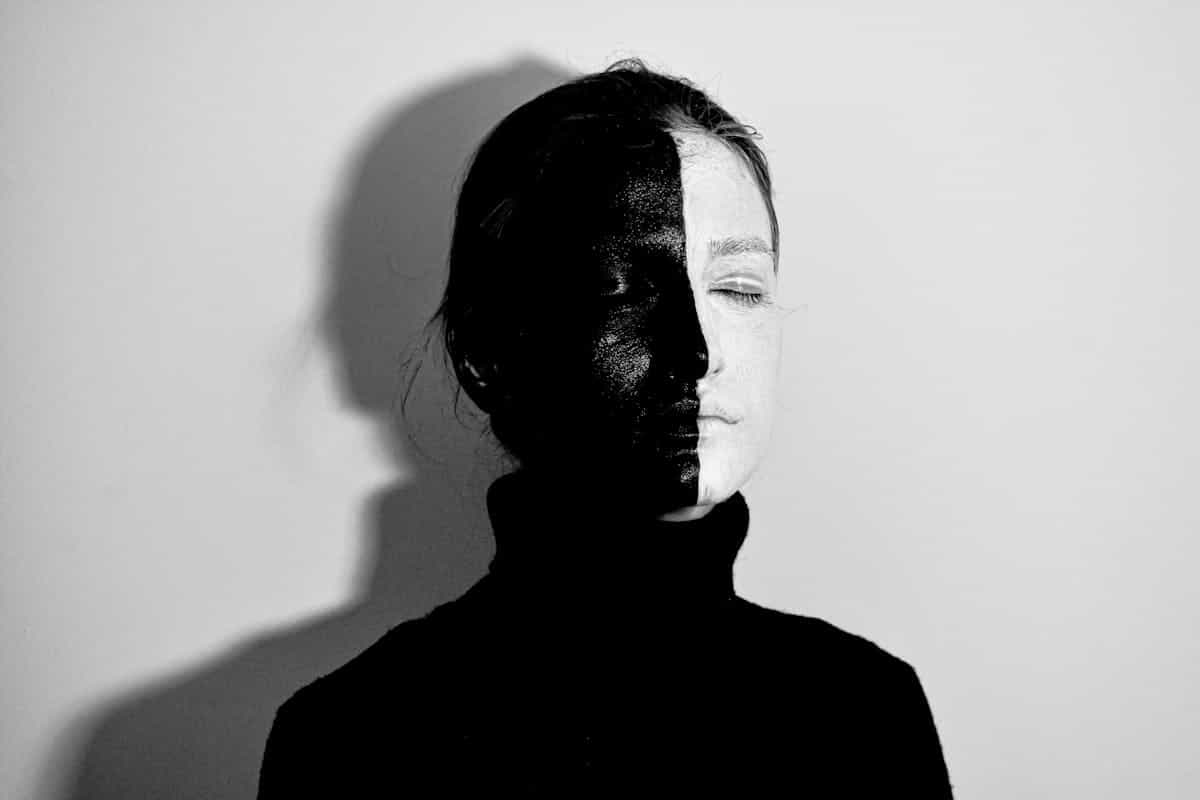
Developmental psychology gives the mirror-and-identity story a concrete anchor. Most children pass the mirror self-recognition test — a spot of colour placed on the face, the child must touch their own cheek rather than the glass — somewhere around 15–18 months. Before that, a young child will often treat the reflection as another person: smiling at it, reaching for it, trying to interact with the face they see. Then something shifts and the hand goes to their own face instead.
No one teaches this. It emerges when the nervous system is ready. The same test has been given to chimpanzees, orangutans, bottlenose dolphins, orcas, elephants, and Eurasian magpies — and a small number of individuals in each group pass it.
This is worth keeping in mind when discussions about mirrors turn to souls: mirror self-recognition does not appear to require any particular spiritual framework. It requires the right neural architecture and developmental timing. That does not make the milestone trivial. It makes it genuinely interesting in a way that vague "mirrors reveal the soul" language can obscure.
What "spiritual mirroring" actually means

"Spiritual mirroring" is used to mean two quite different things, and the distinction matters.
The first meaning is relational: reflecting another person's inner state back to them — their emotions, their energy, their experience — so they feel genuinely seen. This practice appears in therapeutic settings, contemplative communities, and some spiritual traditions where being truly witnessed is treated as a form of presence or grace. The idea is that being mirrored — having your experience accurately reflected rather than redirected or dismissed — is itself a form of connection and, in some frameworks, healing.
The second meaning is literal: using a physical mirror as a focus for practice. Prayer or meditation in front of a mirror. Affirmations spoken to the reflection. Cleansing rituals using the glass to clear accumulated negative energy. In these practices, the mirror functions as a tool for focused attention — not a metaphysical device that operates independently. That distinction — tool versus agent — is the line worth drawing clearly.
Collapsing the two meanings produces hollow content. Spiritual mirroring as empathic presence has real psychological correlates in attunement and co-regulation research. Spiritual mirroring as a ritual with a physical mirror has real value as an attention and intention practice. Both deserve their own explanation rather than being folded into one ambient claim about "mirror energy."
Mirror souls: what the phrase actually means
The phrase "mirror soul" most commonly refers to a person, not an object — someone whose presence reflects your own patterns, contradictions, and unresolved material back to you so clearly that the encounter is hard to avoid. In some frameworks this overlaps with "twin flame" language: the idea of a relationship so intensely reflective that it either catalyses growth or surfaces things you would rather not see.
Separately — and this is worth keeping separate — there is a long tradition of belief that the physical mirror captures or holds the soul. Ancient Romans believed the mirror held part of the soul, which is why breaking one damaged that fragment and required seven years to recover. In certain West African and Afro-Caribbean spiritual traditions, mirrors are understood as thresholds: surfaces through which ancestors can be contacted or through which spiritual energy moves.
These are distinct claims. One is relational and psychological (a mirror soul as a person who reflects you back to yourself). The other is physical and spiritual (the glass as a literal container or portal). Conflating them produces the kind of vague "mirrors hold energy" content that sounds meaningful but tells the reader nothing specific about what any tradition actually believes.
The significance of mirrors across spiritual traditions

Different traditions have arrived at the mirror through different routes, and the meanings do not converge into one tidy conclusion.
In Buddhist teaching, the mirror appears as a metaphor for the mind: originally clear, capable of reflecting everything without distortion, but clouded by grasping and aversion. The mirror does not judge — attachment does. In Hindu contexts, the mirror turns up in cosmological metaphor (the manifest world as a reflection of Brahman) and in devotional ritual, where mirrors are sometimes used in puja as a way of offering the deity their own reflection.
In Sufi and Islamic poetry, the heart is described as a mirror: polished by sincere practice and remembrance of God, it reflects divine qualities; dulled by distraction and heedlessness, it cannot. The image of the mirror as a spiritual barometer — bright or clouded depending on the condition of the soul — runs through the work of Rumi and Hafiz in ways that shaped how much of the world thinks about mirrors and inner life.
In the Jewish tradition, early rabbinical writing expressed caution about excessive mirror use on moral grounds — warnings against vanity rather than claims about what the glass could physically do to the soul. In Christian mysticism, Paul's phrase "through a glass, darkly" (1 Corinthians 13:12) uses the mirror as a metaphor for partial and imperfect knowledge of the divine, with the promise of eventually seeing "face to face."
What these traditions share is not a mechanism. None of them are making the same physical claim about what a mirror does. What they share is an impulse: the mirror as a place where looking at the surface becomes an occasion for looking inward.
When mirrors become a mental health concern

If looking in a mirror regularly triggers panic, extended checking sessions, or a pattern of complete avoidance — that deserves to be treated as a health concern, not a spiritual failing.
Body dysmorphic disorder affects approximately 1.7–2.9% of the general population and typically involves either compulsive mirror checking or active avoidance — sometimes both at different times in the same person. Both patterns tighten the same trap: the mirror becomes more loaded, not less.
Research from 2024 also found that self-focused mirror gazing reduces appearance satisfaction even in people without any clinical diagnosis. This is the opposite of "stare until you love yourself." For most people, long critical sessions in front of a mirror do not produce acceptance. They produce fatigue.
One pattern that appears consistently in clinical accounts: people who avoid mirrors for extended periods often find that their mental image of themselves has drifted further from reality than the actual reflection. A reader described covering her bathroom mirror for six months, and when she eventually looked again with a therapist's guidance, the most striking thing was not what she saw — it was how distorted her internal image had become compared to the face in the glass. The fear had grown; the face had not changed.
No spiritual framework about mirror energy or soul reflection should substitute for professional support when daily functioning is at risk.
Practices that draw on both frameworks without distorting either

If you want to bring intentionality to mirror use without borrowing claims neither psychology nor tradition actually supports:
- Limit sessions with a purpose. "I am checking this specific thing and then stepping away" is more useful than open-ended mirror time, which tends to drift toward criticism.
- Affirmations with realistic wording. Short, believable phrases spoken with slow breathing and steady eye contact work better than overclaiming. The goal is stability, not a sudden shift in feeling. For a research-grounded walkthrough, the mirror affirmations guide covers method and evidence.
- When the mirror is harsh, ask whose voice is speaking. Cooley's framework is useful here: the glass does not judge on its own. Something social is narrating what you see. Identifying the narrator is often the beginning of quieting it.
The mirror is one of the oldest objects in human material culture — polished obsidian in Anatolia as far back as 6000 BCE, polished copper in ancient Egypt by around 3100 BCE, clear glass only in the last two thousand years. In all that time, what the mirror was said to reveal kept changing. Cultures projected onto it what they most needed to confront: vanity, soul, truth, impermanence, divinity, the distorted image.
What you bring to it is still the more interesting story.
Mirror FAQ
What is spiritual mirroring?
"Spiritual mirroring" carries two distinct meanings that frequently get collapsed together. The first is relational: reflecting another person's emotional state back to them so they feel genuinely seen — a practice used in counselling, contemplative communities, and some spiritual traditions as a form of empathy or presence. The second is literal: using a physical mirror as a focus for prayer, meditation, affirmations, or cleansing rituals, treating the reflection as an encounter with an inner self or higher aspect of oneself. Both are legitimate concepts. Mixing them without clarifying which you mean is how content about mirrors accidentally sounds profound while saying very little.
What does "mirror soul" mean?
The phrase "mirror soul" most commonly refers to a person — someone whose presence reflects your own qualities, contradictions, or unresolved patterns back to you in a way that forces self-recognition. In some spiritual frameworks it overlaps with "twin flame" language: a relationship so intensely reflective it accelerates growth or surfaces what you have been avoiding. This is distinct from the separate historical belief that the physical mirror captures or holds the soul — a belief found in ancient Rome and certain West African traditions — which treats the glass itself as the agent rather than the relationship.
What is the psychology behind looking in the mirror?
Looking in the mirror recruits self-recognition, body image, and social self-evaluation simultaneously: you are matching what you see to a stored idea of "me," usually with emotional history attached. Charles Horton Cooley's looking-glass self (1902) adds a social layer — we partly build self-concept from imagining how others see us, so a mirror can trigger simulated social judgment even when you are alone. Research from 2024 found that 73.03% of college students reported negative body-image perception, and self-focused mirror gazing was shown to reduce appearance satisfaction even in people without body dysmorphic concerns. The mirror is not neutral; it is a surface covered in meaning that you and your culture put there.
What is the significance of mirrors spiritually?
Mirrors carry spiritual significance across a wide range of traditions, but the meaning varies enormously by context. In ancient Rome, mirrors were thought to capture part of the soul — breaking one meant seven years of bad luck because the soul fragment was damaged. In certain West African and Afro-Caribbean traditions, mirrors function as thresholds through which ancestors can be contacted. Buddhist teaching uses the mirror as a metaphor for the mind: originally clear and undistorted, clouded by attachment. In Sufi and Islamic poetry, the heart is described as a mirror that polished practice brightens. What the traditions share is not a mechanism but an impulse: the mirror as the place where looking at the surface leads to looking inward.
How do mirrors affect mental health?
Mirrors are neutral tools with highly personal effects. They can support deliberate exposure work in clinical settings when guided, but they can also fuel compulsive checking, shame cycles, or avoidance — patterns common in body dysmorphic disorder, which affects approximately 1.7–2.9% of the general population. Research also shows that self-focused mirror gazing reduces appearance satisfaction in people without any clinical diagnosis, which is why "stare until you love yourself" is not universal advice. If mirrors trigger panic, hours of checking, or complete avoidance, that pattern deserves clinical attention, not moral judgment.
Why do I feel uncomfortable looking in the mirror?
Common reasons include a mismatch between how you feel inside and what you see, accumulated social comparison attached to the face, depression or anxiety colouring what you notice first, or simply catching a neutral expression and reading something negative into it. Avoidance can feel protective short term; clinically, it tends to enlarge fear. People who avoid mirrors for extended periods often find their mental image of themselves has drifted further from reality than the actual reflection warrants. If discomfort is severe or persistent, resources on mirror anxiety and body dysmorphic disorder — and professional support — are worth exploring.