Mirror Science and Physics: How Mirrors Work
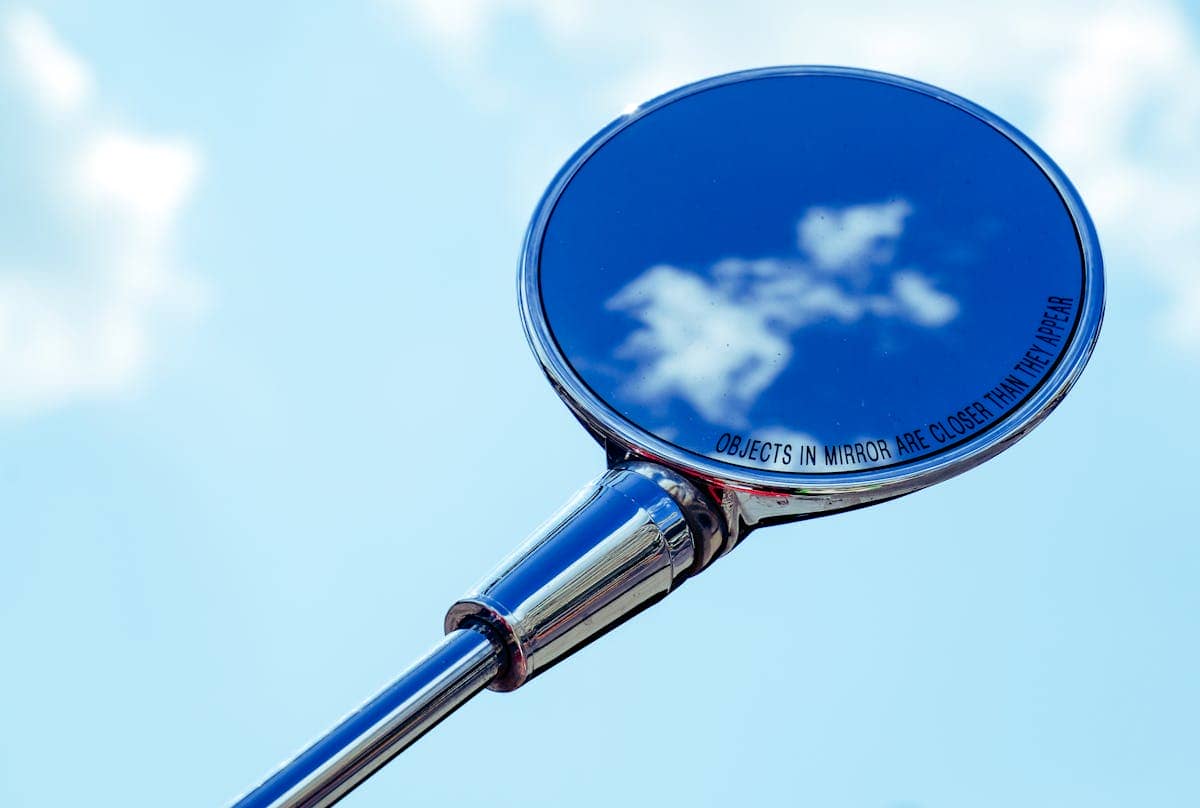
A mirror works by bouncing incoming light off a smooth metallic surface at precisely the angle it arrived. The reflective layer — usually aluminium (88–92% reflectance) or silver (95–99%) — is vacuum-deposited onto polished glass to within nanometre-level smoothness. The surface must be smooth at the scale of visible light wavelengths, which run from 380 nm (violet) to 700 nm (red), to reflect coherently rather than scatter. Every mirror image you have ever seen — from a bathroom reflection to a galaxy imaged by the James Webb Space Telescope — follows the same two-line rule: the angle of incidence equals the angle of reflection.
Understanding why that rule produces a recognisable image, why it does not flip images upside down, and what happens at the photon level requires going one layer deeper than the textbook summary. Here is what that looks like.
What Is the Law of Reflection?

When a ray of light strikes a surface, two things define the geometry of what happens next: the angle of incidence (the angle between the incoming ray and the normal — the imaginary line perpendicular to the surface at the point of contact) and the angle of reflection (the angle between the reflected ray and that same normal).
The law of reflection states:
The angle of incidence equals the angle of reflection. Both are measured from the normal. The incident ray, the reflected ray, and the normal all lie in the same plane.
This is not an approximation. It holds exactly for any smooth reflective surface, at any wavelength in the visible spectrum, at any angle of incidence. A ray hitting a mirror at 30° from the normal leaves at 30°. At 60°, it leaves at 60°. The relationship is 1:1 from 0° (perpendicular incidence) to 90° (grazing incidence).
The Physics Classroom's walkthrough of the law of reflection shows the geometry applied to specific angles with diagrams. The Wikipedia article on reflection in physics covers both the classical and electromagnetic derivations if you want the wave-optics version.
What the textbook version usually skips: the law explains only the direction of the reflected ray. It does not explain why you see a coherent image rather than a diffuse glow. That requires understanding the difference between specular and diffuse reflection.
Specular vs Diffuse Reflection: Why Some Surfaces Create Images and Others Do Not

The law of reflection applies to every surface — rough walls, white paper, skin, gravel. Every surface reflects some light. The difference between a mirror and a white wall is not that one reflects and the other absorbs. Both reflect. What differs is whether the reflection is organised or scattered.
Specular reflection occurs when a surface is smooth at the scale of the incoming light's wavelength. Visible light ranges from 380 nm to 700 nm. When surface irregularities are significantly smaller than the wavelength of light, incoming parallel rays all reflect at the same angle — they stay parallel after reflection. The spatial information carried in the incident light is preserved. The result is a clear, coherent image.
Diffuse reflection occurs when the surface is rough at the scale of light wavelengths. Irregularities larger than roughly 700 nm cause each ray to encounter a locally different surface angle. Parallel incoming rays scatter in different directions after reflection. Spatial information is destroyed. No image forms. The surface appears bright and visible from all angles, but shows no reflection.
This single distinction explains most of what you see in daily life:
| Surface | Reflection type | Reason |
|---|---|---|
| Mirror | Specular | Metal surface smooth to nanometre precision |
| Calm lake | Specular | Water surface flat at light wavelength scale |
| Choppy lake | Diffuse | Wind-driven ripples rough at light wavelength scale |
| White paper | Diffuse | Cellulose fibre surface rough at light wavelength scale |
| Polished metal | Specular | Machined to sub-wavelength smoothness |
| Matte paint | Diffuse | Pigment particles scatter at wavelength scale |
| Fog | Diffuse | Droplets scatter light in all directions |
(This is the part most optics introductions underweight. The specular-diffuse distinction, once understood, lets you predict from the visible texture of any surface whether it will form a reflection — without measurement. The difference between a glossy and matte finish, a reflective lake and scattering fog, a mirror-quality surface and a kitchen tile, is always the same question: is the surface smooth or rough at the scale of the wavelength?)
Why Do Mirrors Flip Left and Right but Not Upside Down?
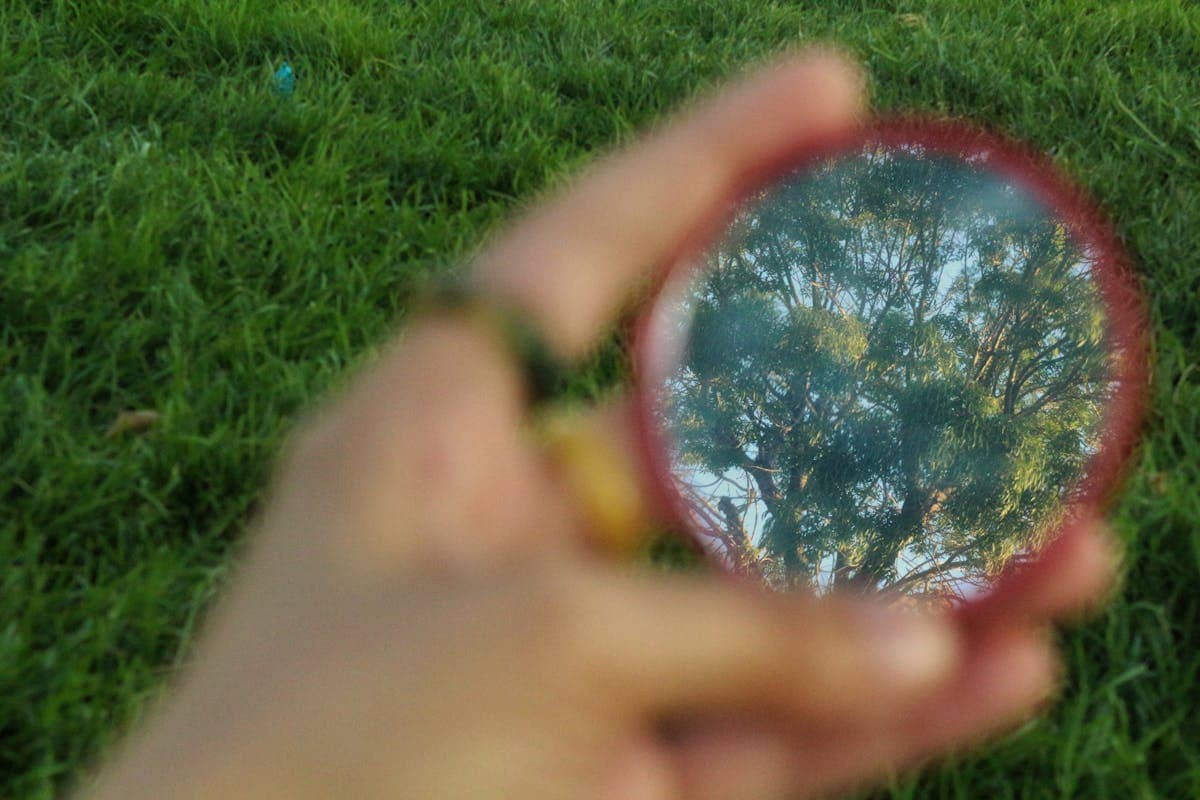
This is one of the most frequently asked questions in optics — and one of the most frequently misexplained.
The short answer: mirrors do not flip left and right. They flip front to back.
Here is what is actually happening. Stand in front of a mirror. Your reflection appears to be a person who has been flipped on the left-right axis: your right hand appears on the reflection's left side. But this is not what the mirror did.
The mirror reversed the axis pointing into it — the front-to-back (depth) axis. The mirror-you is not rotated. It is a depth-reversal of the real you. Your right hand is still on the right side of that reversed figure. The reflection's heart is on the same side as yours.
The confusion arises from a step the brain takes automatically: it interprets the reflection as a person who has turned around to face you. If a real person turned to face you from behind a wall, their right hand would be on your left. But the mirror did not rotate the image. It only reversed depth. When the brain simulates what it would look like for the reflection to have turned around, it introduces an apparent left-right flip — which exists only in the mental model, not in the physics.
The "left-right flip" is a consequence of spatial reasoning, not optics. The mirror treats left-right and up-down identically. It reverses only the dimension perpendicular to its surface.
Verification: hold printed text up to a mirror. It appears reversed. The reversal is in the depth axis — the letters are the same orientation they always were, but the front and back of the paper have been swapped. If you imagine walking behind the page and looking through it at the front, the letters would appear exactly as they do in the mirror. That is the actual geometry.
For how this reversal connects to centuries of cultural meaning attributed to reflections, the guide to mirror symbolism across world cultures covers the cultural history of what humans have made of the mirror image.
The Three Types of Mirrors and How Each Forms Images
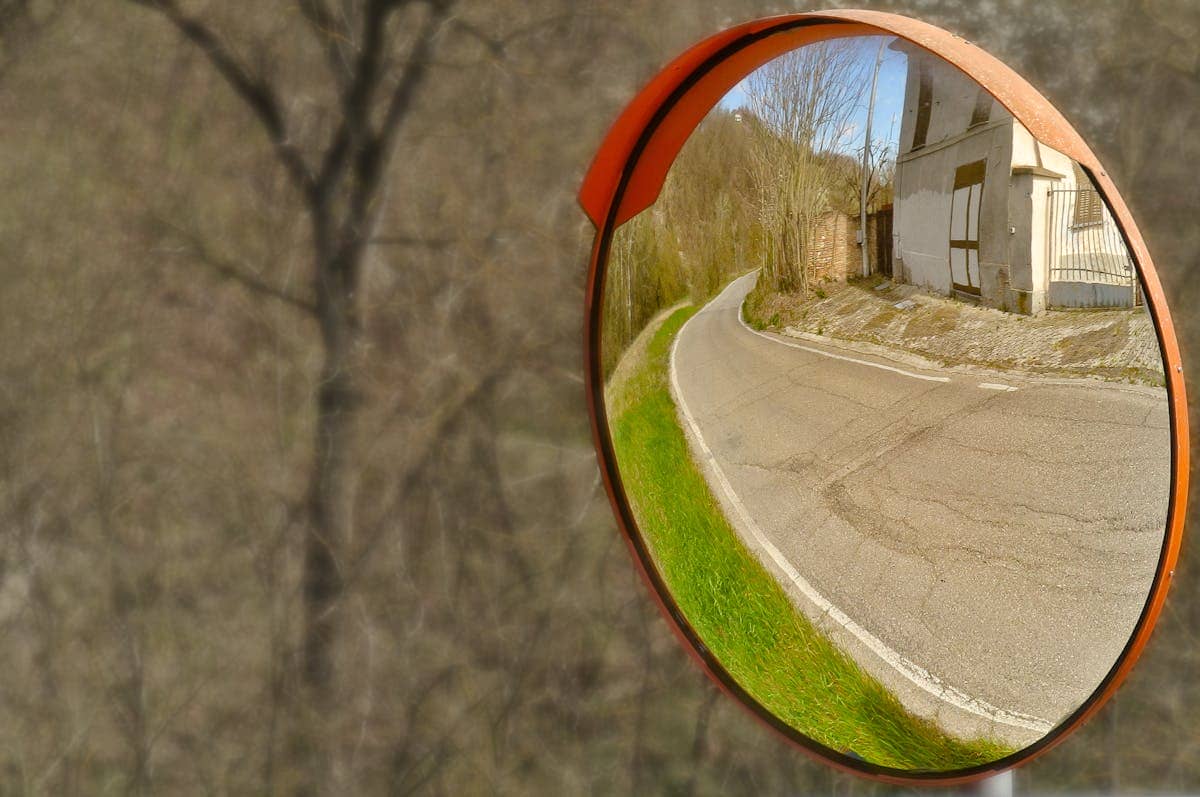
All mirrors obey the same law of reflection. What changes is the geometry of the surface — and that geometry determines where reflected rays converge or diverge, and therefore what kind of image forms.
Plane mirrors have a flat reflective surface. Every incoming ray reflects at the same local geometry. The image formed is:
- The same size as the object
- Upright (same vertical orientation)
- Laterally reversed (depth-axis reversal)
- Virtual — it appears behind the mirror, at the same distance as the object is in front
- Cannot be projected onto a screen
Concave mirrors curve inward, like the inside of a sphere. Incoming parallel rays converge after reflection toward the focal point, located at a distance equal to half the radius of curvature. Behaviour depends on object position relative to the focal point:
- Object beyond the focal point → real, inverted image (can be projected onto a screen)
- Object at the focal point → reflected rays exit parallel, no image formed
- Object between mirror and focal point → virtual, upright, magnified image
Applications: reflecting telescopes (primary mirror), makeup and shaving mirrors (object within focal length), torch and searchlight reflectors, solar concentrators.
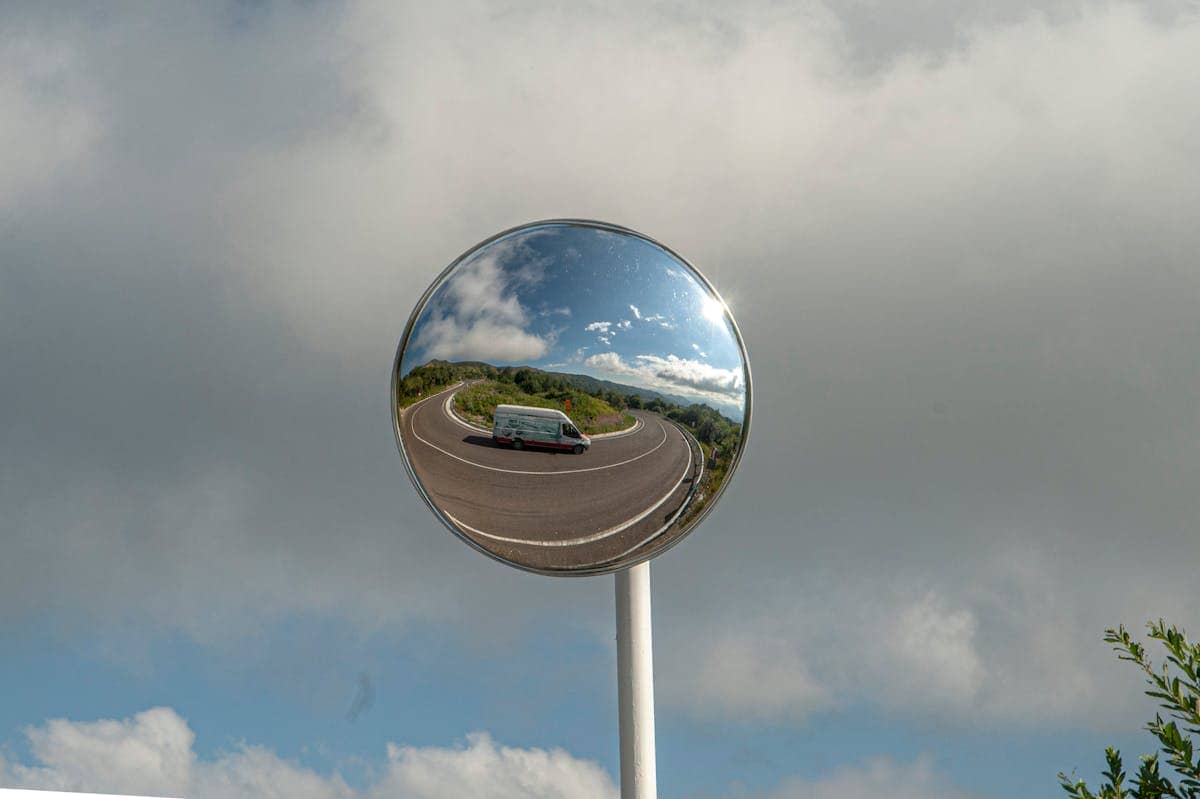
Convex mirrors curve outward. Reflected rays diverge and appear to originate from a virtual focal point behind the mirror. Convex mirrors always produce:
- A virtual image (behind the mirror, cannot be projected)
- Upright orientation
- Diminished size (smaller than the object)
- A wider field of view than a plane mirror of the same physical size
Applications: vehicle wing mirrors, security mirrors in retail, wide-angle surveillance cameras, car park safety mirrors.
| Mirror type | Image orientation | Image size | Image type | Field of view |
|---|---|---|---|---|
| Plane | Upright | Same as object | Virtual | Standard |
| Concave (object far) | Inverted | Variable | Real | Narrower |
| Concave (object close) | Upright | Magnified | Virtual | Standard |
| Convex | Upright | Diminished | Virtual | Wide |
The Mirror Formula: Predicting Where Images Appear
For concave and convex mirrors, the relationship between object position, image position, and focal length is described by the mirror formula:
1/f = 1/v + 1/u
Where:
- f = focal length (positive for concave, negative for convex)
- v = image distance from the mirror's pole (positive if in front of mirror — real image; negative if behind — virtual image)
- u = object distance from the mirror's pole (negative when the object is in front of the mirror, in the standard sign convention)
Magnification:
m = −v/u
- m negative → image is inverted
- m positive → image is upright
- |m| > 1 → image enlarged
- |m| < 1 → image diminished
Worked example: A concave mirror with a focal length of 20 cm. Object placed 30 cm in front.
Applying the formula: 1/v = 1/f − 1/u = 1/20 − 1/(−30) = 0.050 + 0.033 = 0.083, so v ≈ +12 cm.
The image is real (positive v in front of the mirror), inverted (m is negative), and diminished (|m| < 1). This is the configuration used in the primary mirror of a reflecting telescope — the concave mirror creates a real, inverted image of a distant star at a point in front of the mirror where the eyepiece or detector is placed. The star does not need to be inverted for astronomical purposes; the image just needs to be real and focused.
How Mirrors Are Made: Materials, Coatings, and the Limits of Reflectance
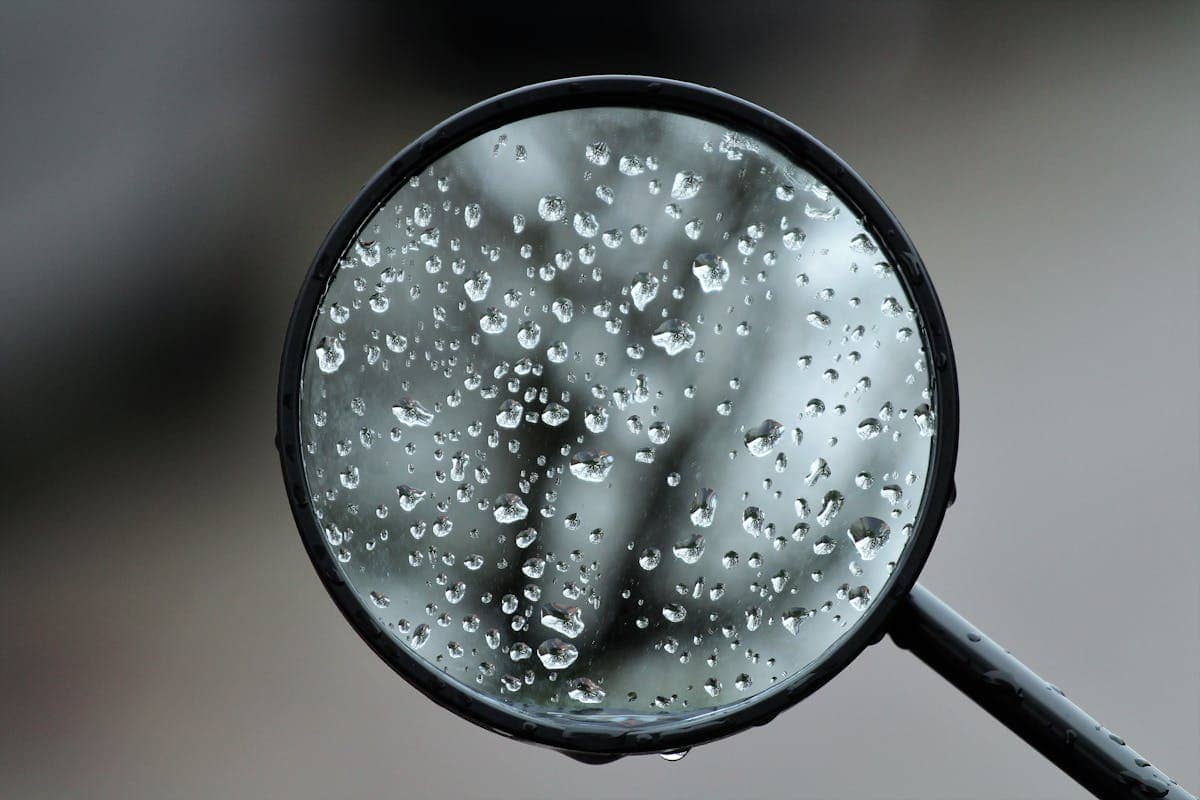
Modern mirrors are not polished glass. Glass is transparent — it does not reflect light efficiently. A modern mirror is a glass substrate (for mechanical stability and flatness) with a thin metallic layer deposited onto its surface. That metal layer does the reflecting.
The manufacturing process:
- A glass blank is ground and polished to the required surface accuracy
- The glass is placed in a vacuum chamber and air is evacuated to prevent oxidation during deposition
- A thin film of metal — typically aluminium — is evaporated and deposited onto the glass in a layer approximately 100 nm thick (about one-quarter the wavelength of green light)
- A protective overcoat of silicon dioxide (SiO₂) or magnesium fluoride (MgF₂) is applied over the metal to prevent tarnishing
Reflectance by material:
- Aluminium: 88–92% of visible light. Uniform across the visible spectrum. Resistant to oxidation under a protective overcoat. Standard for household mirrors and most scientific optics.
- Silver: 95–99% of visible light. Higher reflectance than aluminium but tarnishes without protection. Used in high-performance optical systems where maximum reflectance is required.
- Gold: Lower reflectance for visible light but optimal for infrared. Used on the James Webb Space Telescope's 18 primary mirror segments, which observe in infrared wavelengths where gold's reflectance profile is superior.
No metallic mirror reflects 100% of incident light. The missing 1–12% is absorbed by the metal and converted to heat. In low-power optics this is negligible. In a high-power laser passing through a mirror cavity many times, cumulative absorption becomes a limiting factor in efficiency and thermal management.
Most people dramatically underestimate how precise optical mirrors need to be. When the Hale Telescope at Palomar Observatory was built in the 1930s, the 200-inch (5-metre) Pyrex glass blank took 11 months to cool after casting. Grinding and polishing its surface took another 11 years. The finished mirror had to be accurate to within 20 nanometres across its entire 5-metre surface — an error smaller than the wavelength of visible light. If you scaled that mirror up to the size of the continental United States, the largest permitted imperfection would be about 2.5 centimetres tall. That is what mirror precision actually means at the scientific frontier.
Real-World Applications: From Periscopes to Gravitational Wave Detectors

The same physics that explains a bathroom mirror underpins some of the most precise instruments humans have ever built.
Reflecting telescopes: Isaac Newton built the first reflecting telescope in 1668, replacing a refracting lens with a concave mirror to eliminate chromatic aberration — the colour fringing that lenses produce because different wavelengths refract at slightly different angles. All modern research telescopes are reflectors. The James Webb Space Telescope primary mirror measures 6.5 metres across, composed of 18 hexagonal beryllium segments coated in gold, collectively accurate to nanometre precision. Its operating temperature is −233°C.
Periscopes: Two plane mirrors, angled at 45° to each other, redirect a line of sight above or below an obstacle. The first mirror reflects light horizontally into a vertical tube; the second mirror at the bottom redirects it to the observer's eye. Used in submarines, military observation posts, and periscopic cameras where a direct line of sight is not available.
Laser cavities: A laser requires two mirrors facing each other — one highly reflective (typically 99–100%), one partially reflective (80–99%), called the output coupler. The light beam bounces between them, gaining energy from the lasing medium on each pass. The fraction that exits through the partially reflective mirror is the laser output. Output coupler reflectance of 80–99% means the laser releases 1–20% of its circulating power as beam on each round trip. Mirror surface quality determines cavity losses and efficiency.
LIGO (Laser Interferometer Gravitational-Wave Observatory): LIGO uses mirrors of such extreme optical quality that no classical source of imperfection — vibration, thermal fluctuation, electronic noise — dominates the noise floor. The limiting noise source is quantum vacuum fluctuations: the irreducible quantum noise in the electromagnetic field itself. The mirrors are polished to the point where physics, not manufacturing, sets the lower bound on imperfection. Detecting gravitational waves required mirrors that effectively reached that limit.
For the relationship between mirrors at night and the folklore that grew up around reflective surfaces across cultures, the guide to mirrors at night: superstition, rules, and science covers where the physics ends and the cultural interpretation begins.
How Mirrors Work at the Quantum Level
Classical optics describes what mirrors do with precision. Quantum mechanics explains why those rules hold.
At the quantum level, the interaction between a photon and a mirror is an absorption-and-re-emission event. When a photon reaches the metallic surface of a mirror, it is absorbed by a free electron in the metal. The electron is briefly excited and immediately re-emits a photon at the same wavelength, in the direction determined by the law of reflection. This is not a billiard-ball collision. Each reflection event involves real quantum transitions.
Quantum electrodynamics (QED) gives the complete account. Richard Feynman's path integral formulation describes it this way: a photon travelling from source to mirror to detector does not take a single path. In quantum mechanics, it effectively takes all possible paths simultaneously. Each path contributes a probability amplitude. When the contributions of all paths are summed, amplitudes from paths far from the classical reflection angle cancel through destructive interference. Only paths near the law-of-reflection angle add constructively. The result: macroscopic mirrors obey classical optics exactly — not because classical optics is a fundamental law, but because quantum mechanics reduces to it in this regime.
There is a practical consequence for extreme-scale optics. Very small mirrors, used in photonic chips and quantum optical devices, can begin to deviate from fully classical behaviour because the number of available photon paths is constrained by the mirror's physical dimensions. Quantum effects become detectable. At normal mirror scales — from a hand mirror to a 6.5-metre telescope — classical optics is accurate to within measurement precision.
Three Persistent Mirror Misconceptions
Misconception 1: "Mirrors show the truth; photographs lie."
This is a cultural value, not a physics principle. A flat mirror shows a depth-reversed image of your face in real time, at a distance you can control, without lens distortion. A photograph compresses three dimensions into two using a specific lens with its own optical characteristics, captures a fixed angle and lighting, and often introduces perspective distortion from the focal length. Neither is a neutral representation of your face. They are different representations, each with distinct properties. The piece on why you look worse in mirrors covers the optical and perceptual differences in detail.
Misconception 2: "A perfect mirror would reflect 100% of light."
No metallic mirror achieves this. Silver under ideal conditions reflects 95–99% of visible light; aluminium reaches 88–92%. The remaining 1–12% is absorbed and converted to heat. Dielectric mirrors — thin-film interference stacks — can achieve reflectance above 99.99% for a specific wavelength and angle, but they work on interference rather than metallic absorption and are highly wavelength-selective. A hypothetical mirror reflecting 100% at all wavelengths and angles would violate thermodynamic constraints on absorption.
Misconception 3: "Precision only matters for scientific mirrors."
A standard bathroom mirror is accurate enough for everyday use — but that accuracy is not free. The glass substrate must be flat to within a fraction of a millimetre. The aluminium layer must be uniform to within a few nanometres. The protective coating must remain chemically stable across years of humidity, cleaning, and thermal cycling. A mirror that has delaminated, oxidised at the edges, or developed surface ripples will distort its image visibly. The difference between a cheap mirror and a quality one is not the physics — it is manufacturing precision and coating durability. Household mirrors and telescope mirrors sit on the same physical continuum, separated by several orders of magnitude in surface accuracy but governed by identical optics.
Mirrors have not changed in physical principle since Newton's reflecting telescope of 1668. The same law — the angle of incidence equals the angle of reflection — governs the 6.5-metre James Webb primary mirror and the one in your bathroom. What has changed is the precision with which that law is implemented: from hand-polished glass accurate to a fraction of a millimetre, to beryllium segments accurate to 20 nanometres. That gap of five orders of magnitude in surface precision represents the full range of what human understanding of one simple rule has been put to work building.
Frequently Asked Questions
How does a mirror work scientifically?
A mirror works through specular reflection. A smooth metallic coating — usually aluminium at 88 to 92 percent reflectance, or silver at 95 to 99 percent — bounces incoming light at exactly the angle it arrived, measured from the normal to the surface. Because the coating is smooth at the scale of visible light wavelengths (380 to 700 nm), all reflected rays stay parallel and coherent, forming a clear image rather than scattered light.
What is the law of reflection in physics?
The law of reflection states that the angle of the incoming ray (angle of incidence) equals the angle of the reflected ray (angle of reflection), both measured from the normal — the imaginary line perpendicular to the mirror surface at the point of impact. The incident ray, reflected ray, and normal all lie in the same plane. This law holds for every type of smooth reflective surface at any wavelength.
Why do mirrors flip left and right but not upside down?
Mirrors do not actually flip left and right. They flip the front-to-back axis — reversing depth. The apparent left-right reversal is a result of how humans mentally simulate rotating to face the same direction as the reflection. That mental rotation swaps left and right. The mirror itself only reverses depth, which is why it does not also flip up and down. The confusion is a property of spatial reasoning, not of optics.
What is the difference between specular and diffuse reflection?
Specular reflection occurs when light hits a smooth surface and all rays reflect at the same angle, preserving image information. Diffuse reflection occurs when light hits a rough surface and scatters in many directions, producing no image. A mirror, polished metal, and a calm lake produce specular reflection. A white wall, matte paper, and a choppy lake surface produce diffuse reflection. The dividing line is whether the surface is smooth or rough at the scale of visible light wavelengths.
What are the three types of mirrors?
The three main types are: plane mirrors (flat surface — image is same size as object, upright, laterally reversed, always virtual), concave mirrors (curved inward — can produce real or virtual images of varying size depending on object distance, used in telescopes and makeup mirrors), and convex mirrors (curved outward — always produce a virtual, upright, diminished image with a wide field of view, used in security mirrors and vehicle side mirrors).
What is the mirror formula?
The mirror formula is 1/f = 1/v + 1/u, where f is the focal length, v is the image distance from the mirror pole, and u is the object distance. Magnification is m = -v/u. Negative magnification means an inverted image; positive means upright. If the absolute value of m is greater than 1 the image is enlarged; if less than 1 it is diminished. Focal length is positive for concave mirrors and negative for convex mirrors in the standard sign convention.
How are modern mirrors made?
Modern mirrors are made by vacuum-depositing a thin metallic layer — typically aluminium (88 to 92 percent reflectance) or silver (95 to 99 percent) — onto a polished glass substrate under high vacuum. A protective overcoat of silicon dioxide or magnesium fluoride is applied to prevent oxidation. For precision optics, the glass blank is ground and polished to nanometre-level accuracy before coating. The James Webb Space Telescope uses gold-coated beryllium segments, optimised for infrared reflectance.
How do mirrors work at the quantum level?
At the quantum level, photons are absorbed by free electrons in the metal coating and immediately re-emitted at the same wavelength in the reflected direction. Quantum electrodynamics (QED) gives the complete account: when all possible paths a photon could take are summed, contributions from paths far from the classical reflection angle interfere destructively, while paths near the angle-equals-angle condition reinforce each other. The result is that macroscopic mirrors obey classical optics exactly — not because classical optics is fundamental, but because quantum mechanics reduces to it at this scale.