Seeing Yourself in a Mirror Dream: Meaning, Spiritual Significance, and 9 Interpretations

If you were looking into a mirror in a dream and woke up wondering what it meant — whether it was clearly your face in the glass, or something slightly wrong about the reflection — you are asking a question the mind often asks of itself. A mirror in a dream is one of the most direct images the sleeping brain can reach for when it wants to stage a conversation about identity.
The mirror's condition and your emotional state in the dream do most of the specific work. The bare fact of "I saw my face" is only the opening line. What follows — the crack, the fog, the stranger looking back, the calm, the fear — is where the meaning lives.
What Dream Interpretation Can Actually Tell You — and What It Cannot

Dream interpretation is not a single discipline with agreed-upon rules. Researchers study why dreams happen — memory consolidation, emotional processing, sleep-stage activity. Therapists and spiritual readers work with what specific images mean to a particular person. These are different questions, and they produce different kinds of answers.
The honest limit of mirror dream interpretation is this: any reading is a hypothesis, not a diagnosis. If a dream nudges you toward an honest conversation, a deferred decision, or a grief you have been avoiding — that is worth acting on, regardless of whether a metaphysical claim behind it can be proved.
Treat the reflection as an emotional sketch. Not a prophecy.
Nine Meanings of Looking in a Mirror in a Dream
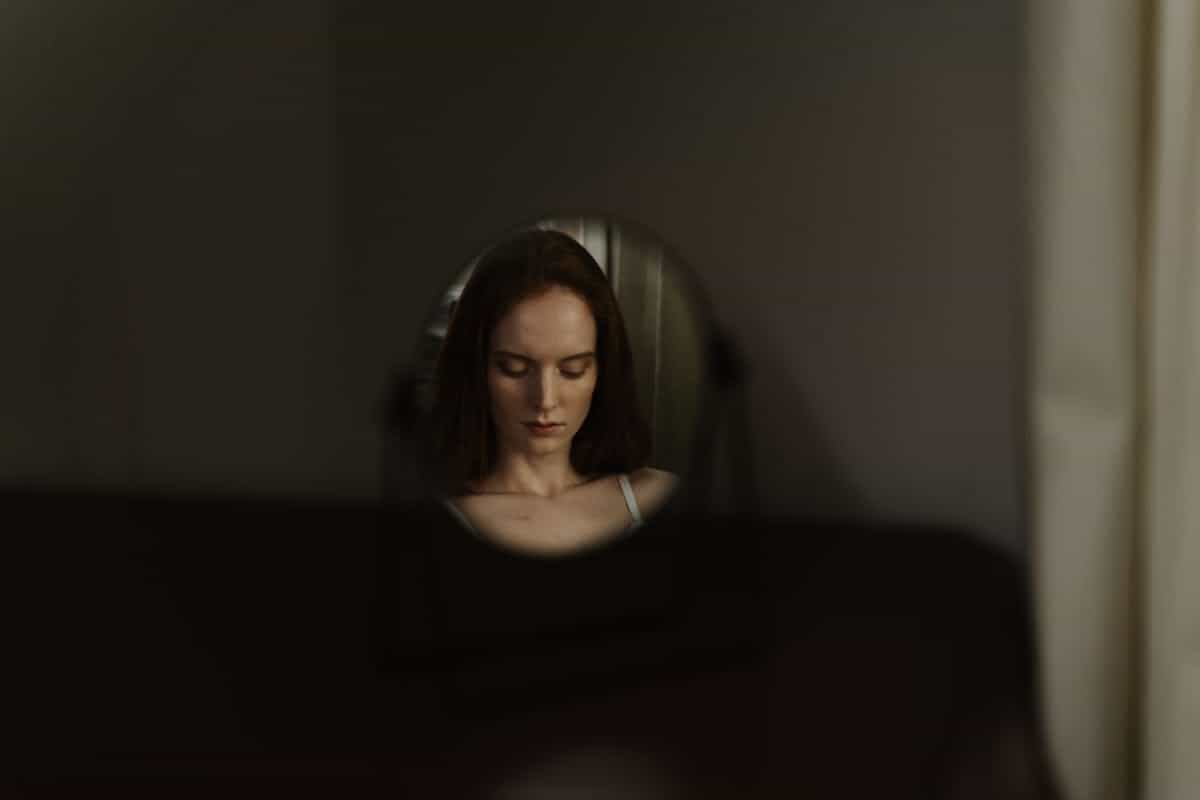
Use these as lenses, not verdicts. The same dream can fit two lenses if your life is genuinely mixed.
1. A moment of honest self-inventory
A calm, steady reflection during a grounded dream often tracks with a simple theme: you are integrating who you are right now, not defending who you were five years ago.
2. The performed self showing its seams
If the mirror appears in a public place or under harsh scrutiny, ask whether you have been maintaining a role so long that the performance has started to feel like personality.
3. Body image and appearance anxiety — with an important research caveat
If the dream focuses on perceived flaws, angles, or disgust, it may sit on the same shelf as waking appearance anxiety. A 2024 study of college students found 73.03% reporting negative body-image perception — a single study, not a universal law, but a sobering signal about how common mirror anxiety is. Research from the same year in the Journal of Behavior Therapy found that self-focused mirror gazing can reduce appearance satisfaction even in people without clinical body dysmorphic disorder. The brain sometimes uses the face as a shorthand for worth. That is what makes the mirror in a dream so charged.
4. Shadow material the psyche refuses to let you avoid
Jung's framework treats dreams as compensation for what consciousness neglects. A mirror dream can be the inner life insisting on a quality you minimise, deny, or disown — often a strength dismissed as arrogance, or a wound dismissed as weakness.
5. A threshold or spiritual opening
Some dreamers report brightness, an expanded sense of space, or quiet significance. Across religious traditions, mirrors carry symbolic weight as truth surfaces. A spiritually charged mirror dream can mark a moment of sincerity: you are willing to be seen, including by yourself.
6. A relationship acting as a mirror
Partners appear beside the glass, behind you, or as a second reflection. This often tracks with projection — admiring, resenting, or fearing in another what you will not name in yourself. The dream stages the relationship as a mirror because that is what it functionally is.
7. Identity catching up to a life transition
New jobs, moves, breakups, parenthood, bereavement — any of these can rewrite who you are without asking permission. A mirror dream can stage the lag: the face stays familiar while everything around it is in motion.
8. Repressed grief or regret the face is already showing
If the reflection weeps, ages rapidly, or looks exhausted while you insist in the dream that you are fine — the mismatch is usually the point.
9. The fear of being seen through
Sometimes the mirror has nothing to do with narcissism. It is about vulnerability: if someone looked clearly, would you still be safe?

What the Mirror Condition Usually Signals
| What you see | What it often tracks to | One waking-life question |
|---|---|---|
| Clear reflection, neutral or warm feeling | Integration, acceptance, alignment | Where in my life am I finally telling the truth? |
| Distorted or "wrong" face | Shame, confusion, identity strain | What label about myself am I defending even when it hurts? |
| Broken or cracked glass | Fractured self-image or ruptured belief | What story about myself shattered recently? |
| Foggy or dirty mirror | Obscured information, avoidance | What am I pretending not to know yet? |
| Someone else's face | Projection, role fusion, boundary blur | What trait am I assigning them that also lives in me? |
| You cannot look away | Fixation, anxiety loop, rare hubris themes | Is this vigilance or obsession in disguise? |
If the glass showed no reflection rather than your face, that is a different image — the no reflection in a mirror dream guide unpacks that pattern on its own terms.
Why Jung and Freud Both Made the Mirror Central to Psychology

The long-form traditions of dream interpretation are right about one structural point: mirrors force confrontation. Freud's framework treats dreams as disguised wishes and fears — the mirror surfaces the self-image that anxiety keeps polished to a lie. Jung's framework emphasises compensation and movement toward wholeness — the mirror hauls the ego toward something it has been refusing to look at.
A mirror is almost too literal for either school, which is precisely why it appears when the subconscious wants to skip metaphorical subtlety. When the mind stages a mirror scene, it is usually because ordinary dream imagery was not landing.
In Jungian language specifically, the mirror is less a magic object and more a compact image for who is looking and who is judged. The work after the dream is to translate that into a waking relationship or decision — not to collect a symbolic merit badge.
Where Mirrors Got Their Spiritual Weight — and Why It Follows You Into Sleep

Ancient Roman belief held that a mirror could hold something vital about the person looking into it. Breaking the glass injured that fragment; the seven-year-bad-luck proverb was the folk remedy. The superstition was ancient — but the mass anxiety about it arrived only after affordable mirrors became common household objects in the late 1800s. Before that, most ordinary people had never owned a clear, accurate mirror at all.
Some Indian traditions read a broken mirror as cleansing rather than cursing — releasing accumulated negative energy rather than trapping it. The same object, the same event, opposite spiritual conclusions. That is the most important thing to carry from mirror superstition: no tradition owns the definitive meaning. What a culture says about mirrors tells you about that culture — about what it values, what it fears, and what it needs language for.
Your dream borrows from this accumulated weight. That is not because the superstitions are true. It is because mirrors have been a site of charged symbolic meaning for so long that the charge is genuinely part of what they are.
How Roles Shape the Dream — Family, Work, and Relationships

Mirrors in dreams rarely arrive alone — they tend to appear beside roles. Family scripts: who is "the strong one," "the caretaker," "the one who never complains." Work contexts: competence, impostor dread, professionalism as mask. Relationships: desirability, jealousy, the reflection you hope someone else sees when they look at you.
If only one of those arenas feels charged when you read that list, start there. You do not need a clean universal match — a single live wire is enough signal to follow.
What It Means When the Same Mirror Dream Keeps Coming Back

Repetition means the underlying question has not been filed. The detail that shifts between episodes — first fog, then a crack, then a cleaner image — often carries more signal than any single occurrence. An arc across several dreams can be more instructive than a one-off symbol, because the change shows where the inner work is moving.
For recurring mirror dreams specifically, the recurring mirror dreams guide tracks how the pattern narrows the message.
The Science Behind Why Your Face in a Mirror Carries Such Charge

Here is the detail most dream guides skip entirely, and it is worth sitting with.
At 13 months, a child reaches toward the "other baby" in the glass — smiling at it, babbling at it, trying to grab its nose. She has no idea the reflection is her. Three months later, at 16 months, something shifts. She looks in the mirror and touches her own cheek, not the glass. She has passed what researchers call the mirror self-recognition test. No one taught her this. It emerged when her nervous system was ready. The same test has been given to chimpanzees, dolphins, elephants, Eurasian magpies, and a handful of other species — and a small number of individuals in each group also pass it.
Most human infants consolidate self-recognition around 15–18 months. Which means that for the first year or more of your life, the face in the glass was a stranger.
Your adult dream did not read those papers. But it still banks on a lifetime of using glass to revisit a question that first arrived before language did: Is that really me? That is why mirror scenes in dreams hit with a specific gravity that other images do not. The mirror was the first object that made self-awareness feel real — and uncertain.
What to Do When You Wake

- Write three lines before coffee: mirror condition, dominant emotion, who else appeared.
- Name the arena — family, work, love, body, spirituality — without forcing all five.
- Choose one honest action small enough to complete in a day: a boundary set, an apology offered, an appointment made.
If mirror-checking in waking life has become a compulsive loop, treat that as a medical and psychological question, not only a symbolic one.

For the wider map of mirror dream meaning — broken glass, fog, empty reflections, strangers in the frame — the mirror dream meaning guide covers all the variations in one place.
Mirrors in waking life obey physics. Mirror dreams obey biography. The culturally loaded idea that glass shows "truth" is a value statement layered on top of optics — useful for poetry, not reliable as a universal law.
If last night's reflection unsettled you, separate two channels: what the image felt like, and what your waking life has been asking you to admit. The convergence of those two is almost always more instructive than any single reading pulled from a list.
The glass is still there in the morning. What changed is whether you are willing to answer what it was asking.
Mirror FAQ
What does looking in a mirror in a dream mean?
Looking in a mirror in a dream almost always signals that your mind is focused on self-perception: how you see yourself, how you think others see you, and whether those two pictures match. The emotional tone of the dream and the condition of the mirror — clear, cracked, foggy, or showing a stranger — narrow the meaning far more than the bare fact of seeing your face does.
What is the spiritual meaning of seeing yourself in a dream?
Spiritually, seeing yourself in a mirror in a dream is often read as an invitation to honest self-examination — the mirror as a symbol for the part of you that cannot be polished or managed in the way you manage your social face. Different traditions give this different language: Buddhist teaching speaks of an undistorted mind, Sufi poetry of a heart that can receive light, Christian scripture of partial knowledge awaiting clarity. What they share is the idea that seeing yourself honestly — not flattering the image — is a form of spiritual practice, not just psychology.
Is seeing yourself in a mirror dream a good or bad sign?
Neither label maps cleanly onto dreams. A calm, clear reflection often tracks with acceptance or integration. A frightening or distorted reflection usually signals tension around identity, concealment, or change — not a literal omen. Treat the dream as information about your inner state rather than a verdict from somewhere outside yourself.
What does it mean if your reflection looks different from you in a dream?
An older reflection may connect to responsibility, regret about time, or fear of ageing. A younger reflection can point to an unhealed past version of yourself or qualities you left behind. A stranger in the glass often appears during identity transitions when your self-concept is genuinely in flux. In all three cases, the mismatch is usually the message.
What does a broken mirror mean in a dream where you see yourself?
It often symbolises a fractured self-image, a belief about yourself that no longer holds, or fear that something important has cracked. Folklore links broken mirrors to bad luck, but that story grew from ancient Roman ideas about reflections and the soul — not from dream psychology. For the full reading of broken mirror dreams, the dedicated guide covers those scenarios in depth.
Why do I keep dreaming about seeing myself in a mirror?
Recurring mirror dreams usually mean the underlying question — Who am I right now? What am I avoiding about myself? — has not been answered in waking life. If the same detail repeats (the same crack, the same foggy surface, the same wrong face), note exactly what changes between episodes. That shift is usually more informative than the symbol itself.
Does dreaming of a mirror mean someone is lying to me?
Some dream guides link dirty or cracked mirrors to deception. Psychologically, that reading maps better to self-deception or obscured self-knowledge than to a specific other person. If someone in waking life feels dishonest, address that with evidence — not with a dream alone as the basis.