
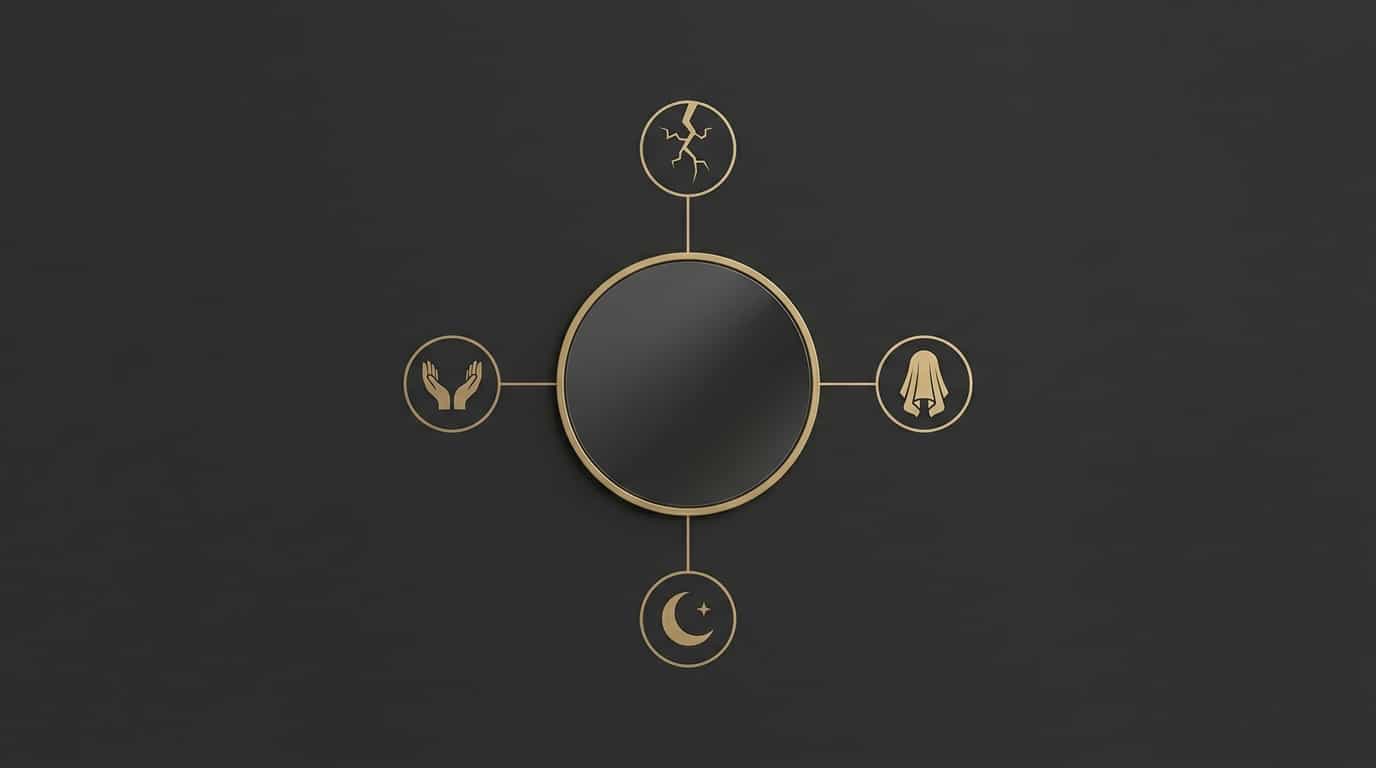
For millennia, humanity has been captivated by the reflective surface. What begins as a simple sheet of polished obsidian, silvered glass, or highly polished metal becomes, in the human imagination, a portal, a trap, a lie detector, and a glimpse into the soul. Mirror superstitions are among the most pervasive and enduring folk traditions across the globe. They transcend culture, religion, and economic status, weaving a complex web of fear, respect, and ritual around an object we interact with every day.
From the moment we are told not to break a mirror or risk seven years of bad luck, to the unease we feel when catching our reflection unexpectedly in the dark, these beliefs are deeply embedded in our collective psyche. But why do these superstitions exist? Why are they so similar in cultures that have never interacted? And which ones do modern spiritualists still hold as sacred?
This encyclopedia explores every facet of mirror folklore, diving into the psychology behind the fear, the variations across continents, and the specific rules governing mirrors in your home. Whether you are a folklore enthusiast, a spiritual practitioner, or simply someone who has wondered why you instinctively cover a mirror during a storm, this guide serves as the ultimate resource on mirror superstitions.
Why Mirrors Have Always Been Surrounded by Superstition
To understand the superstitions surrounding mirrors, we must first understand the object itself. Before the invention of the silvered-glass mirror in 16th-century Venice, reflective surfaces were rare, expensive, and considered magical. The earliest mirrors were pools of still, dark water. To see one’s reflection was to see a “double”—a concept that sparked immediate fear. If your reflection existed outside of you, could it be stolen? Could it act independently?
Mirrors are unique among household objects because they do not merely show reality; they duplicate it. This duplication is the root of all subsequent folklore. Historically, mirrors were believed to hold a piece of the soul. If the mirror broke, the soul was harmed. If the reflection was distorted, the person was cursed.
The Psychology Behind Mirror Fear
Even in our modern, secular world, staring into a mirror for too long can induce a sense of unease. Psychologists refer to this as the “strange-face illusion.” When you gaze at your reflection in low light for an extended period, your brain’s facial recognition system begins to falter, causing your features to appear to warp, melt, or distort into grotesque or unfamiliar forms. This neurological glitch likely fueled ancient fears that mirrors were gateways to malevolent dimensions.
Furthermore, mirrors challenge our sense of self. The concept of the “uncanny valley” —the discomfort we feel when something is almost human but not quite—applies directly to our reflection. It is us, but it is also an intangible, silent copy. In psychoanalytic theory, mirrors represent the ego and the confrontation with mortality. Seeing ourselves age in a mirror forces an awareness of death that humans are psychologically wired to avoid. Consequently, mirror superstitions often serve as a cultural framework for managing this deep-seated existential dread.
When Superstition Meets Genuine Spiritual Belief
It is crucial to distinguish between casual superstition and genuine spiritual practice. For many, avoiding a broken mirror is a harmless habit. However, for practitioners of various spiritual traditions—including Feng Shui, Hoodoo, Santería, and Wicca—mirrors are serious metaphysical tools.
In these contexts, mirrors are not merely symbolic; they are active agents. They are used for scrying (divination), binding spells, and protection. A mirror can be a trap for a negative spirit or a portal for communication with ancestors. When a spiritualist covers a mirror after a death, it is not out of vague superstition; it is to prevent the deceased’s spirit from becoming trapped between worlds or to stop the spirit from reaching out through the reflective surface to pull the living with them. For these practitioners, respecting the power of the mirror is a matter of spiritual hygiene, not just folklore.
The Most Famous Mirror Superstitions in the World
Certain mirror beliefs are so widespread that they have become ingrained in Western pop culture. While variations exist, the core tenets of these five superstitions are recognized from rural villages to urban apartments.
Breaking a Mirror — 7 Years of Bad Luck
This is arguably the most famous of all mirror superstitions. The origin of the “seven years” timeframe is rooted in ancient Greek and Roman belief. The Greek physician Hippocrates theorized that human life renewed itself every seven years—a cycle of growth and regeneration. The Romans later adopted this concept. To break a mirror was to shatter not just a physical object, but a reflection of the self. Therefore, the soul would require a full seven-year cycle to heal and regenerate.
However, the Romans added another layer to this belief. They believed that a person’s health cycled every seven years. A broken mirror was an omen of severe illness or death within that cycle. To mitigate the curse, ancient Romans (and later, Europeans) developed counter-rituals. The most common was to grind the shards of the mirror into dust, ensuring that the sharp pieces could never reflect a face again, thus neutralizing the threat. Another method involved touching a piece of the broken mirror to a tombstone, symbolically “burying” the bad luck.
Quick Fix: What to Do If You Break a Mirror
Folk remedies from around the world offer several ways to reverse the curse:
- Grind the shards to dust (the ancient Roman method)
- Bury the pieces under moonlight to return the energy to the earth
- Spin around three times counterclockwise to reverse the negative flow
- Touch a shard to a tombstone to symbolically “bury” the bad luck
Covering Mirrors After a Death
The tradition of veiling mirrors in a house where a death has occurred is one of the most solemn and widely observed mirror superstitions. This practice dates back to ancient Judaism, where mourners cover mirrors during shiva, the seven-day mourning period.
The reasons are multifaceted:
- To prevent vanity. During a time of grief, focusing on one’s physical appearance is considered disrespectful to the deceased.
- To protect the soul of the departed. It is believed that the soul of the deceased may linger in the house after death. A mirror could confuse the soul, trapping it in the reflective surface and preventing its ascent to the afterlife.
- To protect the living. The mirror could act as a portal through which the deceased might appear to the living, frightening them or tempting them to follow.
In Victorian England, this tradition was strictly observed; servants would rush to drape black cloth over every mirror and even turn portraits to face the wall the moment a death occurred.
Never Sleep Facing a Mirror
The belief that sleeping in front of a mirror is dangerous is a common thread in Feng Shui and European folklore. The primary concern is energy. During sleep, the soul is said to leave the body temporarily (a concept known as astral projection in spiritualist circles). If you sleep facing a mirror, your soul may see its own reflection, become startled, and either flee from the body permanently or be drawn into the mirror, unable to return.
From a Feng Shui perspective, mirrors bounce chi (energy) around a room. In the bedroom, which should be a place of rest and yin energy, a mirror creates excessive yang energy, bouncing it back onto the sleeping person. Practitioners maintain that this causes insomnia, nightmares, and marital discord. The mirror effectively doubles the energy of the room, making it too active for restful sleep. If you cannot avoid having a mirror facing the bed, practitioners recommend covering it with a cloth at night.
Two Mirrors Facing Each Other
Creating an “infinite mirror“ by placing two mirrors directly opposite one another is considered extremely dangerous in most folk traditions. Known as a “spirit trap” or “vortex,” this configuration is thought to open a portal to the spirit world that cannot be easily closed.
In Hoodoo and Southern folk magic, this is sometimes done intentionally to trap a malevolent entity. The entity, drawn to the energy, enters the infinite hallway of reflections and becomes lost, unable to find its way back to the physical world. However, if done unintentionally in a home, folk wisdom warns that it causes confusion, arguments, and a sense of being watched. The endless reflections represent a chaotic flow of energy that can destabilize the household. If you have this configuration, it is advised to either cover one mirror or move them so they do not face each other.
Mirrors at Night
Many cultures have a blanket rule that all mirrors should be covered or turned to face the wall after sunset. In rural Ireland and Scotland, this was a strict household rule. The belief was that the veil between the living and the dead was thinnest at night. To look into a mirror after dark was to risk seeing a spirit standing behind you—or worse, to see a reflection of a spirit instead of your own face, signaling that death was imminent.
Another iteration of this superstition warns against looking into a mirror by candlelight. The flickering flame distorts the reflection, and folklore warns that you might see the face of your future spouse—or the Devil—staring back at you. In many Asian cultures, mirrors are believed to attract wandering spirits at night, which is why bedrooms often have sliding doors to cover built-in wardrobe mirrors before sleep.
Mirror Superstitions by Country & Culture
While the fear of mirrors is universal, the specific rituals and interpretations vary wildly across the globe. Understanding these cultural nuances reveals how societies use mirror superstitions to define their relationship with the spiritual world.
Western European Mirror Beliefs
In Great Britain and Ireland, the tradition of “scrying” or “crystal gazing” was historically a serious divination practice. Mirrors were used to look for omens. A common folk practice was to eat an apple by candlelight in front of a mirror on Halloween; it was believed the face of one’s future spouse would appear in the glass over their shoulder.
In France and Germany, mirrors were often removed from the rooms of the sick or dying. The belief was that if the sick person saw their own pale, emaciated reflection, they might lose the will to fight, interpreting the gaunt image as a ghost of themselves. In some French traditions, a mirror falling off the wall by itself is an omen of an imminent death in the family.
Eastern European & Slavic Traditions
Slavic mirror superstitions are among the most stringent in the world, deeply entwined with Orthodox Christian and pre-Christian pagan beliefs.
| Country | Superstition | Consequence |
|---|---|---|
| Russia | Allowing an unbaptized baby to look in a mirror | The mirror could steal the baby’s soul or cause muteness |
| Poland, Ukraine, Russia | Covering mirrors for 40 days after a death | Prevents the soul from being trapped; looking into a mirror invites death to mark the viewer |
| General Slavic | Returning home after a funeral | Look into a mirror before speaking to prevent death from following you inside |
In Russia, it is considered a grave sin to allow a baby to look into a mirror before it is baptized. The baby’s soul is not yet protected, and the mirror could steal it or cause the child to become mute or fearful.
The tradition of covering mirrors after a death is observed with extreme rigor in countries like Poland, Ukraine, and Russia. Often, every reflective surface—including televisions and polished furniture—is covered for 40 days, the period it is believed the soul remains on Earth. Looking into a mirror during this time is thought to invite death to look back at you, marking you as the next to die. Furthermore, if you return home after a funeral, you must look into a mirror before speaking to anyone to prevent death from following you inside.
Asian Mirror Superstitions
In China, mirror superstitions are governed by the principles of Feng Shui, which views mirrors as powerful tools for manipulating energy.
| Practice | Purpose |
|---|---|
| Convex mirrors above front doors | Deflect negative sha chi (killing energy) from sharp corners or opposing roads |
| Concave mirrors | Used sparingly; believed to absorb and trap energy, dangerous if not managed by a master |
| Mirror facing the toilet | Considered bad luck; flushing water washes away positive energy the mirror collects |
In Japan, mirrors (kagami) are sacred objects. The Shinto religion holds that the yata no kagami (the Eight Span Mirror) is one of the three Imperial Regalia of Japan, representing wisdom. Japanese superstition holds that a mirror reflects not just the face, but the soul. If a mirror is broken or discarded carelessly, it can bring misfortune. Mirrors are often covered when not in use to prevent spirits from becoming trapped within them.
In Korea, it is considered unlucky to give someone a mirror as a gift, as it is akin to giving them “bad luck” or breaking a friendship, since the mirror might reflect misfortune back to the giver.
Latin American Beliefs
Latin American mirror superstitions are a vibrant blend of Indigenous, African, and Spanish Catholic traditions.
In Mexico, mirrors are heavily featured in Día de los Muertos (Day of the Dead) rituals. Mirrors are sometimes placed on altars to allow the spirits of the ancestors to see themselves as they return to the world of the living, ensuring they remember who they are.
In countries like Brazil, associated with the Afro-Brazilian religion Candomblé, mirrors are used in rituals to communicate with orixás (deities). However, a common superstition is that placing a mirror in front of a sleeping person will cause them to have nightmares because their soul will see its reflection and flee.
In Caribbean traditions like Santería, mirrors are used in spells for both love and protection, but a cracked mirror is an immediate sign of spiritual attack or a warning that an enemy has placed a curse.
African & Middle Eastern Traditions
In parts of North Africa, such as Morocco and Egypt, mirrors are often covered in homes to ward off the Jinn—spirits made of smokeless fire. Jinn are believed to be attracted to reflective surfaces and can use them as portals. It is common to find a mirror covered in a bathroom or bedroom to avoid encountering a Jinn in the reflection.
In Ethiopian and Nigerian traditions, a mirror is rarely left uncovered at night. If a person accidentally sees their reflection in a dark mirror, a ritual cleansing may be required.
In Jewish tradition (Mizrahi and Sephardic), the practice of covering mirrors during shiva is combined with the concept of Ayin Hara (the evil eye). A mirror could inadvertently reflect a mourner’s grief back at them, or worse, allow the evil eye to enter the house during a time of vulnerability.
Mirror Superstitions in the Home
The placement of mirrors within a home is a critical aspect of folklore. It is not just if you have a mirror, but where you place it that determines its effect on your fortune, health, and relationships.
Bathroom Mirror Superstitions
The bathroom is a space of cleansing, but in folklore, it is also a space of vulnerability. Because water is a conduit for energy, bathroom mirror superstitions often relate to the drain.
- A mirror directly facing the toilet: Considered very bad luck. The belief is that the mirror will reflect your energy—your fortune, and health directly into the toilet bowl, where it will be flushed away.
- A mirror facing the shower door: Thought to “wash away” vitality.
- A bathroom mirror cracking spontaneously: Interpreted in two ways depending on cultural context:
- Good omen: Negative energy has been flushed out of the house
- Bad omen: A health issue is about to manifest
To counterbalance this, many spiritualists recommend keeping bathroom mirrors clean and smudging the room with sage regularly to prevent stagnant energy from accumulating in the reflection.
Bedroom Mirror Rules
As mentioned, sleeping facing a mirror is a primary concern, but there are other bedroom-specific mirror superstitions.
| Rule | Reasoning |
|---|---|
| No mirror reflecting the bed | Major Feng Shui taboo; linked to infidelity. The “third party” energy invites a third person into the marriage. |
| Mirror facing the bed for single people | Said to “double” the loneliness, reflecting the empty space beside you. |
| Use wardrobe with mirrored doors | Doors can be closed at night, ensuring the reflective surface is hidden during sleep. |
If a mirror must be in the bedroom, it should be positioned so that it reflects a beautiful view, a piece of art, or a wall, but never the bed.
Front Door & Entryway Mirrors
The entryway is where energy enters the home, making the placement of a mirror here one of the most important mirror superstitions.
In Feng Shui, a mirror in the entryway is excellent—if it is placed on a perpendicular wall. The ideal placement is a mirror on the side wall so that you can check your appearance before leaving, but it does not face the front door directly.
| Placement | Consequence |
|---|---|
| Mirror facing front door | Highly problematic. Positive chi (or good luck) enters through the door, and the mirror immediately reflects it back outside, preventing circulation. Believed to cause financial instability and missed opportunities. |
| Dirty or cracked entryway mirror | Suggests the household is “not seeing things clearly” and is prone to arguments. |
If you have a mirror opposite the front door, spiritualists recommend repositioning it to the side. Additionally, the entry mirror should always be spotless.
Mirror Superstitions Around Life Events
Mirrors are not just static objects; they are active participants in the milestones of human life. From birth to marriage to death, specific mirror superstitions guide behavior to ensure safety and prosperity during times of transition.
Wedding & Marriage Mirror Beliefs
Weddings are a time of heightened vulnerability to bad luck and the evil eye. One of the oldest mirror superstitions involves the bride looking into a mirror after she is fully dressed.
- Bad luck for the bride to see her full reflection—including the dress—before the ceremony.
- If she must use a mirror, she should not look over her shoulder into it.
- She should never let the groom see her in the mirror before the wedding.
In some European traditions, the couple is advised to remove mirrors from the wedding venue or cover them to prevent any negative energy from “reflecting” onto the new union.
A broken mirror in a newlywed’s home is considered a dire omen for the marriage, often interpreted as a sign of a pending separation or divorce.
Pregnancy & Baby Mirror Superstitions
Pregnancy is a time when the soul is considered fragile, and mirrors become objects of intense caution.
Across many cultures—including Hispanic, Slavic, and Southeast Asian traditions—pregnant women are discouraged from looking into mirrors for extended periods. The fear is that the mirror could “trap” the baby’s soul before it is born or cause the baby to be born with a reflection of something seen in the mirror (such as a deformity or a birthmark).
After the baby is born, the rules intensify:
| Culture | Practice |
|---|---|
| Latin America | Keep a baby away from mirrors for the first year of life. Believed that seeing its reflection causes narcissism or muteness. |
| Korea | Leaving a mirror uncovered near a newborn can cause the baby to become frightened, leading to sleeplessness or illness. |
To protect the baby, mirrors in the nursery are often covered or removed entirely until the child is old enough to understand that the reflection is not another child trying to steal their identity.
Death, Funerals & Mourning
We have discussed covering mirrors after a death, but the superstitions surrounding death and mirrors extend beyond the immediate aftermath.
In many traditions, if someone is dying, any mirror in the room is turned to face the wall before the moment of death. This prevents the dying person’s soul from seeing itself and becoming confused or scared, which could lead to a painful passing.
After the funeral, there are rituals to “uncover” the mirrors:
- In Irish tradition, the covering cloth is not removed until after the funeral feast. Before uncovering it, the family may knock on the frame of the mirror three times to ensure no spirit is trapped inside.
- In Southern United States folk magic, it is believed that if you look into a mirror in a house where a death has recently occurred, you will see the face of the deceased standing behind you. To avoid this, many people in the rural South will not look into any mirror until after the burial is complete.
Mirrors in Dreams: What Your Reflection Reveals
Mirror superstitions extend beyond waking life into the realm of dreams. Dreaming of mirrors is considered highly significant across folk traditions and modern dream interpretation alike.
| Dream Image | Common Interpretation |
|---|---|
| Seeing yourself clearly in a mirror | Self-awareness, honesty, or a period of personal growth approaching |
| A cracked or broken mirror in a dream | A warning of upcoming disappointment, fractured relationships, or shattered self-image |
| A distorted or warped reflection | Confusion about one’s identity; external pressures distorting your true self |
| An empty mirror (no reflection) | Considered a dire omen in many traditions—may signal feeling lost, invisible, or a warning of spiritual disconnection |
| A mirror with a dark figure behind you | A warning of unseen influences; in folklore, this was interpreted as death approaching |
In Slavic and Germanic folklore, dreaming of a mirror was treated with the same gravity as encountering one in waking life. Dreamers were advised to turn their pillow over upon waking to “reverse” any negative omen seen in a dream mirror.
The Digital Mirror: Do Superstitions Apply to Screens?
As technology evolves, so too does folklore. A question increasingly asked by modern spiritualists and superstitious individuals alike is whether traditional mirror superstitions apply to digital reflections.
Smartphone Cameras & Front-Facing Lenses
Some spiritualists argue that the front-facing camera on a smartphone functions as a mirror—it reflects your image back at you. Consequently, they extend certain precautions:
- Covering phone cameras at night: A growing practice among the spiritually minded, mirroring the tradition of covering mirrors after sunset. The belief is that a powered-off screen can still act as a reflective portal for wandering spirits.
- No selfies in mourning: Some extend the “no mirrors after a death” rule to taking selfies or using phone cameras during the mourning period.
Video Calls & Virtual Reflections
A more debated question is whether seeing oneself on a Zoom or FaceTime call constitutes a reflection worthy of superstition.
| View | Rationale |
|---|---|
| Traditionalists | A screen is not a true mirror—it lacks the silvered backing and physical properties believed to trap souls. No special precautions needed. |
| Modern spiritualists | The reflective quality of a black screen or the “self-view” window during calls creates the same energetic vulnerability. Recommend covering laptop cameras when not in use. |
Black Screens as Mirrors
Folk wisdom has long warned against looking into a dark window or black screen at night. Modern spiritualists apply this warning to:
- Turned-off television screens
- Darkened computer monitors
- Smartphones in sleep mode
The reasoning follows the same logic as traditional mirror superstitions: dark reflective surfaces are portals through which spirits may be seen—or through which they may enter.
Modern Spiritualist Tip: If you have a television or computer monitor in your bedroom, cover it with a cloth at night or position it so the screen does not face the bed.
Which Mirror Superstitions Are Taken Seriously by Spiritualists?
While many people view mirror superstitions as quaint folklore, modern spiritualists, witches, and energy workers treat these beliefs with profound seriousness. For practitioners of modern paganism, Wicca, Hoodoo, and Feng Shui, mirrors are not objects of superstition but tools of power that require respect and maintenance.
1. The Danger of Second-Hand Mirrors
Spiritualists almost universally warn against bringing antique or second-hand mirrors into a home without cleansing them. The belief is that a mirror absorbs the energy of everyone who has ever looked into it. If a previous owner experienced trauma, violence, or depression, that energy is stored in the glass.
A spiritualist will cleanse a new mirror by:
- Smudging it with sage smoke
- Washing it with salt water
- “Sealing” it by anointing the corners with protective oil before hanging
2. The Mirror as a Portal
Serious practitioners take the idea of the mirror as a literal portal. They never leave a mirror facing an external door or window because they believe it can invite wandering spirits into the home. Similarly, the “two mirrors facing each other” configuration is considered dangerous and is only used by advanced practitioners for specific banishing rituals. For the average person, it is considered a spiritual hazard that creates a vortex of chaotic energy.
3. The Practice of Scrying
While ordinary people avoid staring into mirrors, spiritualists embrace it for scrying (divination). However, they do so with ritual protection.
| Practice | Purpose |
|---|---|
| Black mirror (painted black or made of obsidian) | Avoids the “strange-face illusion” and focuses the mind |
| Casting a circle | Creates sacred, protected space before scrying |
| Calling protective spirits | Ensures only benevolent entities may approach |
| Consecrating the mirror | Dedicates the tool to spiritual work only |
They treat the practice not as a game, but as opening a line of communication with the subconscious and the spirit world.
4. Mirror Sealing
A common practice in modern witchcraft is “mirror sealing.” This involves taking a mirror—especially one in the bedroom—and stating an intention while tracing the edges with a finger or a tool. Some practitioners:
- Use black paint to “dull” the reflective power
- Place a small sigil (a symbolic drawing) on the back of the mirror to program it to reflect only love and positivity
This transforms the mirror from a passive object into a protective barrier.
5. The “Three Mirrors” Rule in Feng Shui
In classical Feng Shui, practitioners strictly adhere to the rule of three: never have more than three mirrors in a single line of sight. Mirrors are used to correct flaws in a floor plan (such as a missing corner), but overusing them creates “sha” (killing energy) that makes inhabitants feel agitated and exposed.
Master practitioners treat mirror placement with the same seriousness as structural architecture, believing that a misplaced mirror can lead to financial ruin, illness, or divorce within a year.
Conclusion: Reflecting on the Power of the Glass
From the obsidian mirrors of ancient Anatolia to the high-definition glass of the modern vanity, humanity’s relationship with its reflection remains complex. Mirror superstitions are more than just a collection of old wives’ tales; they represent a collective acknowledgment of the power of perception. They remind us that what we see—and how we see it—matters.
Whether you cover your mirrors after a death out of respect for tradition, avoid sleeping in front of one for better sleep hygiene, or simply throw salt over your shoulder if you accidentally break a glass, you are participating in a tradition that spans thousands of years. These superstitions serve as a bridge between the physical world and the metaphysical, between the self we know and the self we glimpse in the corner of our eye.
Ultimately, the superstition that holds the most weight is the one that resonates with you. If a mirror makes you uncomfortable, trust that instinct. If a broken mirror causes you anxiety, perform a cleansing ritual to set your mind at ease. The true power of a mirror lies not in the glass or the silver backing, but in the energy we project into it. By understanding these global traditions, we can navigate our own reflections with awareness, respect, and a little bit of ancient wisdom.
Disclaimer: This article is intended for informational and entertainment purposes regarding cultural folklore and spiritual practices. It is not a substitute for professional psychological, medical, or financial advice.